
What Is The Best Offshore Forex Broker That Accepts US Clients?
Using an onshore CFTC regulated broker is strongly recommended because it offers stronger protection when trading forex. An offshore broker in this context holds no CFTC registration and no NFA membership, so a US resident who chooses one gives up those protections.
While the brokers in my list accept traders in the US, they are not regulated by the CFTC or NFA. I created this page based on a demand for offshore brokers and their unique features, but I personally recommend considering locally-regulated brokers first.
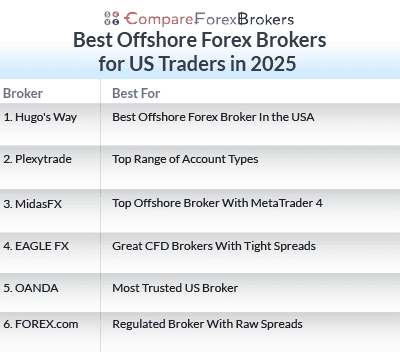
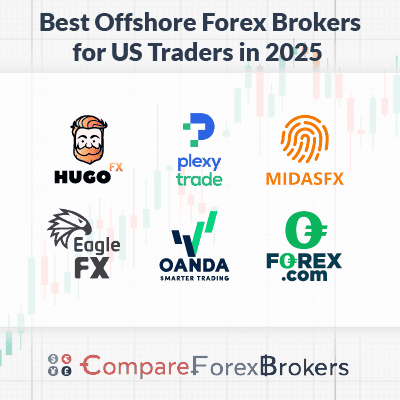
List of offshore forex brokers for US clients is:
Broker comparison table
| Rank | Broker | Score | Regulation | EUR/USD raw | EUR/USD standard | Commission | Min. deposit | Platforms | Leverage | Visit |
|---|---|---|---|---|---|---|---|---|---|---|
| 1 |  Hugo’s Way Hugo’s Way | 39.1 | none | - | 0.9 | $5 | $50 | MetaTrader 4, MetaTrader 5 | 500:1 | Visit |
| 2 |  LQDFX LQDFX | 30 | none | 0.1 | 1.1 | $3.50 | - | MetaTrader 4 | - |
Broker reviews
Hugo’s Way

Average spread
EUR/USD = 0.9 GBP/USD = 1.7 AUD/USD = 1.3
Platforms
MT4, MT5, WebTrader
Minimum deposit
$50
Why We Recommend Hugo's Way
I chose Hugo’s Way because you get offshore broker privileges that are on par with onshore-regulated brokers. I found they deliver the best trading environment with fast execution speeds of around 100ms.
There are also solid spreads starting from 0.20 pips on EUR/USD. Plus, the broker offers 1:500 leverage, this is ten times the amount US brokers can offer.
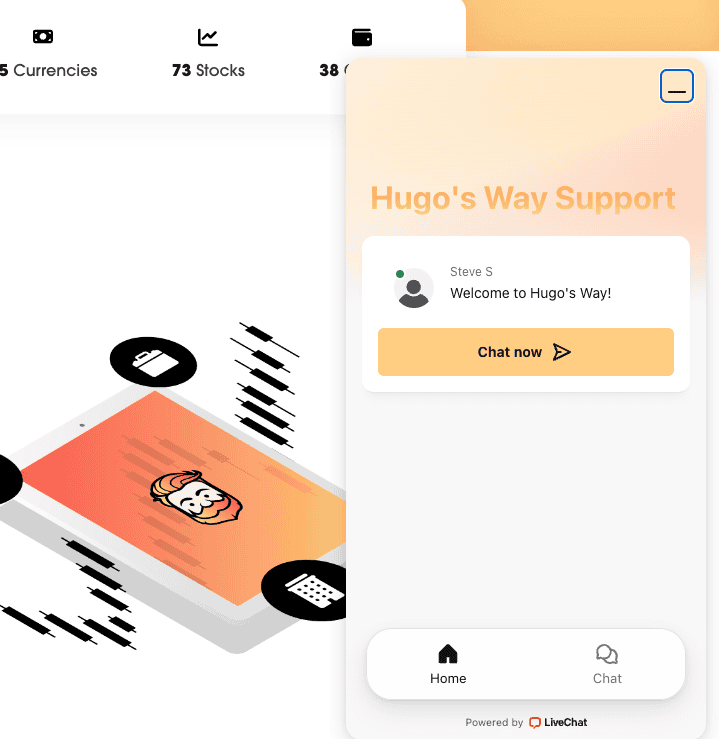
You get the PRO4 (MetaTrader 4) platform, where you can use the broker’s services and access all their 150+ CFD markets. The platform also offers custom indicators and automation tools. Meanwhile, the broker provides solid 24/7 support through live chat, so you can get help over weekends, which is a bonus.
Pros & cons
- Wide variety of funding methods
- Excellent selection of cryptos
- Scalping and hedging permitted
- Unregulated broker
- Limited selection of currency pairs
- Only one trading platform
Broker Details
Competitive Spreads With High Leverage
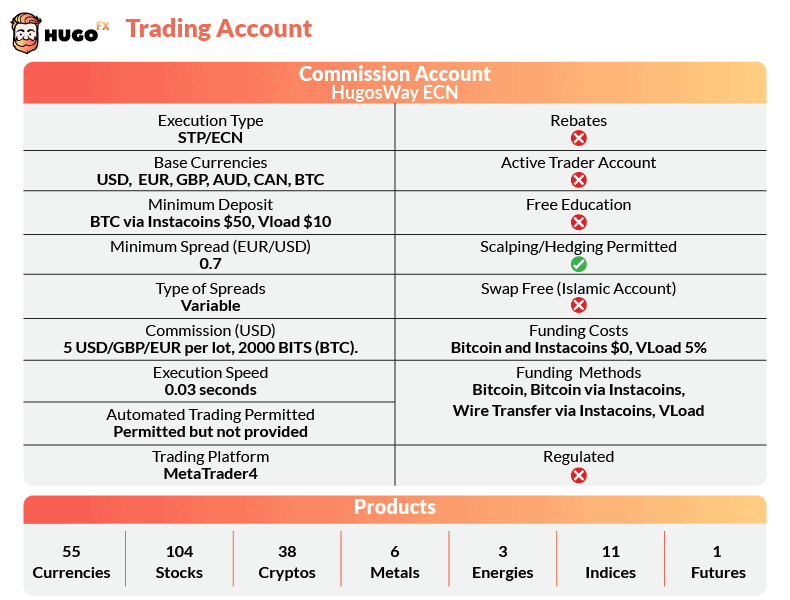
Hugo’s Way only offers its PRO4 trading account only, so you don’t get the choice most other brokers offer. It’s not a bad option though, while using the account, I found EUR/USD spreads from 0.20 pips. However, it can also reach 0.90 pips, which is expensive.
In addition to spreads, you’ll pay $5 per lot traded in commission, equalling $10 roundturn. This is slightly more expensive than other offshore brokers, who average $3.50 per lot.
However, not many offshore brokers can compete with Hugo’s Way for leverage. You can get 1:500 leverage on forex majors and 1:100 on cryptocurrencies, much better than the 1:50 leverage cap for US-regulated forex brokers.
Fast Execution Speeds
Hugo’s Way is a straight-through processing/electronic communication network (STP/ECN) style broker. This means the broker passes your order directly to the liquidity provider to be matched with a buyer or seller.
I generally prefer ECN brokers as they provide faster execution speeds than other broker types. Based on my analyst’s findings, Hugo’s Way performs solidly in this area.
My analyst (Ross Collins) tested Hugo’s Way and 49 other brokers using the ExTest_ForExpat EA for limit orders and Broker Latency Tester EA for market orders. This helped him record their average execution speeds.
As you can see from the table below, Hugo’s Way achieved fast speeds with 94ms on market orders, and 104ms on limit order. I find fast execution speeds have a major impact on your trading, as they reduce the chances of requotes and slippage.
| Execution Speed Testing | ||
|---|---|---|
| Broker | Limit Order Speed (ms) | Market Order Speed (ms) |
| OANDA | 86 | 84 |
| FOREX.com | 98 | 88 |
| IG Group | 174 | 141 |
| Trading.com | 114 | 138 |
Decent Range of Markets
The range of markets with Hugo’s Way is better than what you’ll find from US brokers. The broker offers 55 forex pairs, 73 stocks, six commodities, ten indices, and 38 cryptos.
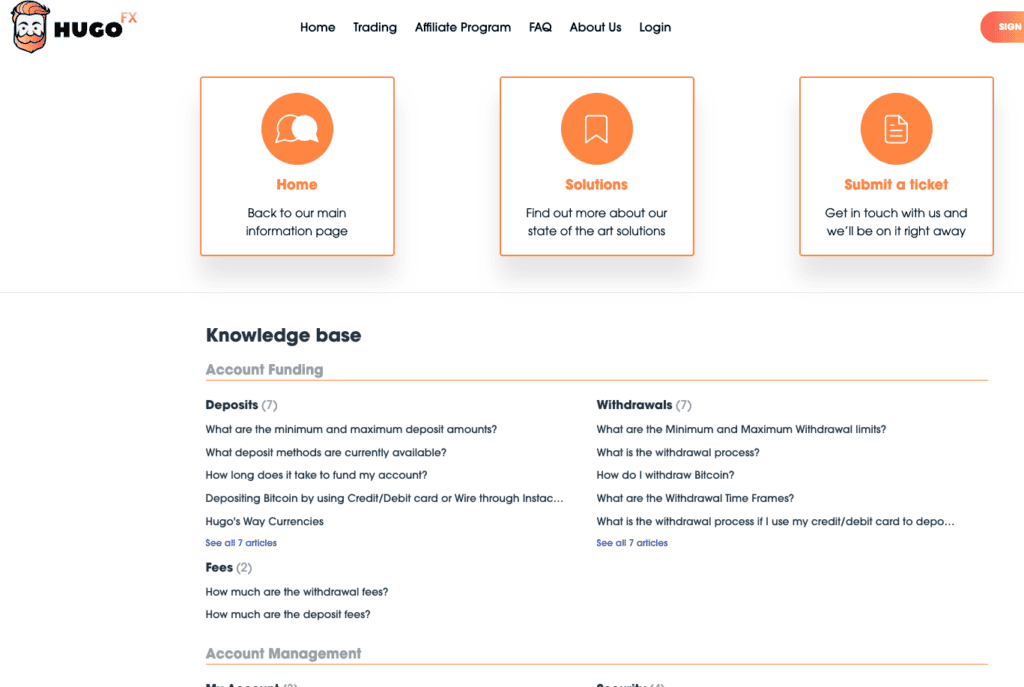
Hugo’s Way screenshots
Plexytrade

Why We Recommend Plexytrade
Plexytrade is my second pick, for its range of account types that allows you to choose your pricing structure. The broker offers both spread-only pricing with no commissions, and Raw pricing with $2 commissions. You can access 120+ markets, from forex to commodities with no swap fees, making them ideal for multi-day trading.
The broker supports MetaTrader 4 and MT5, allowing for advanced technical analysis. These platforms also give you access to virtual private server (VPS) services, which are very useful for automated trading. Trading signals are provided through Trading Central.
Pros & cons
- Multiple account types
- Negative balance protection
- Solid selection of forex pairs
- Unregulated broker
- Wider-than-average spreads
- Only offers MT4 trading platform
Broker Details
Solid Selection Of Trading Accounts
After Plexytrade recently merged with LQDFX, I found the broker’s selection of trading accounts gives you great options to optimize your trading costs. The broker has 4 trading accounts, two standard account types and two commission-based accounts.
- Micro Account: This account requires the lowest minimum deposit at $50, with 1:2000 leverage for its smaller trade sizes, and no commissions. Instead, it’s a spread-only account with spreads from 0.70 pips. This account type has swaps (overnight fees on open positions).
- Silver Account: This account lets you trade larger positions, but lowers the leverage to 1:500 to compensate for this. You get the same tight spreads and zero commission on trades, but also 7-day swap-free trading. This allows you to hold positions up to a week for free, which is great for swing traders.
- Gold Account: Trade with 0 pip spreads and low commissions at $2 per lot trade. This is much cheaper than the $3.50 typical commission. Like the Silver account, you get seven days of swap-free trading, and 1:500 leverage.
- Platinum Account: Has the highest deposit requirement at $10,000, but you get cheaper commissions of just $1 per lot traded. This will save you 50% on the Gold account. The 0 pip spreads make this a good account for high-volume traders.
Large Choice of Forex Pairs
Plexytrade provides 41 currency pairs, covering all the major and minor pairs, plus some exotics. You can use high leverage on all forex pairs. The broker also offers 15 indices, 11 commodities, 48 stocks, and 8 crypto markets, including Bitcoin, Ethereum, and Ripple, on all accounts.
MidasFX

Platforms
MT4, MT5
Why We Recommend MidasFX
I rated MidasFX as the best option for MetaTrader 4 thanks to its ECN-style execution services that pair well with the platform, especially if you scalp or automate trades.
The broker’s ECN account offers low spreads from 0.70 pips on EUR/USD with up to 1:1000 leverage, making it ideal if you’re an experienced trader looking to scale up your positions.
Pros & cons
- Choice of MT4 and MT5 platforms
- Competitive trading fees
- Offers high leverage 1:1000
- Low level of regulation (Saint Lucia FSRA)
- Limited deposit methods
- Can only withdraw funds once per day
Broker Details
MidasFX has MetaTrader 4 and 5
In testing, MidasFX offers two popular trading platforms: MetaTrader 4 and MetaTrader 5, which I think are excellent platforms that work with any trading style.
Unlike broker-owned proprietary platforms, MT4 and MT5 let you customize your trading experience. You can change the look of the platform, use custom indicators, or set up your own Expert Advisors (EAs) for automated trading.
With MetaTrader 4, you can use 30+ indicators out of the box, buidling trading strategies with Bollinger Bands or moving averages without third-party indicators. If you do require bespoke indicators, you can develop them through MQL4, which requires coding knowledge.
Alternatively, you can search the MetaQuotes Marketplace, where you’ll find tens of thousands of EAs and indicators.
I also find MT4 brokers good for scalping, as you can activate one-click trading and set your lot size. This is a faster way to open trades, as you don’t have to go through the order ticket.
No-Dealing Desk Broker With Tight Spreads
MidasFX is a no-dealing desk broker, so all your trades are matched directly with other market participants through their Electronic Communications Network (ECN). I prefer these execution styles as they get the best price, making order filling near-instant and reducing the chance of requotes/slippage.
For their Standard account, MidasFX applies a competitive spread of 0.7 pips on the EUR/USD. There are also no commissions on this account. The MidasFX ECN account has tighter spreads from 0.0 pips, but you pay a $5 commission per lot traded. This commission is average for non-US-regulated brokers, according to my findings.
24/5 Customer Support
The broker offers solid customer support through their live chat, giving you instant access to a human agent who can help resolve your issue. Support is available 24/5, meaning they’ll be available during all market trading hours.
CedarFX

Average spread
1.9
Platforms
MT4
Minimum deposit
$10
LQDFX

How to Choose a Forex Broker?
1. Look for US Regulation
If you’re a U.S.-based trader, it’s essential to choose a broker that is properly regulated in the United States. Only brokers that are registered with the Commodity Futures Trading Commission (CFTC) and are members of the National Futures Association (NFA) are legally allowed to offer forex trading services to U.S. residents.
Important U.S. Trading Restrictions:
- CFDs Are Not Permitted: U.S. regulations prohibit brokers from offering Contracts for Difference (CFDs) to retail clients. U.S. traders can only access spot forex and regulated futures markets.
- No Offshore Brokers: Due to the Dodd-Frank Act, American citizens are generally not allowed to open accounts with offshore or unregulated brokers, even if those brokers accept international clients.
- Leverage Limits and Margin Rules: U.S. brokers must also comply with strict leverage caps (typically 50:1 for major pairs and 20:1 for minors) and mandatory margin call and stop-out rules.
Tip: If you’re a U.S. trader, always confirm that the broker complies with both CFTC and NFA requirements-this ensures legal protection, financial transparency, and a higher level of client fund security.

2. Look out for Trading Costs
You can decide to trade on a commission-based or a commission-free account, and many brokers offer both. The commission-free account is sometimes known as a Standard account. As you’d expect, there’s no commission to pay for trading on this. This is the most common account on offer in the US.
Less common is the commission-based account sometimes known as a Raw account. This account uses ECN or STP processing to connect you directly to liquidity markets for the lowest spreads. As the broker won’t make anything from the spread, they’ll charge you a commission.

3. Pick the Best Trading Software
Choosing the right trading platform is key to a smooth trading experience. The best platform for you depends on your trading style, the tools you need, and how you prefer to access the markets.
MetaTrader 4 (MT4) remains a top choice for forex traders who value a simple, reliable platform with support for automated trading through Expert Advisors (EAs).
TradingView has surged in popularity, especially in the U.S., thanks to its intuitive interface, advanced charting, social trading features, and easy access via web browsers and mobile apps. It’s an excellent choice for visual traders and those who value a collaborative environment.
MetaTrader 5 (MT5) offers more timeframes and asset classes compared to MT4, making it a solid option for traders looking to branch out beyond forex into futures or commodities.
Many brokers also offer their own proprietary platforms, which may include built-in tools, unique features, or seamless account integration.
Before committing, test the platform using a demo account to ensure it suits your strategy, whether you prefer manual trading, automation, or copy trading.
4. Find the Markets You Need
All the brokers we cover offer forex trading, but they will usually offer other instruments as well. For example, the broker may allow you to open positions on ETFs, mutual funds, stocks, cryptocurrencies, and more.
Before you sign up for a broker, check to make sure they provide the exact markets you want to trade. Consider those you might be interested in in the future too.

5. Check the Broker Let’s You Trade How You Want
While all brokers in the US provide access to the spot forex market, some may also have a selection of additional products to complement your trading strategy.
Depending on the broker, you may also be able to trade:
- Precious metals like gold and silver
- Futures contracts, including forex, commodities, or indices
- Options on selected markets
- Equities and ETFs through affiliated or full-service platforms
Larger firms like Charles Schwab may provide access to a wider product range, including stocks, ETFs, and mutual funds, alongside forex through integrated accounts.
Before choosing a broker, make sure they offer the markets you’re currently interested in, and consider whether they support products you may want to explore later, such as futures or metals.
6. Work with Supportive Brokers
You are the client of your chosen broker, and so that broker is obligated to support you. Ensure this really is the case, review their published support channels, timeframes, and contact information.
Then, road test these support channels. Check they are actually able to give you the type of support they advertise, when they advertise it.

Pros and Cons Of Offshore Forex Brokers
Like other daytrading decisions, the choice of whether to open an account with an offshore broker has pros and cons.
| Pros | Cons |
|---|---|
| High leverage, up to 1:500 and above | Fewer regulatory protections |
| Access to tools and platforms not offered onshore | Delayed payments |
| Greater liquidity | Lack of transparency |
| A limited selection of financial markets and trading products |
What Is An Offshore Broker?
An offshore forex broker is a brokerage located and regulated in a jurisdiction other than your home country.
For example, if you live in America but want access to higher leverage than the maximum allowed by CFTC, you could open an offshore brokerage account. New Zealand-based BlackBull Markets might be a good candidate.
Is Trading With An Offshore Broker Legal For US Citizens?
Yes, US citizens can trade with offshore brokers as long as the broker chosen can onboard American citizens. Most brokers won’t be able to due to regulatory requirements, but some will. That’s why I created this list.
Typically, most brokers will declare prominently on their website if their services are unavailable to US traders. However, it may not always be so clear, and you may need to review their terms of service.
Offshore forex trading is an appealing option if you want access to CFD markets. Ideally, you should find one that is licensed by top regulators like the FCA (UK) as this gives a stronger trust signal in my opinion.
Is It Safe To Trade With An Offshore Forex Broker?
Yes, trading with offshore brokers is safe, provided you opt for one that’s licensed and regulated. I never recommend trading with unregulated brokers, as this increases the risk of fraud and mismanagement of funds.
Always do your due diligence before opening a trading account. Review the broker’s reputation online, looking at user review sites like TrustPilot, as well as here on CompareForexBrokers.
I find some offshore brokers still offer the same financial protections as many of the top brokers. Many are also regulated by Tier-1 regulators such as ASIC or the FCA, so look out for this.
When I see this, I know the broker can be trusted, and will have strict financial frameworks. It’s difficult and costly to get a license from these Tier-1 regulators, so successful licensing is a big plus for me.
What Are Some Risks With Using An Offshore Forex Brokers?
Trading forex with an offshore broker carries additional risks, including:
- Limited protection. Many offshore regulators don’t apply the same high standards as those in Tier-1 jurisdictions.
- Lack of transparency. Lax regulation means offshore brokers aren’t required to disclose the same information as their FCA-, CFTC-, and ESMA-regulated counterparts.
- Fund security. Offshore brokers may or may not be required to hold client money in segregated accounts.
- Market manipulation. Market maker brokers may manipulate the spreads to trigger unfavourable exits, causing slippage.
- Leverage risks. With increased leverage comes an increased risk of significant financial losses.
Although the above is a list of risks, be aware that regulated offshore forex brokers are legal and protected by independent authorities. It is the unregulated offshore brokers you should be concerned about. These are not governed by any authority.
Do I Choose An Offshore Regulated Broker?
Choosing an offshore regulated broker is a personal preference. You may prefer an offshore regulated broker if you want access to CFD markets across different assets like share CFDs and gold CFDs (in addition to forex).
Offshore regulated brokers also provide much higher leverage, up to 1:500, or even more. I think this is appealing for experienced forex traders looking to scale their strategies.
If you want the security of the CFTC with decent leverage of around 1:50, and US customer support, it’s better to choose a CFTC-regulated broker.
Who Are The Main Offshore Regulators?
The main offshore regulators hail from countries as diverse as Belize, the Seychelles and Vanuatu.
- The Financial Services Commission (FSC) of Belize
- The Financial Services Commission (FSC) of the British Virgin Islands
- The Financial Services Commission (FSC) of Mauritius
- The Financial Services Authority (FSA) of the Seychelles
- The Financial Services Commission (FSC) of Vanuatu
What Protection Do Offshore Brokers Offer?
The specific protections offered by offshore brokers vary depending on their regulatory status and jurisdiction. In general, regulated offshore brokers will segregate client funds into separate accounts, and some offer negative balance protection.
I always recommend contacting the broker directly and reviewing local regulations if you have any doubts.
The CFTC publishes a Registration Deficient List, called the RED List, of foreign entities that appear to be acting in a capacity requiring registration but are not registered with the CFTC. Inclusion does not mean a violation has been concluded. The CFTC’s own instruction is to check registration before opening an account or paying any money, even when a firm is not on the list, because entities that solicit US residents are generally required to register.
For disputes, the CFTC’s Reparations Program resolves cases between derivatives customers and registered trading professionals, decided by an administrative judge. NFA arbitration provides a similar forum for disputes involving customers and NFA Members, and a party does not need a lawyer. Because the brokers named on this page are not registered with the CFTC and are not NFA Members, those programs are not available. SIPC protection does not cover foreign exchange trades; it protects against loss of cash and securities at SIPC-member brokerage firms.
Do Offshore Brokers Include Insurance On Client Funds?
Yes, offshore brokers in some jurisdictions offer insurance for client funds. This is far from standard practice, however. You’ll need to inquire with your preferred broker or check the local rules and regulations in the relevant country.
Is It Safe To Trust An Offshore Broker?
Yes, it’s safe to trust a regulated offshore broker. Many of the main offshore regulators require licensed brokers to follow basic best practices designed to keep clients safe. Almost all offshore brokers deposit client funds into separate accounts, for example, and some provide negative balance protection.
Segregating client accounts protects your funds should the broker get into financial troubles, or go bankrupt.
On the other hand, offshore brokers may not offer all of the protections that Tier-1 regulators provide as standard. Most offshore brokers don’t carry indemnity insurance, for example. And only a very few have a ‘best execution policy’ that requires them to fill orders with terms most favorable to the client.
What Is The Difference Between An Offshore Broker and Unregulated Broker?
An offshore broker is any broker that operates outside of your country of residence. An unregulated broker does not hold a license from any financial services regulatory authority.
I would avoid unregulated brokers as they can provide unfavourable trading conditions, widen trading costs, and manipulate prices. Having zero financial protection when using your trading account is not worth the risk, regardless of the unregulated broker’s promotions.
For example, as a US citizen wanting higher leverage than the 1:50 allowed by the CFTC can choose to open a trading account with Auckland-based BlackBull Markets. The broker holds a license from the New Zealand Financial Markets Authority, so you will be trading with an offshore-regulated broker, not an unregulated one.
If you choose to open an account with a broker like Hugo’s Way, with no license from any financial regulator, you will be opening an account with an unregulated broker.
CFD TRADING LEGAL DISCLAIMER
It is illegal for American citizens to trade CFDs, regardless of whether an onshore or offshore broker is used. Moreover, the Dodd-Frank Act prohibits offshore brokers from accepting American clients unless they comply with USA-specific regulations for derivatives brokers.
A Risk Warning on Offshore Brokers
Although offshore brokers come with many benefits and a lot of flexibility, it’s important to be aware of the risks.
Offshore brokers are not licensed by the financial regulator of your country, and cannot offer brokerage services in your country. The broker might still be regulated by another body, or they might not be regulated at all. If they are, they are using a regulator without jurisdiction in your country.
Brokers that allow American traders to open investment accounts need to be regulated by CFTC or NFA. Any other broker is an offshore broker, regardless of any international license they may have.
Advantages of offshore brokers include diverse investment options, tax benefits, and higher maximum leverage.
Another advantage is the ability to get around the FIFO (first in first out) rule that the NFA introduced in 2009 for US-based brokers. This stipulates that a trader must exit a trade before entering a new one.
Another way to get around this is hedging, i.e. opening two trades in the opposite direction to offset risks.
Despite the pros, there are risks. If the broker is unregulated, then you can’t be sure they are legit, and there might be a scam. You also won’t have any recourse to settle disputes if there are issues with the broker’s services.
A good regulator will have protections in place, so you can reclaim your funds if the broker were to go bankrupt.
While it’s important to do your own research and due diligence, you can rest assured all offshore brokers on this list have been carefully considered and vetted by the team of experts at Compare Forex Brokers. Measured spreads and execution speeds are carried over from global testing on live accounts, while advertised figures are the broker’s own published numbers; see our methodology.
Our reviews are reader-supported. We may receive payment when you click a link to a partner site. Learn how we make money.
FAQs
Are Offshore Brokers Cheaper?
Why Do Offshore Brokers Have Higher Leverage?
Can You Copy Trade With An Offshore Forex Broker?
Do All Offshore Forex Brokers Accept US Clients?
About the author

Justin Grossbard is the CEO & Co-Founder of CompareForexBrokers established in 2014, along with Noam Korbl and works as Strategic Head Of Research.