
Regulators named in full: a broker regulated by ASIC is regulated by the Australian Securities and Investments Commission; by FCA, the Financial Conduct Authority; by DFSA, the Dubai Financial Services Authority.
New Zealand licence: Axi
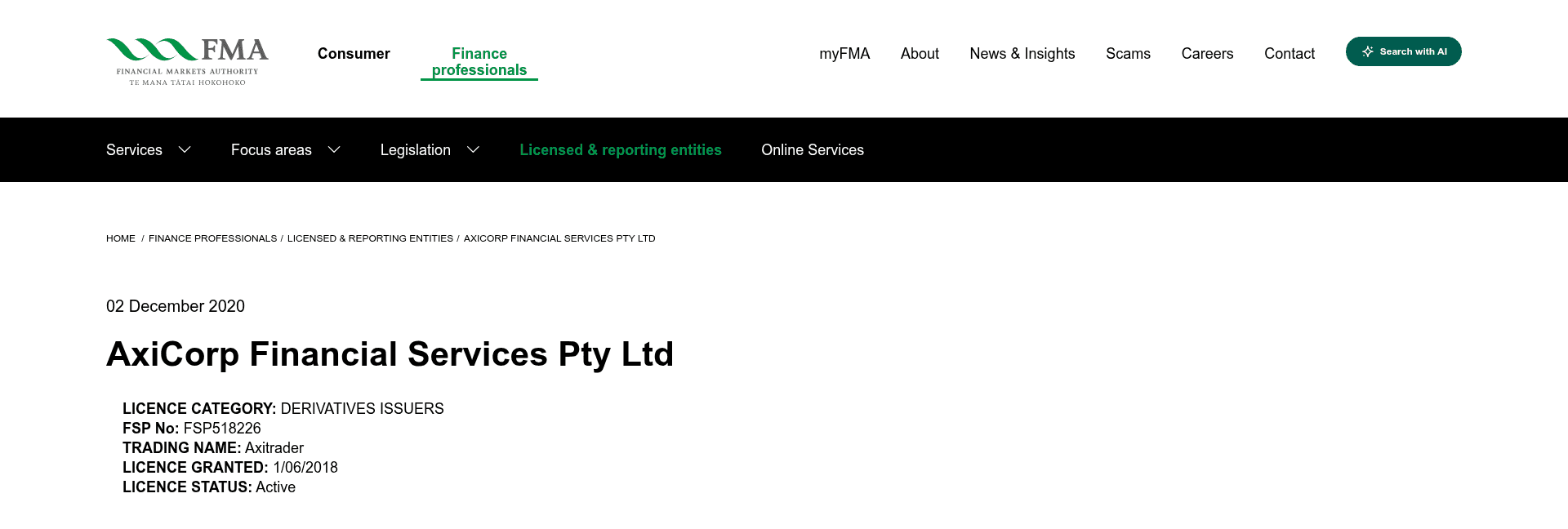
- Legal entity
- AxiCorp Financial Services Pty Ltd
- Licence category
- Derivatives issuers
- Licence status
- Active
- Financial service provider number
- FSP518226
- Date granted
- 1 June 2018
- Date we checked
- 2026-09-19
The Financial Markets Authority lists AxiCorp Financial Services Pty Ltd as a licensed derivatives issuer in New Zealand, and AxiCorp Financial Services Pty Ltd is registered on the Financial Service Providers Register as FSP518226. The registration is not the licence.
| Broker | External dispute scheme | Before it can be escalated, as the disclosure statement puts it |
|---|---|---|
| Axi this review | the external dispute resolution scheme is the Financial Dispute Resolution Service (FDRS), and it charges a complainant no fee | Axi seeks to resolve a complaint within 21 calendar days, and if it cannot resolve one within 2 months it must give reasons, updates and an expected decision date |
| BlackBull Markets | Financial Services Complaints Limited (FSCL), an approved scheme under the Financial Service Providers (Registration and Dispute Resolution) Act 2008 | 30 working days is the firm's own target before FSCL |
| CMC Markets | Financial Services Complaints Limited (FSCL), an independent scheme approved by the Ministry of Consumer Affairs | 20 business days to respond before the complaint may go to FSCL |
| IG Group | Financial Services Complaints Limited (FSCL), IG's New Zealand external scheme | 40 working days must elapse after the complaint is made before it may go to FSCL |
| Plus500 | Financial Services Complaints Limited (FSCL), approved under the Financial Service Providers (Registration and Dispute Resolution) Act 2008 | 20 working days before the complaint may go to FSCL |
| ThinkMarkets | the Insurance and Financial Services Ombudsman Scheme (IFSO), not FSCL | 21 days from the initial complaint is the firm's own target |
Visit AxiWe may be paid if you open an account through this link. It does not change what this review says.
Is Axi licensed in New Zealand?
Yes. Anyone offering contracts linked to an exchange rate in New Zealand must hold a derivatives issuer licence from the Financial Markets Authority, and AxiCorp Financial Services Pty Ltd holds one. The FMA classes retail forex trading as derivatives trading rather than currency dealing, which is why the licence category matters here. The licence was granted on 1 June 2018.
AxiCorp Financial Services Pty Ltd on the FMA register
The register entry names AxiCorp Financial Services Pty Ltd as the licence holder, with the status active. FSP518226 is a registration on the Financial Service Providers Register, not a licence in itself; it identifies who holds the derivatives issuer licence. The FMA recommends New Zealanders avoid overseas forex services it has not licensed, even where an overseas regulator appears to cover them, so a New Zealand client dealing with Axi is dealing with an entity the FMA has licensed.
Who a New Zealand client contracts with
The Product Disclosure Statement dated 9 December 2024 states on page 2 that it, and the CFDs it describes, are issued by AxiCorp Financial Services Pty Ltd under the Financial Markets Conduct Act 2013. The same statement notes that the offer is registered on the New Zealand Disclose Register, where further information about it sits. On page 21 it states that AxiCorp Financial Services Pty Ltd is incorporated in Australia and trades as Axi, providing CFD trading services in New Zealand and Australia. A licensed derivatives provider must give a client a product disclosure statement before they trade, and this is the document Axi uses for that purpose.
Where a New Zealand client’s money is held
The statement states on page 21 that client funds are held on trust in one or more trust accounts maintained with Australian authorised deposit-taking institutions. It also states that Axi holds no individual segregated accounts, and that client money is co-mingled with other clients’ money in its trust accounts. On the question of interest, the statement says Axi is entitled to the interest payable on funds held in the client trust account and may pay that interest to itself. The FMA names insolvency of the provider as a risk to read a product disclosure statement for, noting that a client may be an unsecured creditor and have difficulty getting their money back.
What happens when a position moves against you
The statement states on page 15 that an account balance falling below the minimum margin requirement is a default event that lets Axi close positions. On page 8 it states that the maximum leverage available for a CFD varies with the underlying instrument, with the rates set out in the Retail Client Product Schedule. The FMA describes leveraged forex trading as borrowing money to place a bet, with the full borrowed amount repayable on a loss. The safeguard specific to retail clients appears on page 6: negative balance protection, which limits losses to the money in the account.
What Axi charges a New Zealand account
The statement states on page 14 that there are two account types: a Standard Account charged through spreads and commission free, and a Pro Account charged through commissions with low or zero spreads. On page 8 it explains pricing: Axi derives its prices from its liquidity providers or hedging counterparties and then applies its own spread to the quoted price. A daily financing fee may accrue on positions still open at market close, 5pm New York time, Monday to Friday, as stated on page 18. On page 21 the statement sets out the other charges: an inactivity fee applies after 12 continuous months with funds in the account, no trading and no open positions, charged within 30 business days of that point and quarterly thereafter. Profit, loss and charges not denominated in the account currency are converted at Axi’s exchange rate, which may differ from its quoted FX price. Administrative charges may include deposit and withdrawal fees, international remittance fees, duplicate statements, audit letter fees and debt collection fees.
Funding and withdrawing in New Zealand dollars
The statement states on page 21 that an account is funded by debit or credit card, bank transfer or other methods through the client portal, and that Axi accepts no property or cash. On page 14 it states that an account may hold sub-accounts in different currencies, and that where a client selects no currency, the default account currency is New Zealand dollars. The currency conversion charge described above applies to anything not denominated in the account currency.
How to complain, and who hears it
The statement states on page 23 that Axi is a member of an external, independent dispute resolution scheme operated by the Financial Dispute Resolution Service, and that the scheme charges a complainant no fee. Axi seeks to resolve a complaint within 21 calendar days, and if it cannot resolve one within 2 months it must give reasons, updates and an expected decision date. FDRS is reached at www.fdrs.org.nz, by email at [email protected], by phone on 0508 337 337, or by post to PO Box 2272, Wellington 6140.
How Axi scores against every broker we rate
Axi scores 64.5 against every broker we rate, and that figure is the global published score, scored on the broker’s global offering rather than on a New Zealand test. Axi is an ECN broker, with regulators including the FCA in the United Kingdom, ASIC, CySEC, the FMA in New Zealand and the DFSA in Dubai.
Axi in New Zealand, in one line
A New Zealand client of Axi contracts with AxiCorp Financial Services Pty Ltd, an FMA-licensed derivatives issuer whose own disclosure statement gives retail clients negative balance protection, pools their money in Australian trust accounts, and routes complaints to FDRS at no cost to the complainant. The full global review is at /reviews/axi-review/.
Visit AxiWe may be paid if you open an account through this link. It does not change what this review says.
Related pages
About the author

Justin Grossbard is the CEO & Co-Founder of CompareForexBrokers established in 2014, along with Noam Korbl and works as Strategic Head Of Research.
Our reviews are reader-supported. We may receive payment when you click a link to a partner site. Learn how we make money.