
Regulators named in full: a broker regulated by ASIC is regulated by the Australian Securities and Investments Commission; by FCA, the Financial Conduct Authority.
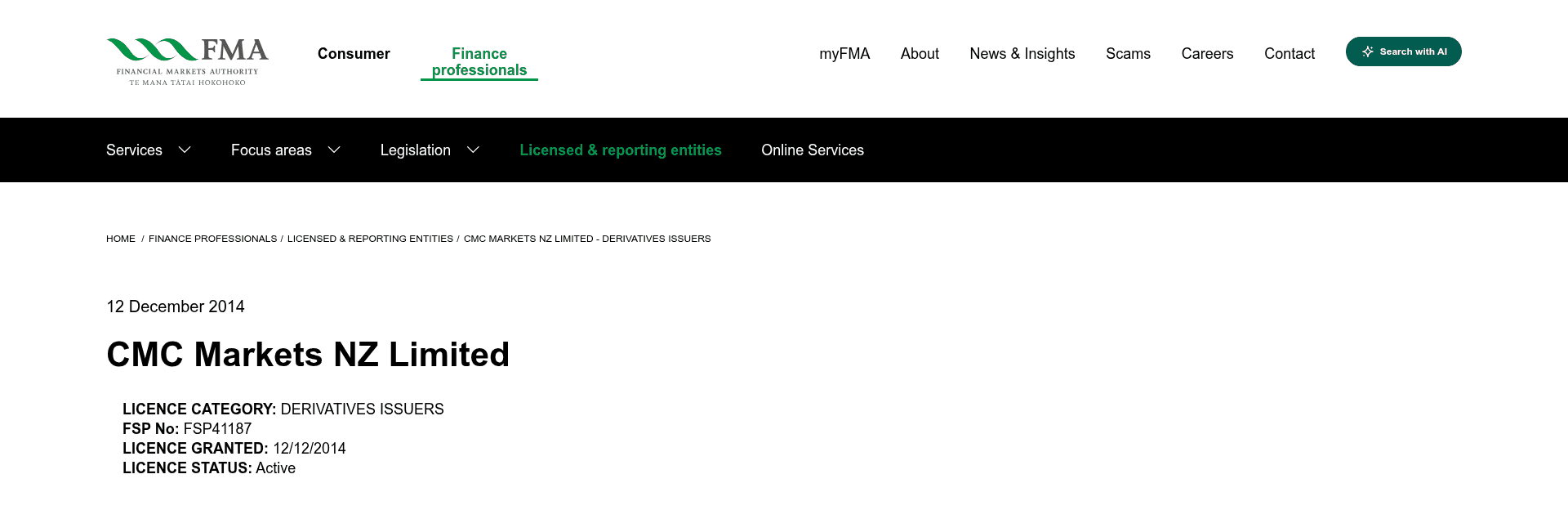
New Zealand licence: CMC Markets
- Legal entity
- CMC Markets NZ Limited
- Licence category
- Derivatives issuers
- Licence status
- Active
- Financial service provider number
- FSP41187
- Date granted
- 12 December 2014
- Date we checked
- 2026-09-19
The Financial Markets Authority lists CMC Markets NZ Limited as a licensed derivatives issuer in New Zealand, and CMC Markets NZ Limited is registered on the Financial Service Providers Register as FSP41187. The registration is not the licence.
| Broker | External dispute scheme | Before it can be escalated, as the disclosure statement puts it |
|---|---|---|
| Axi | the external dispute resolution scheme is the Financial Dispute Resolution Service (FDRS), and it charges a complainant no fee | Axi seeks to resolve a complaint within 21 calendar days, and if it cannot resolve one within 2 months it must give reasons, updates and an expected decision date |
| BlackBull Markets | Financial Services Complaints Limited (FSCL), an approved scheme under the Financial Service Providers (Registration and Dispute Resolution) Act 2008 | 30 working days is the firm's own target before FSCL |
| CMC Markets this review | Financial Services Complaints Limited (FSCL), an independent scheme approved by the Ministry of Consumer Affairs | 20 business days to respond before the complaint may go to FSCL |
| IG Group | Financial Services Complaints Limited (FSCL), IG's New Zealand external scheme | 40 working days must elapse after the complaint is made before it may go to FSCL |
| Plus500 | Financial Services Complaints Limited (FSCL), approved under the Financial Service Providers (Registration and Dispute Resolution) Act 2008 | 20 working days before the complaint may go to FSCL |
| ThinkMarkets | the Insurance and Financial Services Ombudsman Scheme (IFSO), not FSCL | 21 days from the initial complaint is the firm's own target |
Visit CMC MarketsWe may be paid if you open an account through this link. It does not change what this review says.
Is CMC Markets licensed in New Zealand?
Yes, CMC Markets NZ Limited holds a derivatives issuer licence from the Financial Markets Authority and its status on the register is active. The Product Disclosure Statement dated 7 May 2026 states on page 2 that the company is regulated in New Zealand by the FMA under that licence, under the Financial Markets Conduct Act 2013. The same page carries a caveat worth reading: the FMA’s role in licensing is limited and does not imply approval or endorsement of the business. The FMA itself is explicit that anyone offering contracts linked to an exchange rate in New Zealand must hold a derivatives issuer licence, and that a licensed derivatives provider must give a client a product disclosure statement before they trade.
CMC Markets NZ Limited on the FMA register
The FMA register enters CMC Markets NZ Limited in the derivatives issuers category, with the licence granted on 12 December 2014. The full entry sits on the FMA’s licensed providers page for the company, where the status shown is active.
CMC Markets NZ Limited is one of a small group of derivatives issuers rated on this site, and the other four licensed issuers we rate are covered on the FMA regulated brokers page.
Who a New Zealand client contracts with
The PDS states that CMC Markets NZ Limited is the issuer of both the document and the products it describes, so a New Zealand client’s contract sits with this local entity rather than with an offshore parent. The statement gives the company’s address as Level 39, 23 Albert Street, Auckland 1010, and lists an account opening phone line, 0800 26 26 27, that operates only in New Zealand.
Where a New Zealand client’s money is held
Client money sits on trust in one or more client bank accounts with a registered bank or banks in New Zealand, as the PDS states on page 18. The same page adds that CMC Markets retains any interest on client monies held in the segregated client bank account, and that it does not use client money to meet obligations incurred when hedging with other counterparties, which are funded from its operating cash account. Money owed to clients, which may include client gains, moves from the operating cash account to the segregated trust account daily, and page 15 of the statement says that prior to segregation the client is an unsecured creditor for the money owed. The obligations under the agreement are unsecured obligations, which matters if the provider fails: the FMA warns that in an insolvency a client may be an unsecured creditor and have difficulty getting their money back.
What happens when a position moves against you
The PDS states on page 11 that when account value falls to or below the close-out level at any point in time, the platforms automatically initiate account close-out. A close-out warning may be sent, but page 16 of the statement tells clients not to rely on the platforms giving that warning. For a controlled exit, a guaranteed stop loss order carries a GSLO premium each time one is placed; the statement sets the premium as the rate displayed on the platform multiplied by the number of units, debited immediately.
What CMC Markets charges a New Zealand account
Commission is charged each time a trade is entered into in certain products, with a possible minimum, as the PDS states on page 17. The same page applies holding costs to positions open at the end of each calendar day, defined as 5pm New York time with the local equivalent varying with daylight saving, except for shares listed on the New Zealand Exchange, where the holding cost is calculated on positions held at 9am NZST. Activating certain products on a platform can require a market data fee, which the statement says covers what CMC Markets pays its price vendors. The New Zealand website advertises a waiver of ordinarily applicable commissions on US share CFDs for trades placed until 31 December 2026.
Which markets and platforms the New Zealand entity offers
The PDS lists the product classes on page 5: shares, indices, currencies, commodities, treasuries and cryptocurrencies. Page 2 names the trading venues as the CMC Markets platforms, including The CMC Markets Platform and the MetaTrader Platform. The New Zealand website advertises more than 12,000 instruments on the Next Generation platform.
How to complain, and who hears it
The PDS states that CMC Markets is a member of an independent dispute resolution scheme operated by Financial Services Complaints Limited, a scheme approved by the Ministry of Consumer Affairs. FSCL sits at Level 4, 101 Lambton Quay, Wellington 6145. Under the scheme the company has 20 business days to respond to a complaint before it may go to FSCL, and the statement says there is no cost to the client to use FSCL’s services.
The risk CMC Markets ranks first in its own disclosure
The first warning in the PDS, on page 2, is that unlike most other kinds of financial products, a client may end up owing significant amounts of money. The same page adds that margin payments may be required at short notice and can be substantial. Page 5 states that trades are off-exchange with CMC Markets as the counterparty to every trade, and can only be closed with CMC Markets. The FMA reinforces the point from the other side of the trade, describing leveraged forex trading as borrowing money to place a bet, with the full borrowed amount repayable on a loss, and noting that it regularly receives complaints from consumers who have lost money in online forex trading.
How CMC Markets scores against every broker we rate
CMC Markets scores 64.6, which is the global published score, based on the broker’s global offering; there is no New Zealand score because there is no New Zealand test. The broker operates as a market maker, and its regulators span ASIC, the FCA in the United Kingdom, BaFin in Germany, CIRO in Canada, MAS, the FMA in New Zealand and the BMA.
CMC Markets in New Zealand, in one line
A New Zealand client contracts with a locally incorporated, FMA licensed issuer whose own disclosure sets out where client money sits, what it costs and what happens when positions move against you, and the full platform and cost picture sits in the global review at /reviews/cmc-markets-review/.
Visit CMC MarketsWe may be paid if you open an account through this link. It does not change what this review says.
Related pages
About the author

Justin Grossbard is the CEO & Co-Founder of CompareForexBrokers established in 2014, along with Noam Korbl and works as Strategic Head Of Research.
Our reviews are reader-supported. We may receive payment when you click a link to a partner site. Learn how we make money.