
New Zealand licence: BlackBull Markets
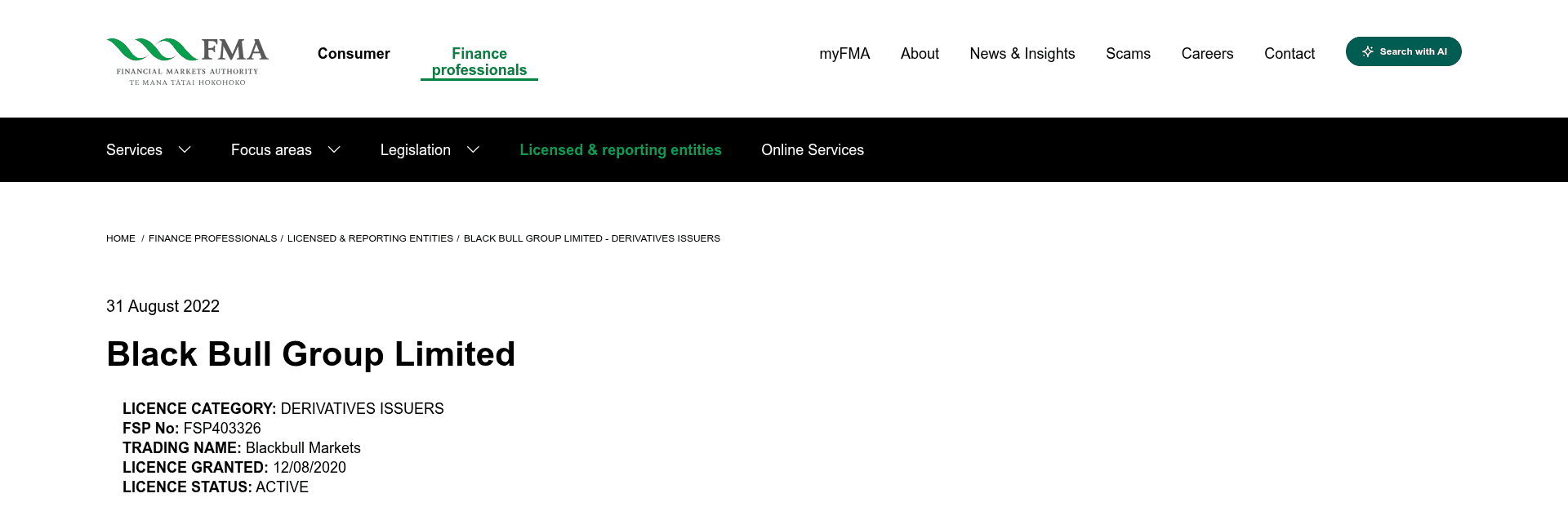
- Legal entity
- Black Bull Group Limited
- Licence category
- Derivatives issuers
- Licence status
- Active
- Financial service provider number
- FSP403326
- Date granted
- 12 August 2020
- Date we checked
- 2026-09-19
The Financial Markets Authority lists Black Bull Group Limited as a licensed derivatives issuer in New Zealand, and Black Bull Group Limited is registered on the Financial Service Providers Register as FSP403326. The registration is not the licence.
| Broker | External dispute scheme | Before it can be escalated, as the disclosure statement puts it |
|---|---|---|
| Axi | the external dispute resolution scheme is the Financial Dispute Resolution Service (FDRS), and it charges a complainant no fee | Axi seeks to resolve a complaint within 21 calendar days, and if it cannot resolve one within 2 months it must give reasons, updates and an expected decision date |
| BlackBull Markets this review | Financial Services Complaints Limited (FSCL), an approved scheme under the Financial Service Providers (Registration and Dispute Resolution) Act 2008 | 30 working days is the firm's own target before FSCL |
| CMC Markets | Financial Services Complaints Limited (FSCL), an independent scheme approved by the Ministry of Consumer Affairs | 20 business days to respond before the complaint may go to FSCL |
| IG Group | Financial Services Complaints Limited (FSCL), IG's New Zealand external scheme | 40 working days must elapse after the complaint is made before it may go to FSCL |
| Plus500 | Financial Services Complaints Limited (FSCL), approved under the Financial Service Providers (Registration and Dispute Resolution) Act 2008 | 20 working days before the complaint may go to FSCL |
| ThinkMarkets | the Insurance and Financial Services Ombudsman Scheme (IFSO), not FSCL | 21 days from the initial complaint is the firm's own target |
Visit BlackBull MarketsWe may be paid if you open an account through this link. It does not change what this review says.
Is BlackBull Markets licensed in New Zealand?
Yes, Black Bull Group Limited is licensed by the Financial Markets Authority as a derivatives issuer under the Financial Markets Conduct Act 2013. The Product Disclosure Statement dated 10 September 2025 states on page 25 that the company “is registered as a financial service provider on the Financial Service Providers Register and is licensed by the Financial Markets Authority”. The licence matters because the FMA states that individuals or businesses offering contracts linked to an exchange rate in New Zealand must hold a derivatives issuer licence, and it classes retail forex trading as derivatives trading rather than currency dealing. The FMA also recommends New Zealanders avoid overseas forex trading services it has not licensed, even where an overseas regulator appears to cover them.
Black Bull Group Limited on the FMA register
-
Entity: Black Bull Group Limited
-
Licence category: derivatives issuer
-
Licence status: active
The register was read on 19 September 2026 and showed the licence as active. A licensed derivatives provider must give a client a product disclosure statement before they trade, which is the document every figure on this page is drawn from.
Who a New Zealand client contracts with
The contracting party is Black Bull Group Limited, which states on page 25 of the Product Disclosure Statement that it is the issuer of both the statement and the CFDs it describes. Its office address is Level 20, 188 Quay Street, Auckland 1010, and its phone number is +64 (9) 558 5142. The statement also says the firm’s trading hours follow the trading hours of the New York markets.
Where a New Zealand client’s money is held
Client money sits in a segregated client trust account held with ANZ Bank, a New Zealand registered bank, as the statement states on page 22. Client monies are co-mingled with other clients’ monies in that one account, and the firm may hold a buffer of its own funds within it. The firm may retain interest earned on client money as a fee for its services, at its discretion, and that interest is then credited to no client. Client money may be used for the firm’s authorised hedging activities, with Black Bull Trade Limited named as the expected approved counterparty. The statement states on page 23 that client money may not be used to satisfy the firm’s debts or liabilities or to meet its general operations. On receivership or liquidation, client monies held in the trust account remain the property of the clients on whose behalf they are held, unless they qualify for payment out.
What happens when a position moves against you
The statement states on page 11 that a stop out closes positions automatically once the margin level drops below 50 per cent. This occurs without prior notice, and the positions closed are selected by the firm in its sole discretion, as page 13 states. No margin calls are made; monitoring additional margin requirements is solely the client’s responsibility. The trading platforms highlight the live margin calculation in red once the margin level falls below 70 per cent, giving a visual warning before the stop out level is reached. Leverage is capped by instrument: commodities and futures at 1:100, precious metals at 1:500, and equities, ETFs and cryptoassets at 1:100, as page 12 states.
What BlackBull Markets charges a New Zealand account
The spread is the difference between the bid price and the ask price for a CFD as quoted by the trading platforms, and it varies with the underlying asset and market liquidity, as page 20 states. Commission is calculated when an order opens and charged to the trading account when it closes, and it is not charged on all CFDs. Standard accounts pay spread and holding costs with no commission, while Prime accounts also pay commission at USD 6.00 per lot on some CFDs, as page 21 states. Holding costs are a swap charge or swap benefit applied on each overnight rollover, at a rate the firm sets from the interbank rate, the rollover period and the position size. Swap rates are tripled at the end of Wednesday’s trading day, whether or not the position is held over the weekend. The inactivity fee is NZ$5.00, charged immediately after ninety consecutive days without a trade and then monthly; an account left at zero or negative after the fee may be closed and the agreement terminated on reasonable notice. Converting between base currency accounts costs roughly 2 per cent, at the firm’s discretion, as page 24 states.
Funding and withdrawing in New Zealand dollars
Deposits are accepted only by electronic transfer from a New Zealand bank account in the same name as the trading account and previously verified, or through an approved third-party, credit card or payment gateway provider, as page 23 states. The statement states on page 22 that no payments are accepted from, or made to, a person who is not the client. Accounts can be opened with any of eleven base currencies: NZD, USD, EUR, GBP, CAD, JPY, AUD, ZAR, CHF, THB and SGD.
How to complain, and who hears it
Complaints that the firm does not resolve can go to Financial Services Complaints Limited, an approved dispute resolution scheme under the Financial Service Providers (Registration and Dispute Resolution) Act 2008, as page 26 states. FSCL can be reached at PO Box 5967, Wellington 6140, by phone on 0800 347 257 or +64 (4) 472 3725. The firm acknowledges receipt of a complaint within five working days and aims to resolve all complaints within 30 working days of receipt. Complaints to FSCL are handled free of charge, so the process costs the client nothing at either stage.
How BlackBull Markets scores against every broker we rate
BlackBull Markets scores 94 against every broker we rate, and that is the global published score, reflecting the broker’s worldwide offering rather than any New Zealand test.
BlackBull Markets in New Zealand, in one line
A New Zealand client of BlackBull Markets contracts with Black Bull Group Limited, an Auckland company holding an active FMA derivatives issuer licence, and the broker’s worldwide offering is covered in the global review.
Visit BlackBull MarketsWe may be paid if you open an account through this link. It does not change what this review says.
Related pages
About the author

Justin Grossbard is the CEO & Co-Founder of CompareForexBrokers established in 2014, along with Noam Korbl and works as Strategic Head Of Research.
Our reviews are reader-supported. We may receive payment when you click a link to a partner site. Learn how we make money.