
What trading IG Group costs
One standard lot of EUR/USD on IG Group's standard account costs US$11.30 for the round turn: 1.13 pips of spread (US$11.30), with no commission.
| Account | A month of trading | One round turn, 1 lot |
|---|---|---|
| One spread, no commission1.13 pips, published average | US$226.00 | US$11.30 |
A pip on EUR/USD is US$10.00 per standard lot, so the cost of a round turn is the spread in pips times that, plus any commission.
Our verdict on IG Group
I would point a New Zealand trader who wants a licensed derivatives issuer with negative balance protection and a guaranteed stop facility at this broker. The fact that would give a reader pause is the counterparty term: every CFD is over the counter with the firm as counterparty to every trade, and every trade must be closed with the firm (page 2).
The recommendation stands: the NZ desk score is 82, an editorial desk judgement built from the same eight categories, scored from published information, not tested, placing it behind CMC Markets and ahead of ThinkMarkets in the rated set. The fact that cuts against it is that commission on individual share CFDs is charged as a percentage of notional value or in cents per share, subject to a minimum charge (page 10).
Pros
- Negative balance protection covers retail clients, with a debit balance reset to zero at no cost (page 13)
- A guaranteed Limited Risk facility is offered on shares, indices, commodities, cryptocurrencies, bonds, rates and currencies (page 5).
- Bank transfers carry no minimum funding amount, while deposits by card, Apple Pay or PayPal start at NZ$100, and a demo account is available from the broker, a fact our global broker test holds.
- Financial Services Complaints Limited investigates and resolves a complaint at no charge to the complainant (page 12).
Cons
- A Limited Risk premium is charged for the guaranteed facility, payable when the Stop Order is triggered (page 10).
- A client's money may be co-mingled into trust accounts with other customers' money and held outside New Zealand (page 11).
- Forty working days must elapse after a complaint is made before it may be referred to the dispute scheme (page 12).
IG Group score breakdown
| Area | Rating |
|---|---|
| Trading Costs | 7.5/10 |
| Trading Experience | 8/10 |
| Trust | 9/10 |
| Trading Platform | 8.5/10 |
| Customer Service | 8/10 |
| Range of Markets | 9/10 |
| Education | 9/10 |
| Funding | 8/10 |
NZ desk assessment, scored from published information, not tested
How is our rating calculated?Our New Zealand assessment
82 is IG's NZ desk score, an editorial desk judgement scored from published information, not tested. New Zealand clients use IG Australia, whose platforms include the IG Trading Platform, MT4, ProRealTime, TradingView and L2 Dealer, with availability depending on account eligibility. Compare our CMC Markets review for its New Zealand standard account and FX Active.
No account was used, and the 141 ms market order fill cited is a global panel figure, not a New Zealand measurement.
- Score basis:
- AI-assisted desk-based assessment, 8 weighted categories
- Source review:
- 16 October 2026
View the source screenshot

How popular is IG Group in New Zealand?
New Zealanders made 170 branded searches for IG Group in August 2026, placing it 4th of the 6 brokers we review. Search interest measures attention, not quality; the score above is the review verdict.
- 170
- Brand searches, August 2026
- n/a below 1,000
- vs July 2026
- 10
- Login searches
- 1.8%
- Share of all searches
Source: Google search volume, New Zealand, August 2026.
How this is measured
Google Ads reports how many times a month people in New Zealand searched each broker's brand terms, and the brokers are ranked on that figure alone.
A term counts for a broker only when that broker's own website holds the first organic Google result for it in New Zealand; bare brand words that any company could own are left out.
A month-on-month change prints only where the previous month reached 1,000 searches, because Google rounds smaller volumes.
These figures were collected once and are not refreshed monthly, unlike the monthly refreshes for this site's other markets; the first-organic-result check, which determines which search terms count for which broker, was run once on 20 September 2026 and does not repeat.
How safe is IG Group?
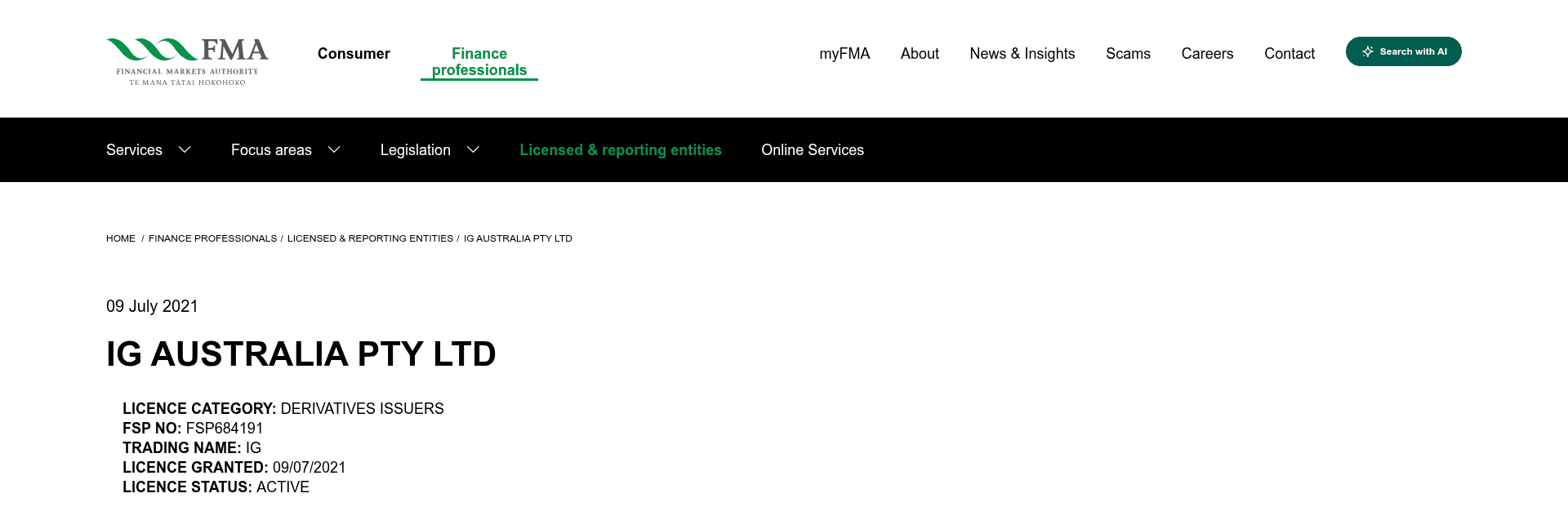
Yes, the contracting entity, IG Australia Pty Ltd, holds an active derivatives issuer licence from the FMA, granted on 9 July 2021. I confirmed the licence status on the FMA register, read on 19 September 2026. It is separately registered on the Financial Service Providers Register as FSP684191. FSP registration is not the licence: the register lists both, and they are two different things.
| Fact | What the record says | Source |
|---|---|---|
| Licensee name on the FMA register | IG Australia Pty Ltd | FMA licensed providers register |
| Issuer named in the statement | IG Australia Pty Ltd, incorporated in Australia and registered in New Zealand as a foreign company | Product disclosure statement, page 12 |
| Registration number on the Financial Service Providers Register | FSP684191 | FMA licensed providers register |
| Licence category | Derivatives issuers | FMA licensed providers register |
| Licence status | Active | FMA licensed providers register |
| Licence granted | 9 July 2021 | FMA licensed providers register, licence granted field |
| Register read on | 19 September 2026 | FMA licensed providers register |
| FMA enforcement action against this company | None found, searched 21 September 2026 | FMA enforcement search on fma.govt.nz |
| What the statement says about regulation | licensed by the FMA to issue derivatives under the Financial Markets Conduct Act 2013, and separately regulated by ASIC in Australia | Product disclosure statement, page 12 |
| What the statement says the FMA licence does not mean | the FMA holds no responsibility for the contents of the statement or any other material IG gives a client | Product disclosure statement, page 12 |
| Where the licence appears in the statement | the New Zealand licence and FSP number are printed in the running footer of every page of the PDS | Product disclosure statement, page 2 |
| Regulators of the group | ASIC, FCA (United Kingdom), BaFin (Germany), NFA, CFTC, MAS, FINMA, FMA (New Zealand), JFSA, DFSA (Dubai), BMA, FSCA (South Africa) | Our global broker test |
| Licensee register page | https://www.fma.govt.nz/business/licensed-providers/ig-australia-pty-ltd/ | FMA licensed providers register |
Every row above names its own record: seven from the FMA register, four from the product disclosure statement, one from an FMA enforcement search and one from our global broker test.
Some of the abbreviations on this page are expanded to the regulator's full name: a broker regulated by ASIC is regulated by the Australian Securities and Investments Commission; by FCA, the Financial Conduct Authority; by DFSA, the Dubai Financial Services Authority.
The product disclosure statement says the company is licensed by the FMA to issue derivatives under the Financial Markets Conduct Act 2013 and separately regulated by ASIC in Australia (page 12). Both apply to the company a New Zealand client contracts with, and the FMA’s role in licensing a derivatives issuer is limited, implying no approval or endorsement of the firm’s business, trading or solvency (page 12). The FMA holds no responsibility for the contents of the statement or for any other material the firm gives a client (page 12). The New Zealand licence and the FSP number are printed in the running footer of every page of the statement (page 2).
FMA regulation and global licences
The group’s other regulators, the FCA in the United Kingdom, BaFin in Germany, the NFA, the CFTC, MAS, FINMA, the JFSA, the DFSA in Dubai, the BMA and the FSCA in South Africa, regulate other entities in the IG Group, not the company a New Zealand client contracts with.
A New Zealand client can look the entity up on the FMA’s own licensed-providers register, and can see every other firm holding the same licence on our list of FMA-licensed derivatives issuers.
FMA enforcement history
A search of fma.govt.nz on 21 September 2026 under 4 search terms returned no FMA enforcement action against this company: IG Australia Pty Ltd, IG Australia Pty Limited, IG Markets, IG Markets Limited.
Source: the Financial Markets Authority, fma.govt.nz, searched 21 September 2026.
IG Group client money and dispute scheme
A New Zealand client contracts with IG Australia Pty Ltd, incorporated in Australia and registered in New Zealand as a foreign company, Company No. 7639257, NZBN 9429047618251 (page 12).
| Fact | What the record says | Source |
|---|---|---|
| Group scale | part of the IG Group, founded 1974, about 1,600 staff worldwide | Product disclosure statement, page 12 |
| Where client money is held | trust accounts with a registered bank in New Zealand and, permitted by the legislation, trust accounts outside New Zealand | Product disclosure statement, page 11 |
| Whether client money is pooled | client money may be co-mingled with other customers' money in one or more trust accounts | Product disclosure statement, page 11 |
| Whether client money may be invested | money held on trust may be placed in term deposit investments | Product disclosure statement, page 11 |
| Who carries the trust bank risk | IG accepts no liability for the solvency of a bank holding the trust accounts | Product disclosure statement, page 11 |
| Whether client money funds the firm's hedging | client money is not used to meet IG's hedging obligations, which it funds from its own money | Product disclosure statement, page 11 |
| Counterparty to a trade | CFDs are over the counter with IG as counterparty and every trade must be closed with IG | Product disclosure statement, page 2 |
| First stop for a complaint | the first stop is IG's Trading Services Department in Melbourne, then its Compliance Department | Product disclosure statement, page 12 |
| Time the firm has to respond | 40 working days must elapse after the complaint is made before it may go to FSCL | Product disclosure statement, page 12 |
| Dispute resolution scheme | Financial Services Complaints Limited (FSCL), IG's New Zealand external scheme | Product disclosure statement, page 12 |
| Scheme telephone | Toll free 0800 347 257 | Product disclosure statement, page 12 |
| Cost to the client of using the scheme | FSCL charges the complainant nothing | Product disclosure statement, page 12 |
Every row above comes from one record, the product disclosure statement.
History and ownership
IG Australia Pty Ltd is part of the IG Group, founded in 1974, with about 1,600 staff worldwide (page 12). Our global review of the brand covers the group’s worldwide offering.
Where a New Zealand client’s money is held
Client money is held in trust accounts with a registered bank in New Zealand and, as the legislation permits, in trust accounts outside New Zealand (page 11). A client’s money may be co-mingled into one or more trust accounts with other customers’ money, and money held on trust may be placed in term deposit investments (page 11). The firm accepts no liability for the solvency or any act or omission of a bank holding the trust accounts (page 11).
Client money is not used to meet the obligations the firm incurs when hedging with other counterparties, which it funds from its own money (page 11).
Who a New Zealand client contracts with
The contracting entity is IG Australia Pty Ltd itself, an Australian company registered here as a foreign company, not a New Zealand subsidiary, so the agreement a client signs is with the Australian company. Documents served on the firm in New Zealand go to its appointed agent, Bell Gully Solicitors (page 12).
How to complain, and who hears it
The first stop is the firm’s Trading Services Department in Melbourne, then its Compliance Department (page 12). Forty working days must elapse after the complaint is made before it may be referred to the scheme (page 12). Financial Services Complaints Limited is the firm’s New Zealand independent external dispute resolution scheme, toll free on 0800 347 257, and it charges a complainant nothing to investigate or resolve a complaint (page 12).
IG Group at a glance
The table below sets out the essentials for a New Zealand reader: the score, what it costs to trade and how fast orders fill. Who you contract with, the licence that covers you and how the entity handles your money are in the sections above. Read the table beside our global review, which covers the worldwide offering and stays separate from this entity review.
| Fact | What the record says | Source |
|---|---|---|
| Published score | 68.2 out of 100, global | Our global broker test |
| Standard EUR/USD round turn | US$11.30 per 1.0 lot, 1.13 pips published average | Broker site: IG's average for the 12 weeks ending 29 May 2020 |
| Limit order fill | 174 ms, global | Our global broker test |
| Market order fill | 141 ms, global | Our global broker test |
Every row above names its own record: three from our global broker test and one from the broker's own site.
IG Group spreads and commission
Just one EUR/USD price is worked through in this section, the pricing that carries one spread and no commission, and the figures behind it are IG’s own, not anything we measured. Ross Collins’s spread tests return nothing on this broker, and the numbers were read on IG’s Australian pages, because no New Zealand site exists and the statement points New Zealand clients there. Our methodology for these figures is on our standard spreads page.
Forex Direct, for Professional clients only
Professional clients alone can open Forex Direct, IG’s forex direct market access pricing on L2 Dealer, so a retail trader in New Zealand cannot trade forex through it, and no cost figures appear on this page. Shares and share CFDs remain available to retail clients on L2 Dealer.
One spread, no commission
No commission applies on the standard CFD pricing, and IG puts the EUR/USD average spread at 1.13 pips, a figure it averaged across the 12 weeks to 29 May 2020, beside a 0.6 pips minimum (from IG’s charges page, read on 13 October 2026). On 1.0 lot, with one pip worth US$10.00, that average works out to a round turn of US$11.30, all of it spread.
What it costs to trade with IG Group
Beyond the spread, the statement sets out the charges that come with holding positions. Interest adjustment formulas use a 360-day divisor for Australian, US and European shares and indices, and a 365-day divisor for UK, Singapore and South African ones, and the interest rate charged includes the firm’s own administration cost on top of the market cost between days. Live exchange data is a monthly subscription that varies by account classification and by exchange, charged until cancelled, and free derived prices are displayed instead of exchange prices for US, UK, European and Australian shares where a client does not subscribe, while execution is always against the underlying exchange price (all page 11).
| Fact | What the record says | Source |
|---|---|---|
| One spread, no commission: EUR/USD spread | 1.13 pips, published average | Broker site: IG's average for the 12 weeks ending 29 May 2020 |
| One spread, no commission: commission per 1.0 lot round turn | None | Our global broker test |
| One spread, no commission: cost per 1.0 lot round turn | US$11.30 | Computed, spread times US$10 a pip plus commission |
| Spread measured on a New Zealand account | None held | Our global broker test, New Zealand record |
| Holding costs | interest adjustments use a 360-day divisor for Australian, US and European shares and indices and 365 for UK, Singapore and South African | Product disclosure statement, page 11 |
| Interest and the firm's administration cost | the interest rate charged includes IG's own administration charge on top of the market cost | Product disclosure statement, page 11 |
| Market data fees | live exchange data is a monthly subscription that varies by account classification and exchange, charged until cancelled | Product disclosure statement, page 11 |
| Free derived prices | free 'derived prices' are shown instead of exchange prices for US, UK, European and Australian shares, while execution stays on the exchange price | Product disclosure statement, page 11 |
| Commission rule in the statement | commission on individual share CFDs is charged as a percentage of notional value or in cents per share, subject to a minimum charge | Product disclosure statement, page 10 |
| Currency a contract is quoted in | many CFDs are traded in Australian dollars, some in the instrument's home currency | Product disclosure statement, page 2 |
Every row above names its own record: six from the product disclosure statement, two from our global broker test, one from the broker's own site and one from a computation over those figures.
Other fees a New Zealand trader should check
Page 9 of the statement of 3 February 2025, as amended by the supplementary statement of 1 June 2026, sets the currency cost you face: a conversion between currencies is made at a rate no more than 1.0% less favourable to you than the prevailing interbank mid-market spot rate at the time of the conversion, and a crystallised profit or loss realised in a currency other than your base account currency is converted on close unless you ask otherwise. This matters because many CFDs are traded in Australian dollars, and some are denominated in a home currency, such as a CFD on a US share in US dollars (page 2). If your account is in one currency and your trades settle in another, that capped conversion cost may be a real charge on every converted profit or loss, so I would factor it into your numbers before you trade.
IG Group funding methods and withdrawals
Any fee for these services is charged to your account at the time of the transaction, and the applicable costs sit on IG’s website rather than in the statement (page 11), so check the website before you fund the account.
Deposit methods (NZ clients)
The other fees table lists these payment routes as services that may attract a fee: credit card payment, New Zealand Mastercard debit, New Zealand Visa debit, New Zealand credit card, AU$, HK$, US$ and Euro credit or debit cards, Paypal, Real Time Gross Settlement for payments by New Zealand clients and for withdrawals, Telegraphic Transfer, and Cash in Transit, which the table marks as one that may apply for some payments (page 11).
Withdrawals
The section 4.9 fee table names a Real Time Gross Settlement (RTGS) withdrawal as a service that may attract a fee for all clients, and the statement sends you to the firm’s website for the applicable costs (page 11). A withdrawal from client money is made on your instruction, into your own bank account, or to a third party where that is compliant with regulations, or to the firm where the money is due and payable to it or is an excess in the client money trust account (page 11). IG does not accept property, and any money you deposit, including your net running profits, is held separately from the firm’s money in a trust account, in accordance with the Governing Legislation and the Client Agreement (page 11).
IG Group accounts and minimum deposit
The statement sets out no account tiers for this entity. Commission on individual share CFDs is charged as a percentage of notional value or in cents per share, subject to a minimum charge (page 10).
| Fact | What the record says | Source |
|---|---|---|
| Minimum deposit | None by bank transfer; NZ$100 by card or PayPal | Broker site, read 13 October 2026 |
| Minimum deposit by account | Not held for this brand | Our global broker test |
| Accounts this page costs | 1 | Computed by our cost engine |
| Account our cost engine builds (standard) | One spread, no commission | Our cost engine label, not the broker's own |
Every row above names its own record: one from the broker's own site, one from our global broker test, one from a computation over those figures and one from our cost engine's own labels.
Minimum deposit
Funding differs by payment method: bank transfers carry no minimum, while card, Apple Pay and PayPal deposits start at NZ$100, on IG’s funding pages read the same day as its charges page. The base currency list is not on record anywhere for this entity.
IG Group trading platforms
Clients in New Zealand are served by the Australian site, where IG’s platform comparison, checked the same day as its charges page, names MT4, ProRealTime, the IG Trading Platform, L2 Dealer, and TradingView.
Copy and social trading
IG’s comparison gives TradingView social features and marks no other platform that way, and none of the pages kept for these clients names a copy trading service. If you want that service, ask the broker directly.
IG Group app
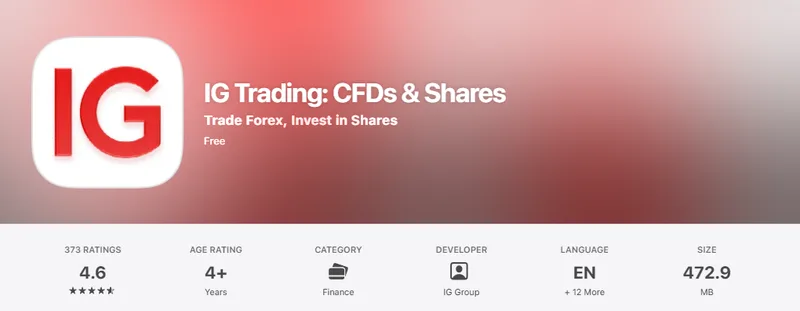
IG Group's app IG Trading: CFDs & Shares is rated 4.6 out of 5 from 373 ratings on the New Zealand App Store, checked 1 November 2026.
IG Trading Platform is rated 3.9 out of 5 on Google Play (New Zealand store) from 23.2K reviews shown worldwide, checked 1 November 2026.

IG Group execution speed and slippage
In our global execution test, this broker’s market order fill was 141 ms and its limit order fill was 174 ms. IG ranks 26th of 36 on the limit order fill and 19th of 36 on the market order fill (our global execution table, 36 brokers, ordered on the limit order fill, fastest first). Both times were measured on the global panel, not on a New Zealand account. Our methodology is on our execution speeds page.
A fill time says how quickly an order went through. It does not say at what price: the price a reader gets is a separate question of slippage, and a fast fill can still fill at a worse price than the one on screen.
IG Group markets
The statement’s product classes are CFDs on individual shares, indices, options, currencies and futures contracts (page 2). It gives classes and no counts, so no instrument count appears on this page. For share, forex, indices and some commodity CFDs the initial margin requirement is a percentage of the value of the opening CFD, and those percentages may vary across the different markets and are normally between 3.33% and 75% (page 3). The statement gives you the band, and the number for your market comes when logged into your account, from the deal ticket when opening a position, or from the dealing desk on request (page 3). Those percentages work out to about 30:1 leverage at the loosest end and about 1.33:1 at the tightest (our arithmetic from the statement’s margin band, page 3). Margin can increase as the aggregate size of your position in a market increases, and the majority of positions attract the firm’s lowest rates (page 3). If you want the asset class detail, start with our guide to what a CFD is and how it is treated in New Zealand.
Product classes in the statement: individual shares, indices, options, currencies and futures contracts (Product disclosure statement, page 2)
IG Group leverage and margin in New Zealand
What the statement sets out about controlling risk on a leveraged position is a guaranteed Limited Risk facility, offered on shares, indices, commodities, cryptocurrencies, bonds, rates and currencies (page 5). A Limited Risk premium is charged for it, payable when the Stop Order is triggered (page 10).
| Fact | What the record says | Source |
|---|---|---|
| Close-out level | an automated close-out process monitors accounts entering a margin call, and it does not guarantee to prevent negative equity | Product disclosure statement, page 3 |
| Negative balance | negative balance protection applies to a retail client, and a debit balance is adjusted back to zero at no cost | Product disclosure statement, page 13 |
| Guaranteed stop facility | a guaranteed Limited Risk facility is offered on shares, indices, commodities, cryptocurrencies, bonds, rates and currencies | Product disclosure statement, page 5 |
| Guaranteed stop premium | a Limited Risk premium is charged, payable when the Stop Order is triggered | Product disclosure statement, page 10 |
Every row above comes from one record, the product disclosure statement.
How leverage interacts with margin on this account
An automated close-out process monitors client accounts entering a margin call, and the process does not guarantee to prevent negative equity (page 3). Negative balance protection applies to a retail client, and a debit balance is adjusted back to zero at no cost (page 13). The close-out level itself is named: positions are closed as soon as market conditions allow once your account equity falls to 50% of your aggregate margin requirement (page 3). Normally you receive an automated email as soon as the account enters margin call, on a best endeavours basis, but the firm has no obligation to notify you and may act without notification, and it gives no warning when an account is merely approaching a margin call, so monitoring your account at all times is your responsibility (page 3). When close-out happens, the automated close out system or the dealing desk decides, at their discretion, which positions to reduce, following a best endeavours First In First Out policy that aims to close the oldest positions first (page 3). Exceptions apply, and the order then runs from positions with no stops, to positions with non-guaranteed stops, to positions with guaranteed stops, and finally to positions in illiquid markets or trading sessions (page 3).
IG Group customer support
Clients ringing from New Zealand reach the firm toll free on 0800 442 150 (statement, page 12), and its Australian office in Melbourne handles the business New Zealand investors place with it. Page 12 also carries a fax line, 61 3 9860 1702, and the email address [email protected].
Telephone number in the statement: 0800 442 150, toll free from New Zealand (Product disclosure statement, page 12)
Office serving New Zealand investors: IG serves New Zealand investors from an office in Australia (Product disclosure statement, page 12)
IG Group vs ThinkMarkets and CMC Markets
On score, ThinkMarkets sits one place below this broker in our rated New Zealand set, with an NZ desk score of 81. New Zealand clients at ThinkMarkets get one retail account, ThinkTrader, with zero commission, and its New Zealand contract specifications put the EUR/USD minimum at 0.8 pips, worth at least US$8.00 a round turn on a standard lot. That floor and the 2020 average costed earlier in this review measure different things, so the two figures cannot be read as a like-for-like cost comparison.
CMC Markets sits above this broker, with an NZ desk score of 86.8. CMC Markets runs its commission account as FX Active, taking a fixed 0.0025% of each transaction across every forex pair, a charge on the value traded rather than a flat per-lot figure, so the costing in this comparison leaves that account aside. For CMC Markets, the one spread, no commission account carries a tested EUR/USD figure, its pip value and round turn matching the ThinkMarkets figures above, and it is the only account that table holds for the firm.
What other review sites say about IG Group
These are ratings of IG Group from other platforms, read on the date shown and expressed on each platform's scale, so you can weigh them against our own score.
| Platform | Rating | Volume | Read on |
|---|---|---|---|
| Trustpilot | 3.7 / 5 | 10,261 | 1 November 2026 |
| TradingView | 4.0 / 5 | 1,082 | 1 November 2026 |
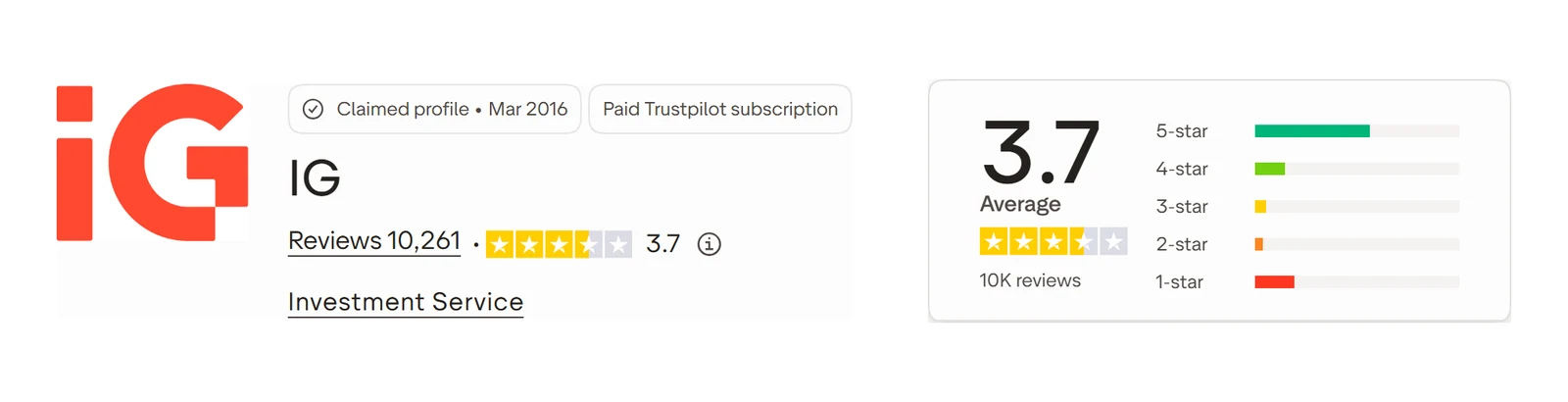
IG Group holds a Trustpilot rating of 3.7 out of 5 from 10,261 reviews, checked 1 November 2026.
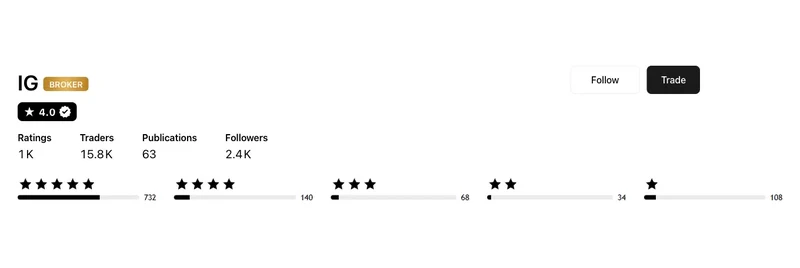
On TradingView, IG Group is rated 4.0 out of 5 from 1,082 ratings, checked 1 November 2026. The TradingView profile for IG Group shows 15.8K traders, the count of those who have connected an account through TradingView.
Our score is based on published criteria and is not influenced by these third-party ratings.
Should you open an account with IG Group?
Yes, I would point a New Zealand trader who wants a wide range of CFD product classes and negative balance protection at this broker, with the counterparty terms read first. The brand publishes on its global site that 70 per cent of retail CFD accounts lose money, read on 13 September 2026, a global figure and not a New Zealand one. This broker is not for a trader who wants a local branch, because anyone in New Zealand who signs up is serviced by the Australian entity from its Melbourne base (page 12).
I have not tested the New Zealand entity, and neither has anyone here. The page draws on five sources: the FMA register, the New Zealand product disclosure statement, the broker’s Australian pages, the brand’s global site, and our global broker test. Before depositing, read the client money terms in the statement and the complaints route for yourself, and check the funding routes against the way you plan to move your money.
IG Group FAQs
How do IG's order fill times compare with the rest of the brokers we time?
What name does the FMA register hold for IG?
What does IG charge for holding a position over a weekend, and is there an inactivity fee?
Which account types does IG's New Zealand statement set out?
Testing log
| Record | Detail |
|---|---|
| Execution recorded | A market order filled in 141 ms, as measured by our global test panel. |
| FMA register read | 19 September 2026, licence status active. |
| Product disclosure statement | The statement is dated 3 February 2025 and we read it in full on 20 September 2026. |