




Our verdict on ACE Markets
I have read the product disclosure statement dated 22 April 2026, and there are terms in it a New Zealand retail client would want. Client money sits with Bank of New Zealand Limited in a client trust account holding no other money, including the firm's own (page 20). What gives me pause is the margin variation term: the firm may change the margin percentage at any time, with retrospective application to open positions, and the change takes immediate effect once you have been notified in writing (page 11). You are told, not asked.
Because this site has not tested Ace Markets, I would establish some things for myself before depositing: the close-out rule on page 12, since the firm will not make margin calls, and the deposit conditions on page 21, since the firm accepts no third-party payments. Those checks are yours to make.
Pros
- Client money is co-mingled only with other client monies, and the account holds no other money including the firm's own (page 20)
- Client monies remain the property of clients on an insolvency, except for monies that qualify for payment out of the client trust account (page 20)
- Complaints are handled free of charge, acknowledged within five working days, and aimed at resolution within 30 working days (page 23)
- The firm is a member of Financial Dispute Resolution Service, an approved dispute resolution scheme (page 23)
- The firm requires no minimum deposit to become a client, and trading can begin once funds meet the initial margin (page 26)
Cons
- The firm will not make margin calls, and monitoring the continuing margin requirement is the client's sole responsibility (page 12)
- Positions are closed automatically, without prior notice, where total equity falls below 50% of continuing margin (page 12)
- The margin percentage may be varied at any time, applies to open positions, and takes immediate effect once the firm notifies you in writing (page 11)
- A client may lose more than the amounts deposited, notwithstanding the trading platform's risk-minimising features (page 14)
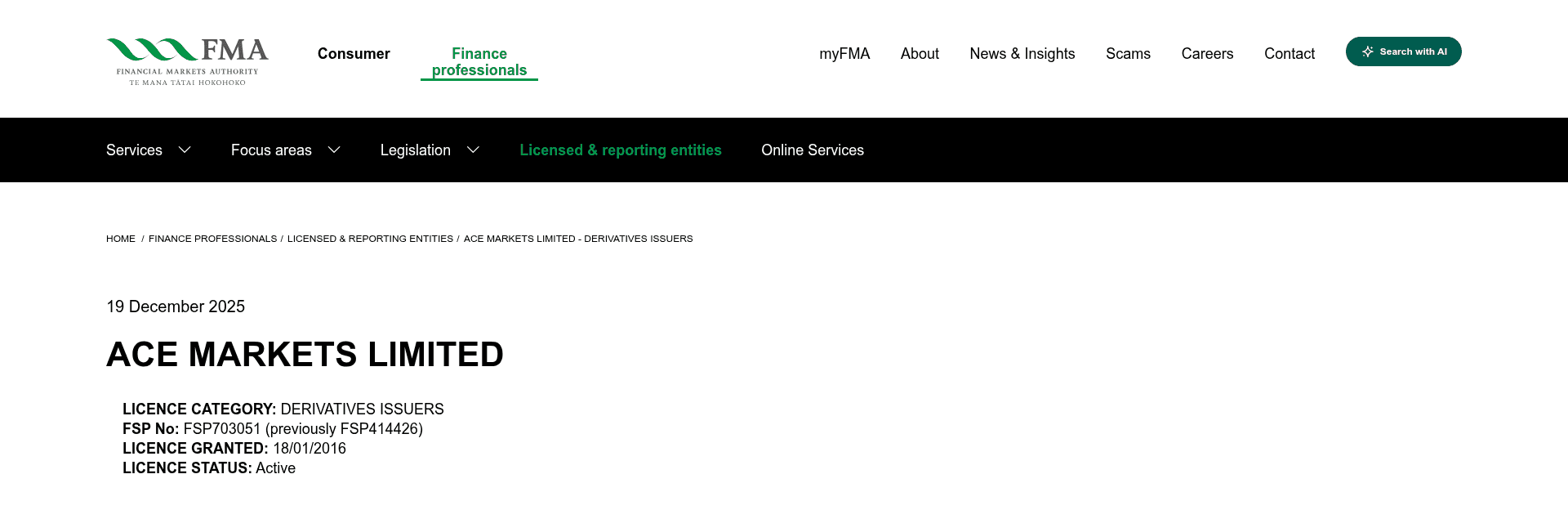
Is ACE Markets safe? FMA licence, ACE Markets Limited
Yes, Ace Markets Limited holds an active Financial Markets Authority derivatives issuer licence, granted on 18 January 2016, and I have read the register entry David Levy checked. The register was read on 19 September 2026, and it is where every licensing fact on this page comes from. If you want the licence in the regulator’s own words, our guide to the derivatives issuer licence sets out the full FMA register.
The registration number FSP703051 is a separate thing from the licence. It is a registration on the Financial Service Providers Register, while the derivatives issuer licence is what authorises the firm to issue derivatives to a New Zealand retail client. The register also lists the company under a former name, BL Global Markets Limited, and the register page address still carries that former name; the entity a client contracts with today is Ace Markets Limited.
What the FMA licence covers
The statement itself says on page 22 that the firm is registered on the Financial Service Provider Register and licensed by the Financial Markets Authority under the Financial Markets Conduct Act 2013 as a derivatives issuer. The FMA’s own consumer pages state that anyone offering forex contracts linked to an exchange rate in New Zealand must hold a derivatives issuer licence, and that it classes retail forex trading as derivatives trading, not currency dealing.
The FMA also requires a licensed derivatives provider to give a client a product disclosure statement before they trade, which is the document this page is built from. It further recommends New Zealanders avoid overseas forex services it has not licensed, even where an overseas regulator appears to cover them. Ace Markets holds a New Zealand licence that you can check for yourself on the FMA register, which is the practical answer to that recommendation.
FMA enforcement history
A search of fma.govt.nz on 21 September 2026 under 2 search terms returned no FMA enforcement action against this company: ACE Markets Limited, ACE Markets.
Source: the Financial Markets Authority, fma.govt.nz, searched 21 September 2026.
ACE Markets client money protection and dispute scheme
The company behind this statement is a New Zealand registered company that operates from Auckland, and it is the issuer of both the statement and the CFD a client trades (page 22).
Who a New Zealand client contracts with
The counterparty on every CFD you open is Ace Markets Limited, the company that issued the statement and issues the instrument you are trading. Your contract is with that company.
Where a New Zealand client’s money is held
Client money is held in a client trust account with Bank of New Zealand Limited, a New Zealand registered bank (page 20). Client monies are co-mingled with other client monies in that account, and the account holds no other money, including the firm’s own (page 20). Interest is not earned on client money held in the client trust account, so you earn no interest on the balance of your trading account (page 20). Prohibited uses of client money include satisfying the firm’s debts or liabilities, meeting its general operational obligations, and hedging activities (page 21). Other than client money, the firm holds no other client property (page 20).
What happens if the company fails
If the firm is placed under management or put into receivership or liquidation, client monies in the client trust account remain the property of the clients they are held for, except for monies that qualify for payment out of the client trust account (page 20). The FMA names insolvency of the provider as a risk to read the statement for, and says a client may be an unsecured creditor. The statement also says the firm’s creditworthiness has not been assessed by an approved rating agency (page 15).
How to complain, and who hears it
The firm is a member of Financial Dispute Resolution Service (FDRS), an approved dispute resolution scheme (page 23). It makes all reasonable efforts to acknowledge receipt of a complaint within five working days, and aims to resolve all complaints within 30 working days of receipt (page 23). Complaints to the firm, and to FDRS, are handled free of charge (page 23).
ACE Markets at a glance: 10 key facts
This table gathers what the product disclosure statement and the FMA register set out about Ace Markets, from the licence and the office to the close-out level and the complaints timetable. Every entry carries its page number, so you can check each one against the statement yourself.
| Fact | What the record says | Source |
|---|---|---|
| Contracting entity | ACE Markets Limited | FMA register |
| FSP registration | FSP703051 | FMA register |
| Licence status | Active | FMA register |
| Licence granted | 18 January 2016 | FMA register |
| Address | the office is Floor 28, 151 Queen Street, Auckland 1140, on 0800 437 683 | Product disclosure statement, page 22 |
| Client money held at | the client trust account is held with Bank of New Zealand Limited, a New Zealand registered bank | Product disclosure statement, page 20 |
| Negative balance | a client may lose more than the amounts deposited, notwithstanding that the trading platform has features intended to minimise the risk of loss | Product disclosure statement, page 14 |
| Close-out level | where total equity falls below 50 per cent of the continuing margin, positions are closed automatically by the trading platform without prior notice, and the firm selects which ones | Product disclosure statement, page 12 |
| Dispute scheme | the firm is a member of Financial Dispute Resolution Service (FDRS), an approved dispute resolution scheme | Product disclosure statement, page 23 |
| Base currencies | the trading account is maintained in either NZD or USD, nominated by the client | Product disclosure statement, page 12 |
ACE Markets funding methods and withdrawal times
Money may only be deposited to the client trust account by electronic transfer from a New Zealand bank account, and the statement attaches conditions to that route on page 21: the bank account must be in the same name as the trading account, it must already have been verified by the firm, and payments from third parties are not accepted. Money received is processed during normal business hours, which the statement gives as 10:00am to 6:00pm.
Deposit methods (NZ clients)
If you would be funding from a joint account, a partner’s account, or an account the firm has not yet verified, those conditions are the first thing to check before you apply.
Withdrawals
A withdrawal is requested on a Withdrawal Form, processed as soon as practicable but possibly taking up to two working days, and paid by electronic transfer to the registered bank account (page 21).
ACE Markets account types and minimum deposit
The firm currently offers clients only a Standard Account (page 11). Opening one means passing a suitability assessment: the firm judges whether you have the knowledge, experience, and understanding to trade CFDs, and an applicant judged unsuitable is not eligible to become a client (page 25). A quoted price is not an offer to contract, and the firm may accept or reject an order in its sole discretion (page 8). The cost of trading is the spread, the difference between the bid price and the offer price for a CFD quoted through the trading platform, together with holding costs: a position held overnight is rolled to the next working day, resulting in a swap charge or a swap benefit (page 18). The statement says the spread and holding costs are the fees and charges payable, and that there are no others (page 18). Your trading account is maintained in either NZD or USD, nominated by you (page 12).
Minimum deposit
The firm requires no minimum amount to be deposited into the trading account to become a client, and you may trade once there are enough funds to meet the initial margin (page 26).
ACE Markets trading platforms
Trading is through the online trading system MetaTrader 5, or by contacting the dealing room (page 7). Those are the two routes the statement gives. If you would rather deal with a person than a screen, the dealing room is the phone route.
ACE Markets markets
The product disclosure statement dated 22 April 2026 describes what it offers in two places, and they do not match. On page 2 it says the underlying instruments for which CFDs are offered include certain currencies, commodities such as gold and silver, and cryptocurrencies, and indices are not in that list. On pages 7 and 8 its own numbered list of underlying instruments opens with indices and currencies and continues with commodities and cryptocurrencies, and it says the products it offers may change from time to time. I am not choosing between the two: the statement says two different things about what it offers, and you should read both pages before assuming any particular market is available. A Standard Account entitles a client to leverage a position using a ratio of 100:1, and the margin percentage applied to a Standard Account will be 1% of the value of the CFD as a starting point (page 11). The CFDs the firm offers have no set expiry, so a position stays open until closed by you or the firm (page 9). The statement gives classes of underlying instrument rather than a count of pairs or products. If you are new to these instruments, our guide to what a CFD is and how it is treated in New Zealand covers the mechanics.
ACE Markets leverage and margin for New Zealand clients
Leverage on a Standard Account lets you hold a position larger than the money you commit, and the margin percentage the statement applies is the starting point for what you must keep in the account to hold it. How the firm treats that requirement when a position moves against you is set out in the statement’s own terms.
How leverage interacts with margin on this account
The firm will not make margin calls, and monitoring the continuing margin requirement is your sole responsibility (page 12). The firm may vary the margin percentage at any time, with retrospective application to positions already open, and it commits to notifying you in writing of any variation, with the change taking immediate effect following that notification (page 11). Where total equity falls below 50% of the continuing margin, positions are closed automatically by the trading platform without prior notice, and the firm selects which ones (page 12). A stop loss is an order to close out a position at a specific price, and the firm does not guarantee the position will be closed out at the exact price specified (page 8). A client may lose more than the amounts deposited, notwithstanding that the trading platform has features intended to minimise the risk of loss (page 14). The FMA describes leveraged forex trading as borrowing money to place a bet, with the full borrowed amount repayable on a loss.
ACE Markets customer support
The office is Floor 28, 151 Queen Street, Auckland 1140, and the phone number is 0800 437 683 (page 22). The dealing room operates 24 hours a day from Monday 10:00am NZST to the close of markets on Saturday at 12:00pm NZST (page 22). If you trade sessions in New Zealand time, our market hours guide sets out the trading week.
Should you open an account with ACE Markets?
Yes, if you have read the statement’s margin and close-out terms and they suit the way you trade. This site has not tested this broker and publishes no score for it. The FMA’s own opening line on forex trading is that trading for profit is very risky, and it says it regularly receives complaints and enquiries from consumers who have lost money in online forex trading.
No, if a term in the statement does not sit right with you: the firm may vary the margin percentage at any time, and a client may lose more than the amounts deposited. Before depositing, check the licence on the FMA register, read the close-out rule and the stop loss terms, and satisfy yourself that the quoted spread works for your position sizes.
FAQs
Is Ace Markets licensed in New Zealand?
Has this site rated or tested Ace Markets?
What happens to my money if the company fails?
Can I lose more than I deposit with Ace Markets?
Testing log
| Record | Detail |
|---|---|
| FMA register read | 19 September 2026, licence status active. |
| Product disclosure statement | The statement is dated 22 April 2026 and we read it in full on 20 September 2026. |