




Our verdict on EC Markets
I read the statement dated 16 May 2025 page by page, and the terms I would weigh before depositing are its client money arrangements and its close-out rules. The statement commits to holding all client funds separate from the company's own funds in trust accounts with major banking institutions (statement, page 18). What gives me pause is on page 23: there is a possibility that you will lose more than the funds you have deposited, and the close-out the statement offers for that is described as decreasing a probability, not removing it (page 22).
Before you deposit, I would read the close-out terms yourself, because the statement states the margin close-out level at two different figures on two different pages, and you should hold both. I have not tested this broker, so what you can rely on here is the statement itself, with its pages.
Pros
- All client funds are held separate from the company's own funds in trust accounts with major banking institutions (statement, page 18).
- The company will use its own funds in the short term to cover a customer balance shortfall caused by another client's default (page 18).
- The company holds professional indemnity insurance for loss from breaches of legislative obligations, though decisions sit with the third party provider (page 14).
- The company charges no withdrawal fees, though some banks use intermediary banks whose charges are the client's responsibility (statement, page 17).
- The Financial Dispute Resolution service charges no fee to investigate or resolve a complaint referred to it (page 20).
Cons
- Funds in the trading account are held in trust but are not segregated from other customer funds within the trust account (statement, page 13).
- A monthly inactivity fee may be charged where there is no trading activity for 120 consecutive days (statement, page 16).
- The company is entitled to retain any interest earned on balances in the trading account or the customer funds accounts (statement, page 19).
- There is a possibility that you will lose more than the funds you have deposited (statement, page 23).
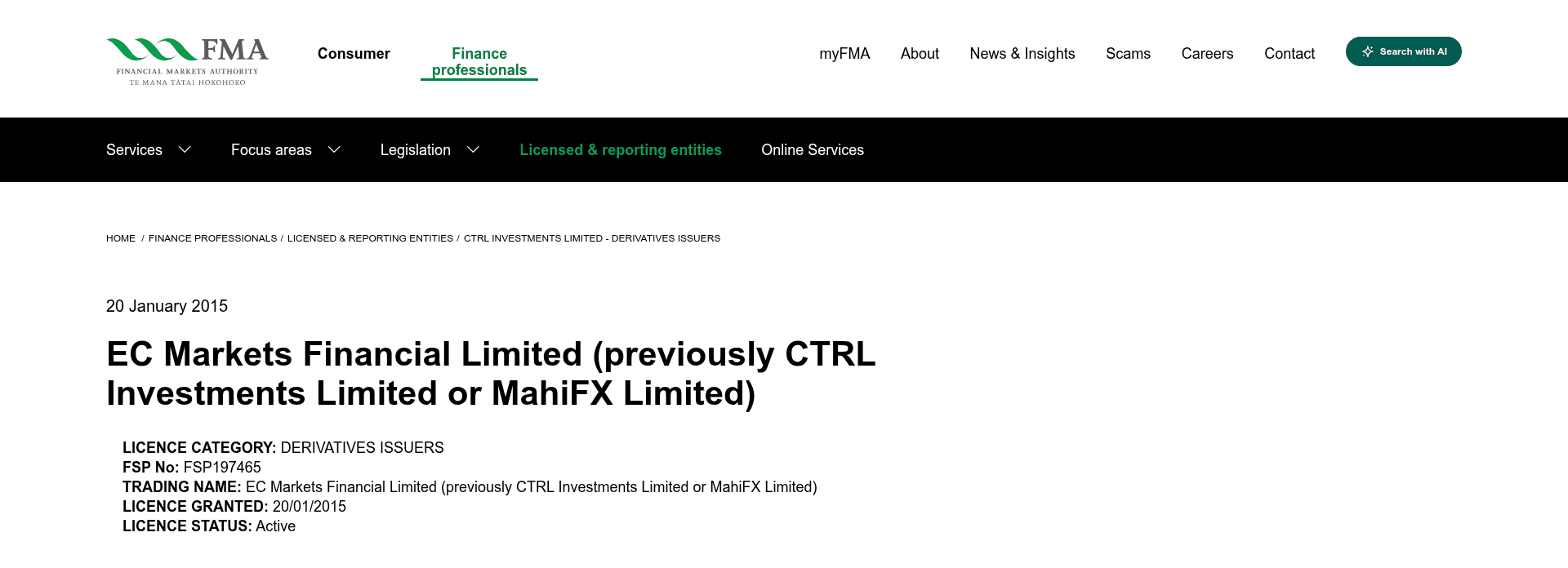
Is EC Markets safe? FMA licence, EC Markets Financial Limited (previously CTRL Investments Limited or MahiFX Limited)
Yes, EC Markets Financial Limited, trading as EC Markets, holds a derivatives issuer licence from the Financial Markets Authority, and the licence status is Active. The Financial Markets Authority granted the licence on 20 January 2015, and I read this on the FMA register on 19 September 2026. The company also holds the registration FSP197465 on the Financial Service Providers Register, and that registration is a separate thing from the licence: the derivatives issuer licence is what authorises the issuing of derivatives to a New Zealand client. David Levy fact-checked the figures and credentials on this page, and the work behind it is reading the statement and reading the register, nothing more.
One thing will catch you if you check the register yourself. The register lists this licensee under a legal name that carries two former names, CTRL Investments Limited and MahiFX Limited, and the register page for the licensee still sits at the address ending /ctrl-investments-limited/. A name the company no longer uses is in the address of the page you will land on, and the page you have found is the right one.
What the FMA licence covers
The Financial Markets Authority states that anyone offering contracts linked to an exchange rate in New Zealand must hold a derivatives issuer licence, and that a licensed derivatives provider must give a client a product disclosure statement before they trade. The statement here is only for offers of derivatives made in New Zealand (statement, page 21), and the company says on page 14 that it is licensed by the Financial Markets Authority as an issuer of derivatives, and that should the licence be withdrawn or a stop placed on the issuance of its statement it may be unable to transact. The FMA also classes retail forex trading as derivatives trading, not currency dealing, and it recommends New Zealanders avoid overseas forex services it has not licensed. You can read more about FMA regulated brokers and the full register on our dedicated page.
FMA enforcement history
- EC Markets previously known as CTRL
CTRL Investments Limited changed its name to EC Markets Financial Limited (trading as EC Markets)
The FMA's enforcement case page records that in July 2024 CTRL was censured for failing to meet its NTA level requirements, and that on 15 August 2024 CTRL Investments Limited changed its name to EC Markets Financial Limited (trading as EC Markets).
- FMA censures CTRL for Derivatives Issuer licence breaches
CTRL failed to meet its minimum Net Tangible Asset (NTA) requirements between 31 March 2023 and 29 March 2024.
The FMA censured CTRL Investments Limited for breaching the obligations of its Derivatives Issuer licence. The FMA states the breach was caused by the failure of an overseas electronic money institution CTRL used to hold a significant amount of the company's assets, and that CTRL also failed to provide a replenishment plan, daily NTA reporting and an assurance report within the prescribed timeframes. The FMA notes CTRL had no open positions or retail clients at the time of the breaches. The page carries an update that CTRL changed its name to EC Markets Financial Limited on 15 August 2024.
- CTRL Investments Limited issued infringement notice for late financial statements
The infringement notice requires CTRL to pay a $7,500 fee.
The FMA issued an infringement notice to derivatives issuer CTRL Investments Limited for failing to file financial statements by the due date. CTRL was required to file audited financial statements for the year ended 31 March 2023 by 31 July 2023, and at the date of publication of the media release had yet to file them. CTRL has 28 days to pay the infringement fee or respond to the notice in the prescribed manner. The page carries an update that CTRL changed its name to EC Markets Financial Limited on 15 August 2024.
- FMA censures CTRL Investments for derivatives issuer licence breaches
CTRL had materially contravened two standard conditions of its licence by failing to comply with requirements for certain outsourcing arrangements
The FMA censured CTRL Investments Limited for contravening the conditions of its derivatives issuer licence. Through its ongoing monitoring of the derivatives issuer sector, the FMA was satisfied that CTRL had materially contravened two standard conditions of its licence by failing to comply with requirements for certain outsourcing arrangements and allowing clients who did not understand derivatives and associated risks to trade.
FMA warning about a website or third party misusing this company's name, in which the FMA records that the company is not associated with the imposter. Such a warning is not FMA enforcement action against EC Markets Financial Limited (previously CTRL Investments Limited or MahiFX Limited):
- Mahi-FX
The website www.mahi-fx.com is displaying MahiFX Limited’s company and FSPR registration details without authority.
The FMA recommends exercising caution before dealing with the website www.mahi-fx.com, and states that Mahi-FX is not a New Zealand registered company and is not associated with, nor an authorised representative of, MahiFX Limited. The FMA recommends exercising caution to ensure the correct website for MahiFX Limited is accessed.
Source: the Financial Markets Authority, fma.govt.nz, searched 21 September 2026.
EC Markets client money protection and dispute scheme
EC Markets Financial Limited, trading as EC Markets, is the issuer of the products and is registered in New Zealand as a private limited liability company under the New Zealand Companies Act 1993 (statement, page 19). It was incorporated on 30 March 2010 and was registered as a foreign company in Australia on 8 August 2011 (page 19).
Who a New Zealand client contracts with
The company quotes both the buy and the sell price in a trade, and all transactions are entered into with EC Markets as principal (statement, page 7). It earns a commission from its hedging counterparties based on the volume of hedged positions, and those commissions are incorporated into prices (page 15). The hedging counterparty is EC Markets Global Limited, registered in the Cayman Islands (page 19). Neither the company’s nor its hedging counterparties’ creditworthiness has been assessed by an approved rating agency (page 13).
Where a New Zealand client’s money is held
All client funds are held separate from the company’s own funds in trust accounts, and the customer funds accounts are held with major banking institutions (statement, page 18). Funds in your trading account are held in trust but are not segregated from other customer funds within the trust account (page 13). A consequence of that pooling is that your funds may be used to meet the payment obligations of other customers, and a default by another client may cause you loss (page 18). To mitigate the risk that a default by another client causes a loss to the customer funds accounts, the company says it will use its own company funds in the short term to cover any customer balance shortfall while it pursues the defaulting customer (page 18). You receive no interest on balances in the trading account or the customer funds accounts, and the company is entitled to retain any interest earned on them (page 19).
What happens if the company fails
If the company became insolvent and a deficit arose, a customer might become an unsecured creditor of the company (statement, page 18). The Financial Markets Authority names insolvency of the provider as a risk to read the statement for, and says a client may be an unsecured creditor. The company holds professional indemnity insurance to compensate customers for loss or damage attributed to breaches of relevant legislative obligations, though decisions on the policy sit with the third party provider (page 14).
How to complain, and who hears it
The company is a member of the Financial Dispute Resolution service in New Zealand, membership number FM1028 (statement, page 20). It seeks to acknowledge a complaint promptly and provide a substantive response within no more than 30 days (page 20). The Financial Dispute Resolution service will only investigate once the company has been given the opportunity to resolve the complaint, so a formal complaint must first be lodged in writing with the company (page 20). The service charges no fee to investigate or resolve a complaint referred to it (page 20).
EC Markets at a glance: 11 key facts
The table below sets out what the issuer’s own paperwork says, line by line. I built it from the Product Disclosure Statement and the FMA register, and every entry carries the page it came from, so you can check any of it against the document yourself.
| Fact | What the record says | Source |
|---|---|---|
| Contracting entity | EC Markets Financial Limited (previously CTRL Investments Limited or MahiFX Limited) | FMA register |
| FSP registration | FSP197465 | FMA register |
| Licence status | Active | FMA register |
| Licence granted | 20 January 2015 | FMA register |
| Registered office | the company is based in Auckland, with a registered office at Level 1, 1 Albert Street, Auckland 1010, on +64 9 302 0798 | Product disclosure statement, page 19 |
| Client money held at | all client funds are held separate from the company’s own funds in trust accounts, and the customer funds accounts are held with major banking institutions | Product disclosure statement, page 18 |
| Negative balance | there is a possibility a client will lose more than the funds they have deposited | Product disclosure statement, page 23 |
| Close-out level | on a margin closeout event the company closes out the least profitable positions automatically at the market rate applicable at the time until there is enough account equity to support the margin, which could mean all open positions are closed | Product disclosure statement, page 6 |
| Dispute scheme | the company is a member of the Financial Dispute Resolution service in New Zealand, membership number FM1028 | Product disclosure statement, page 20 |
| Inactivity fee | a monthly inactivity fee may be charged where there is no trading activity for 120 consecutive days, and a monthly low activity fee where no transaction is opened or closed within 120 consecutive days | Product disclosure statement, page 16 |
| Base currencies | funds must be deposited in the client’s base currency, and funds received in another currency are automatically converted when credited | Product disclosure statement, page 17 |
EC Markets funding methods and withdrawal times
Funding a trading account by bank transfer or wire carries no fee from the company, though your own bank may impose a charge (statement, page 17).
Deposit methods (NZ clients)
The company accepts Visa, Mastercard, and wire transfers (statement, page 17). Credit card deposits appear on instant bank verification, and wire transfers take two to five business days to clear (page 17).
Withdrawals
The company charges no withdrawal fees, though some banks use intermediary banks whose charges are your responsibility (statement, page 17). The minimum withdrawal amount is ten New Zealand dollars or the equivalent in another currency (page 17). Withdrawal requests are processed within 5 business days once accepted, and funds are only returned in your base currency (page 18). After funds are first deposited from a credit card, those funds may only be refunded to that same credit card, and any additional amounts only to the verified bank account (page 18).
EC Markets account types and minimum deposit
Opening an account runs through a questionnaire that assesses your financial capacity, knowledge and experience in trading financial products including derivatives (statement, page 21). Funds must be deposited in your base currency, and funds received in another currency are automatically converted when credited (statement, page 17). The company also operates a swap free Islamic account and invites interested parties to contact customer service (statement, page 17). On the cost side, the statement sets out a monthly inactivity fee where there is no trading activity for 120 consecutive days and a monthly low activity fee where no transaction is opened or closed within 120 consecutive days: the fee is NZD 10 per month over 120 days and NZD 50 per month over 365 days, charged retroactively for the whole inactivity period (statement, page 16).
Minimum deposit
Activating a trading account requires a minimum deposit of NZD 250 or the equivalent in another currency (statement, page 21).
EC Markets markets
The statement sets out the contracts on offer on page 5: over the counter, non-deliverable CFDs on shares, ETFs, indices, commodities, foreign exchange and cryptocurrencies, traded on a margin or leveraged basis. In its worked example the statement posts margin of 1%, so the exposure is amplified or leveraged by a factor of 100 times the margin (statement, page 9). If you are new to these instruments, our guide to CFD trading explains what a CFD is and how it is treated in New Zealand.
EC Markets leverage and margin for New Zealand clients
The company closes positions automatically on a margin close-out event: it closes the least profitable positions at the market rate applicable at the time until there is enough account equity to support the margin, which could mean all open positions are closed (statement, page 6). It states on page 6 that close-out occurs when your margin level is less than or equal to 50% of the required margin to support your open positions, and its glossary states on page 25 that the same event occurs when your margin level is less than or equal to 15% of the required margin. The statement gives both figures, each on its own page, and I do not choose between them. Both pages carry the same second trigger: close-out after 5 business days of being in breach of the margin requirement. The close-out exists, the statement says, to significantly decrease the probability of you losing more than the amount that is in your trading account (statement, page 22).
Before any of that, the company may alert you through notifications in the trading platform when the account reaches a specific percentage or less of the required margin, though it warns that in a fast moving market there may be little time between alerts or no time to warn at all (page 6). You can manage the risk yourself with limit orders, stop loss orders and take profit orders, which the statement warns may still fail to execute at or even around the price specified in exceptionally volatile or illiquid conditions (statement, page 11). There is no cooling off period in relation to CFD transactions (page 12), and the statement says plainly that there is a possibility you will lose more than the funds you have deposited (page 23).
How leverage interacts with margin on this account
The overnight financing fee, also called the swap fee, is the interest charged for holding a position open each night, debited from the trading account whether the position is long or short (statement, page 16). A position counts as held overnight if it is open at 12:00 am in the GMT+3 time zone, which the statement notes means the fee can fall during the day for a client in the New Zealand time zone (page 16). A position held overnight on Wednesday incurs three times the daily overnight financing charge, because trades require a two day settlement period (page 16).
EC Markets customer support
The company is based in Auckland, with a registered office at Level 1, 1 Albert Street, Auckland 1010, and a phone number of +64 9 302 0798 (statement, page 19). If you trade through the New Zealand session, our market hours guide sets out the trading session in New Zealand time.
Should you open an account with EC Markets?
Yes, if you are comfortable contracting with a licensed derivatives issuer you have read for yourself, because the statement puts the licence, the trust account structure, and the dispute route in writing. No, if you need a tested view of costs or execution before you deposit, because I cannot give you one.
The Financial Markets Authority describes leveraged forex trading as borrowing money to place a bet, with the full borrowed amount repayable on a loss, and it says it regularly receives complaints and enquiries from consumers who have lost money in online forex trading. Weigh that against what the statement commits to. Before depositing, I would read pages 6, 18, and 23 of the statement, confirm the licence status on the register, and satisfy yourself that the pooled trust structure and the close-out terms are ones you accept.
FAQs
Has CompareForexBrokers rated or scored EC Markets?
Who regulates EC Markets in New Zealand?
What is the minimum deposit to open an account?
How long do withdrawals take?
Testing log
| Record | Detail |
|---|---|
| FMA register read | 19 September 2026, licence status active. |
| Product disclosure statement | The statement is dated 16 May 2025 and we read it in full on 20 September 2026. |