Our verdict on Pacific Financial Derivatives
I have read the statement, and it commits to client money held in trust accounts for client funds (page 16). Yet its wording that no fees or commissions apply to enter a contract (page 14) sits alongside the firm's New Zealand website, read on 13 October 2026, listing PFDTrader at zero commission and PFDPro and PFDProPlus at US$1 per side on a standard lot. The term that gives me pause is on page 12: in the event of a failure to make margin payments, the company may reduce or close all open contracts without further notice, and the client is liable for any shortfall.
Because I have not tested this broker, what you should establish for yourself before depositing is what only use can tell you: how the platform behaves, what the spread inside the quoted price costs on the pairs you trade, and how a withdrawal runs in practice.
Pros
- Money paid for margin and fees is held in separate trust accounts for client funds, apart from the company's own assets (page 16)
- Per the firm's New Zealand website, read on 13 October 2026, PFDTrader carries no commission, and the statement builds the spread into the quoted price rather than adding a separate charge (page 14)
- Complaints can be escalated to Financial Dispute Resolution, which charges the complainant no fee to investigate or resolve a complaint (page 17)
- A margin warning is displayed on the client's trading terminal, with the balance bar turning red (page 8)
- Local transfers are not charged transfer fees (page 15)
Cons
- Stop loss orders are not guaranteed, and their execution depends on market volatility and liquidity (page 13)
- No interest is paid to the client on money held in the trading account (page 16)
- If you fail to make margin payments the company may reduce or close all open contracts without further notice, leaving you liable for any shortfall (page 12)
- If equity falls short of the required margin you must either deposit additional funds or close out existing open positions (page 7)
Desk-based assessment: scored from published information, not tested
Pacific Financial Derivatives score breakdown
| Area | Rating |
|---|---|
| Trading Costs | 6/10 |
| Trading Experience | 6.5/10 |
| Trust | 7.5/10 |
| Trading Platform | 6/10 |
| Customer Service | 6.5/10 |
| Range of Markets | 6/10 |
| Education | 5.5/10 |
| Funding | 7/10 |
NZ desk assessment, eight editorial categories
How is our rating calculated?Scored on 8 of 8 categories.
Our New Zealand assessment
64 is Pacific Financial Derivatives' NZ desk score, an editorial desk judgement scored from published information, not tested. PFD has three MT4 tiers, PFDTrader, PFDPro and PFDProPlus, with commission and funding terms depending on tier. Spreads are shown live, not as a comparable published average here. Compare our EC Markets review.
The live feed spreads are snapshots, not costed here, and no account was opened or traded.
- Score basis:
- Desk-based assessment, 8 weighted categories
- Source review:
- 16 October 2026
View the source screenshot
How safe is Pacific Financial Derivatives?
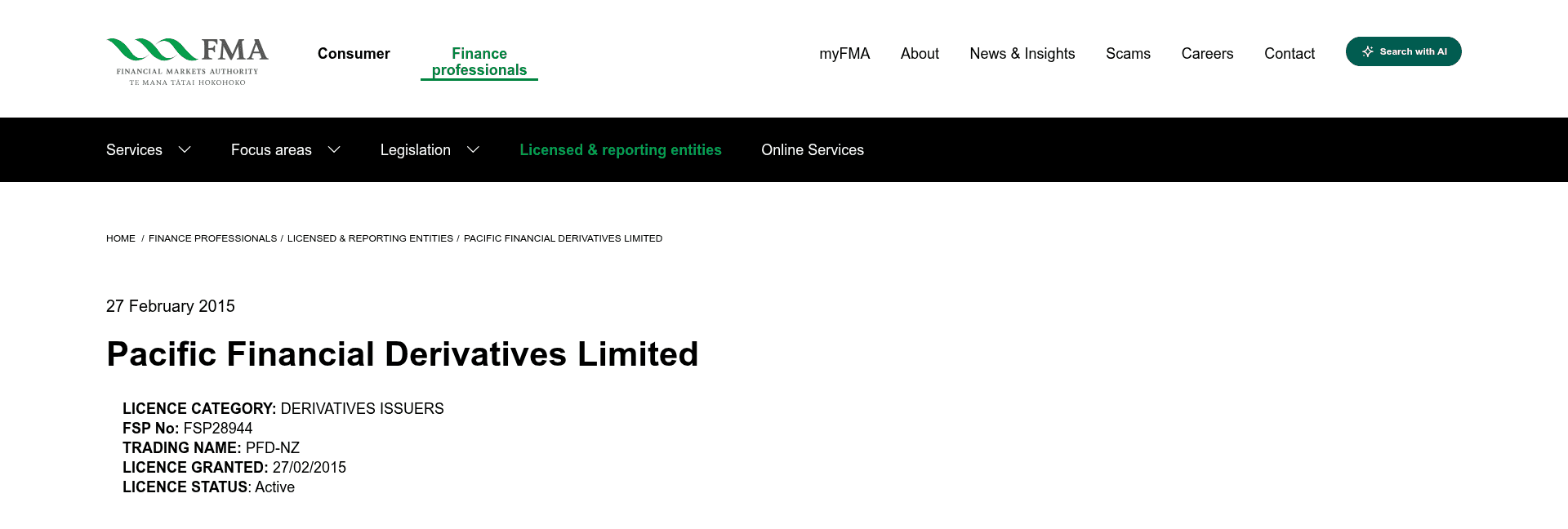
Yes, Pacific Financial Derivatives Limited holds a derivatives issuer licence from the Financial Markets Authority, granted on 27 February 2015 and shown as Active on the register when I read it on 19 September 2026. The register prints the trading name PFD-NZ. The company also holds the registration FSP28944 on the Financial Service Providers Register, and that registration is not the licence: the licence is the separate thing that authorises the issuing of derivatives to a New Zealand client. You can check the derivatives issuer licence and the full FMA register for yourself.
The company published its own product disclosure statement, dated 11 June 2024, at pfd-nz.com, and I have read it page by page. The Financial Markets Authority requires a licensed derivatives provider to give a client a product disclosure statement before they trade, so if you open an account this is what you will be handed. It forms one of three documents in the Client Services Agreement, alongside the Client Information Form and the General Terms and Conditions (page 18).
What the FMA licence covers
The FMA states that trading forex through contracts linked to an exchange rate is trading a derivative, and that anyone offering those contracts in New Zealand must hold a derivatives issuer licence from it. It classes retail forex trading as derivatives trading, not currency dealing.
It also recommends New Zealanders avoid overseas forex services it has not licensed, even where an overseas regulator appears to cover them. The FMA published a warning on 8 January 2025 about pfdmarkets.com, a website it says was purporting to be registered in New Zealand by misusing the details of the genuine company, Pacific Financial Derivatives Limited, and its warning states that the company has no association with that website.
FMA enforcement history
A search of fma.govt.nz on 21 September 2026 under 3 search terms returned no FMA enforcement action against this company: Pacific Financial Derivatives Limited, Pacific Financial Derivatives, PFD-NZ.
FMA warning about a website or third party misusing this company's name, in which the FMA records that the company is not associated with the imposter. Such a warning is not FMA enforcement action against Pacific Financial Derivatives Limited:
- PFDMarkets- Impersonates New Zealand Company
The website is purporting to be registered in New Zealand by misusing details of the genuine company, Pacific Financial Derivatives Limited.
The FMA recommends caution when dealing with pfdmarkets.com and its associated website, and states that Pacific Financial Derivatives Limited has no association with pfdmarkets.com or its associated website. The FMA states it received reports of investors being unable to withdraw their funds from the website.
Source: the Financial Markets Authority, fma.govt.nz, searched 21 September 2026.
Pacific Financial Derivatives client money and disputes
Pacific Financial Derivatives Limited is a New Zealand registered company and a licensed derivatives issuer under the Financial Markets Conduct Act 2013, and the Financial Markets Authority has regulatory oversight over the company (page 17).
Who a New Zealand client contracts with
Pacific Financial Derivatives Limited offers margin foreign exchange and contracts for difference, and it is the issuer and provider of them (page 5). The company accepts money only and does not accept property (page 16).
Where a New Zealand client’s money is held
Money paid for margin and fees is held in separate trust accounts for client funds (page 16). No interest is paid to the client on money held in the trading account (page 16). A balance is kept in the client trust account to meet obligations such as client withdrawals, and the remaining funds are forwarded to counterparties and applied against margin, fee and settlement obligations (page 16). The hedging counterparties the company deals with include CMC Markets Asia Pacific Pty Ltd, Forex Capital Markets Ltd, Advanced Markets UK Ltd and TF Global Markets (UK) Ltd (page 16).
What happens if the company fails
That money is not regarded as part of the company’s assets and cannot be accessed by the company except to pay for hedging contracts, fees and margin calls (page 16). Once money moves from the client trust account to a counterparty it is no longer afforded the protection of being held in trust (page 16). The company’s creditworthiness has not been assessed by an approved rating agency (page 13). The Financial Markets Authority names insolvency of the provider as a risk to read the statement for, and says a client may be an unsecured creditor.
How to complain, and who hears it
A complaint should first be made in writing and sent to the company’s Risk & Compliance Manager, and the company confirms receipt and endeavours to investigate and respond within 10 days (page 17). The external scheme is Financial Dispute Resolution, an approved dispute resolution scheme under the Financial Service Providers (Registration and Dispute Resolution) Act 2008 (page 17). Financial Dispute Resolution charges the complainant no fee to investigate or resolve a complaint (page 17).
Pacific Financial Derivatives at a glance
The table below sets out what the register and the statement establish, line by line: who you contract with, what the licence covers, where your money sits, what it costs to trade and withdraw, and how margin and close-out work. I have not tested the broker, so every line traces to one of those two documents.
| Fact | What the record says | Source |
|---|---|---|
| Contracting entity | Pacific Financial Derivatives Limited | FMA register |
| FSP registration | FSP28944 | FMA register |
| Licence status | Active | FMA register |
| Licence granted | 27 February 2015 | FMA register |
| Client money held at | money paid for margin and fees is held in separate trust accounts for client funds | Product disclosure statement, page 16 |
| Negative balance | in the event of a failure to make margin payments the company may reduce or close all open contracts without further notice, and the client will be liable for any shortfall | Product disclosure statement, page 12 |
| Close-out level | if equity falls short of the required margin the client must either deposit additional funds or close out existing open positions | Product disclosure statement, page 7 |
| Dispute scheme | the external scheme is Financial Dispute Resolution, an approved dispute resolution scheme under the Financial Service Providers (Registration and Dispute Resolution) Act 2008 | Product disclosure statement, page 17 |
Pacific Financial Derivatives deposits and withdrawals
Client trades can only be placed when there are cleared funds in the client’s account (page 16). Every payment you send must be made with a card or bank account registered to you, the deposit page warns, and funds arriving from someone else may be returned to the sender.
Card deposits go through Stripe, which takes Visa, Mastercard and American Express, and the company charges 2.65% plus NZ$0.30 on a domestic card or 3.70% plus NZ$0.30 on an international one, per its deposit page. Funding through PayPal is taken in USD, EUR, NZD, GBP or AUD, and the company sets 3.4% on a domestic transaction, 4.4% on an international one, plus a fixed fee that changes with each currency, figures its deposit page shows. Online banking through POLi funds an account in NZD only, at a fee of 1% per transaction capped at NZ$3 plus GST. Wire deposits land in the company’s accounts at ANZ Bank Limited or at Bank of New Zealand in USD, NZD, GBP, AUD, EUR or JPY, and the reference is the client’s full name with their PFD account number.
Withdrawals
When you close a contract and request a withdrawal, the USD balance is converted to the requested currency at the exchange rate the company quotes (page 13). A telegraphic transfer fee of $25 is payable by you on funds the company sends, and local transfers are not charged transfer fees (page 15). All fees are charged in New Zealand dollars or the equivalent in the foreign currency being transferred (page 15). A withdrawal is lodged either through an online request, signed in with your MT4 login details, or on a paper form, the company’s withdrawal page explains. Refunds to your card stop at the amount you originally deposited, and profit above that comes out by bank transfer or PayPal, the deposit page shows, with the company taking 2% on PayPal withdrawals.
Pacific Financial Derivatives accounts
An account is opened only after consideration, and the company reserves the right to refuse to open accounts for any person (page 7). Accounts are denominated in US dollars, and margins, profits, losses, interest and rollover fees are all calculated in USD (page 13). Entering a contract carries no fees or commissions under the statement, which treats the spread, folded into the quoted price, as one revenue source and interest on client funds as a further one (page 14). The company’s New Zealand website, read 13 October 2026, shows commission at zero on PFDTrader and at US$1 per side per standard lot, or US$2 round turn, on the PFDPro and PFDProPlus accounts. Its account table shows no minimum initial deposit on PFDTrader and PFDPro, and requires US$1,000 on PFDProPlus. A position held overnight, at 5 pm New York time (EST), is rolled to the next working day, which results in the client paying a swap charge or receiving a swap credit (page 14).
Orders on PFDTrader, PFDPro and PFDProPlus all fill by market execution, and the company applies swaps per trade on the first two, while PFDProPlus swaps are netted out for unhedged positions, as its website account table shows. Overnight positions on the Islamic (swap-free) account attract no interest or swap charge, though an administrative fee applies once a position is held for more than three days, per the account’s own page.
Pacific Financial Derivatives trading platforms
Swap rates are available through the MT4 client terminal, which the statement names as the trading platform (page 15). You reach the swap rate fees by right clicking on a symbol in Market Watch and opening Specification (page 15).
PFD Trader, the company’s MT4 terminal, runs on Windows 7 and newer versions, while MT4 apps for iPhone and Android are offered free of charge, and Huawei smartphone users download MT4 for Android from Huawei AppGallery, per the company’s downloads and MT4 pages. Mac users reach the same terminal by running it inside a virtual machine or with Windows emulation software, WINE among the options named on the company’s MT4 page. Managers of several accounts get the Windows MT4 Multi Terminal, while MAM splits block orders from a master account across investor accounts, supports Expert Advisors, and the money manager must hold the licence or authorisation their jurisdiction requires. A FIX API handles limited FIX messaging, version 4.2, and access details come on request from [email protected]. Scalping, news trading and running robots are permitted on PFDTrader, Expert Advisors run on the MT4 terminal, and the MT4 page links to the MetaQuotes signals service for copying other traders.
Pacific Financial Derivatives markets
The CFDs offered are based on currencies, metals, commodities, indices and stocks, and the CFD contracts offered do change from time to time (page 6). Instead of paying the whole face value of an FX contract, you pay a margin of typically 1 per cent of the face value of the currency traded (page 5). At that margin rate, you could gain exposure to a EUR/USD 100,000 contract for an initial margin that is a fraction of its face value (page 7, worked example). A contract’s size can be any amount equal to or greater than 1,000 of a particular trading currency (page 9). If you are new to these instruments, you can read what a CFD is and how it is treated in New Zealand.
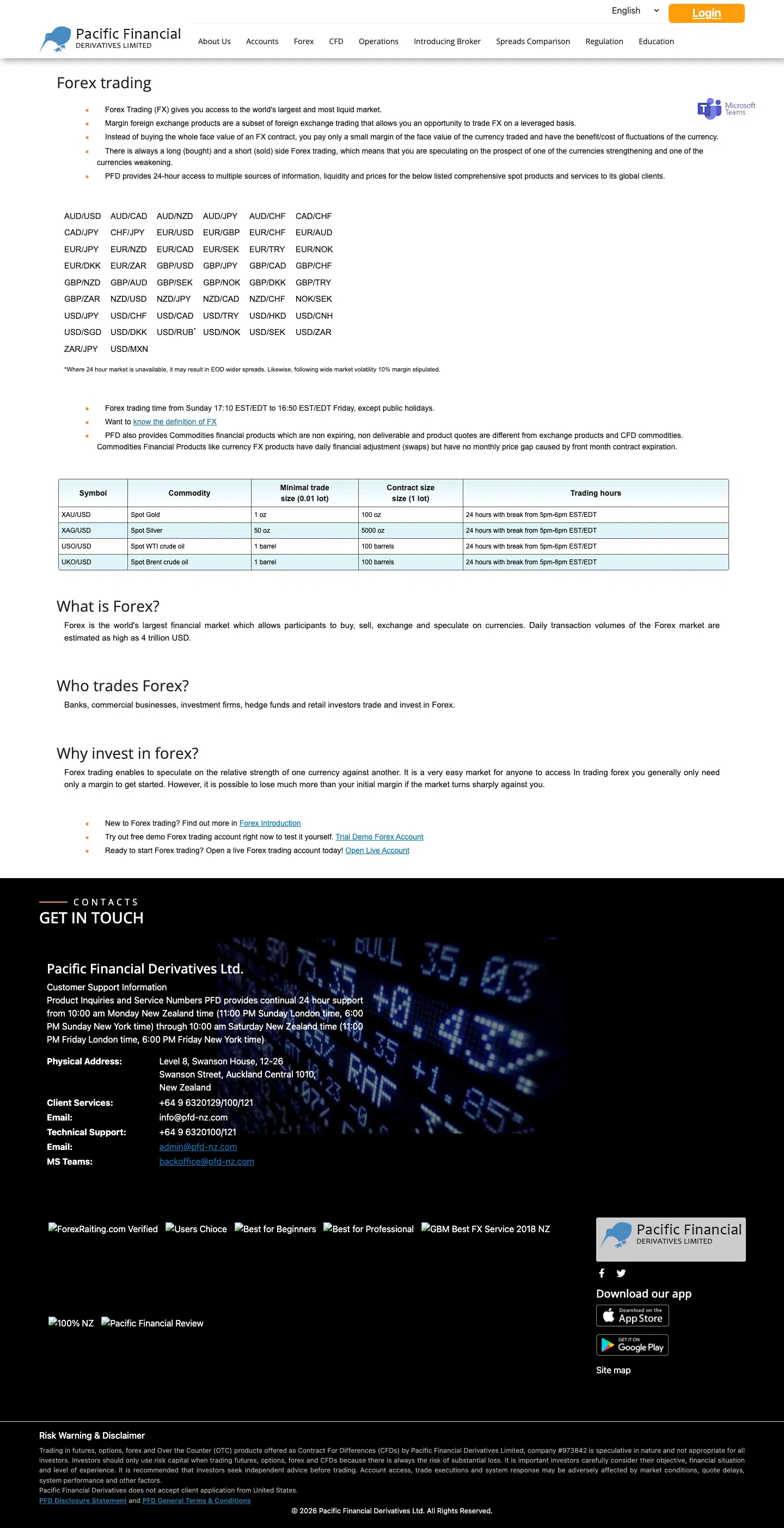
Each of the PFDTrader, PFDPro and PFDProPlus product lists on the company’s New Zealand website carries 56 forex pairs, 4 metals (gold, silver, platinum and palladium against the US dollar) and 2 spot crude oils, WTI and Brent, at a 5% margin. The Islamic (swap-free) list carries 42 forex pairs and 2 metals, gold and silver, and none of the four lists carries a cryptocurrency. How many instruments you can trade depends on which account you hold.
Pacific Financial Derivatives leverage and margin
If equity falls short of the required margin the client must either deposit additional funds or close out existing open positions (page 7). On the company’s New Zealand website, read in October 2026, PFDTrader and PFDPro carry maximum leverage of 300:1 while account equity is up to US$5,000 and 100:1 above that, PFDProPlus is set at 100:1, and the Islamic (swap-free) account runs up to 300:1.
How leverage interacts with margin on this account
Pacific Financial Derivatives fixes the margin call level at 100% on the lower leverage terms and closes contracts out if equity falls below 50%, and on the higher leverage terms it fixes the margin call level at 150% and closes contracts out if equity falls below 100% (page 8). When a margin warning is displayed on the client’s trading terminal, the balance bar turns red (page 8). In the event of a failure to make margin payments the company may reduce or close all open contracts without further notice, and the client will be liable for any shortfall (page 12). Stop loss orders are not guaranteed, and their execution depends on market volatility and liquidity (page 13).
Pacific Financial Derivatives customer support
Pacific Financial Derivatives lists the phone number +64-9-6320121 (page 17). Help desk cover runs 24 hours a day, from 10:00am Monday through to 10:00am Saturday, New Zealand time, as the company’s contacts page shows. Client services answers at [email protected], technical support at [email protected] and account opening at [email protected], alongside a National Toll Free line on 0800 000973, with MS Teams and Skype also listed on the contacts and support pages.
Should you open with Pacific Financial Derivatives?
Yes, if what you want is a retail account with a licensed derivatives issuer, because the licence and the statement are what you can verify, and the trust account terms are the kind of commitment I would read for. The FMA describes leveraged forex trading as borrowing money to place a bet, with the full borrowed amount repayable on a loss, and it says it regularly receives complaints and enquiries from consumers who have lost money in online forex trading.
Ask the company, before you deposit, which leverage and margin call terms would govern the account you intend to open at the equity you will hold, because its New Zealand site lets the account picked and the funds in it decide that tier. Get that answer in writing, then read the statement’s close-out terms against it and see whether the two match.
Pacific Financial Derivatives FAQs
Does Pacific Financial Derivatives Offer a Demo Account?
What Is the Initial Margin on One Standard Contract With Pacific Financial Derivatives?
Where Is Pacific Financial Derivatives Based?
What Does the FMA Derivatives Issuer Licence Oblige Pacific Financial Derivatives to Do?
Does Pacific Financial Derivatives Offer Any Platform Other Than MetaTrader 4?
Record log
| Record | Detail |
|---|---|
| FMA register read | 19 September 2026, licence status active. |
| Product disclosure statement | The statement is dated 11 June 2024 and we read it in full on 20 September 2026. |