




Our verdict on Zero Markets
I have read the company's New Zealand Product Disclosure Statement and the FMA register read on 19 September 2026. The company commits on page 21 to paying client money promptly into a client trust account with a bank in New Zealand, segregated from any money held for its own account, and to funding its hedging obligations from its own money rather than client money. What gives me pause sits beside them: money held on trust may be co-mingled into pooled trust accounts with other clients' money, and the company is solely entitled to all interest derived on invested client money (page 21).
Before depositing, I would establish three things for myself: the conversion spreads on profits held outside the nominated base currency, the stop out level and the margin call terms, and the bank wire charges on page 21.
Pros
- The licence is active and was granted on 27 August 2018 (FMA register, read 19 September 2026).
- Client money is held on trust in a segregated client trust account, separate from any money held for the company's own account (statement, page 21).
- The company does not use client money to meet its own hedging obligations (statement, page 21).
- Financial Dispute Resolution Services charges a complainant no fee (statement, page 22).
- The underlying instrument may be bullion, stocks, commodities, indices, cryptocurrencies or currencies (statement, page 2).
Cons
- Client money may be co-mingled into one or more pooled trust accounts with other clients' money (statement, page 21).
- The company is solely entitled to all interest derived on invested client money (statement, page 21).
- The company's creditworthiness has not been assessed by an approved rating agency (statement, page 19).
- There is no minimum time to meet a margin call and no limit to how often margin calls can be made (statement, page 12).
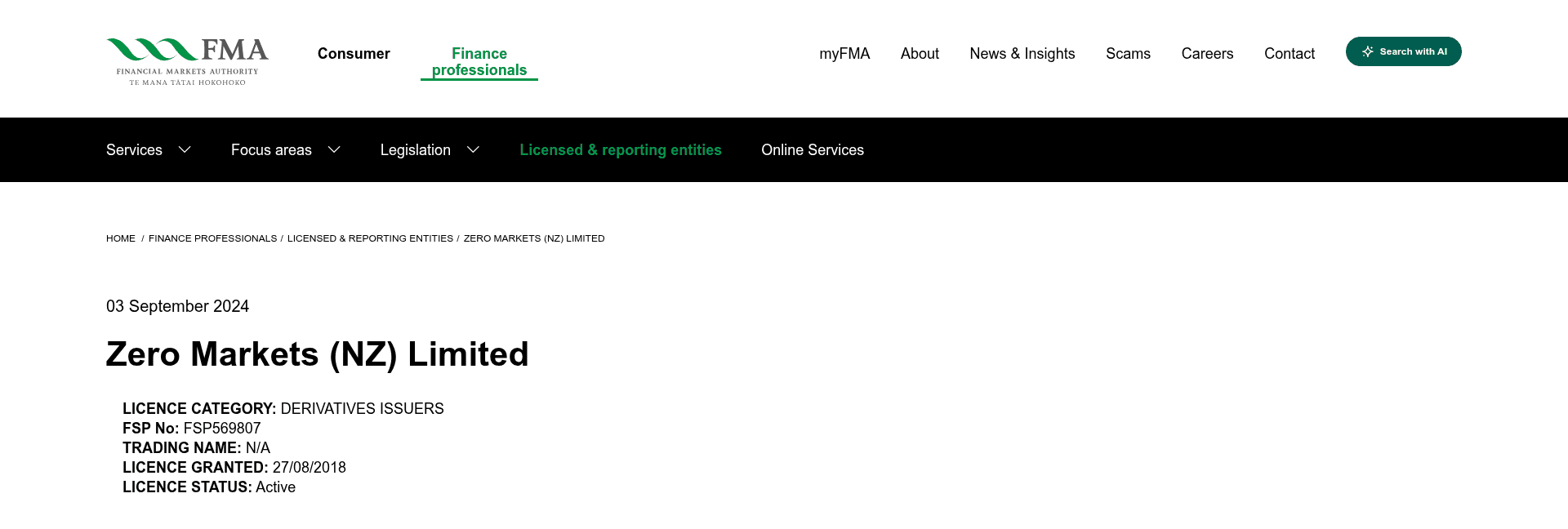
Is Zero Markets safe? FMA licence, Zero Markets (NZ) Limited
Yes, Zero Markets (NZ) Limited holds an active derivatives issuer licence from the Financial Markets Authority, granted on 27 August 2018. We read the FMA register on 19 September 2026 and confirmed both the licence and the company’s registration on the Financial Service Providers Register, FSP569807. The two are different things: that registration is an entry on the register, while the derivatives issuer licence is the authorisation that lets the company issue derivatives to a New Zealand client.
The register states that Zero Markets (NZ) Limited was previously known as Trademax Global Markets (NZ) Limited or Carrick Just Capital Markets Limited. The Financial Markets Authority says that trading forex through contracts linked to an exchange rate is trading a derivative, and that anyone offering those contracts in New Zealand must hold a derivatives issuer licence from the FMA. It classes retail forex trading as derivatives trading, not currency dealing. A licensed derivatives provider must give a client a product disclosure statement before they trade, and the FMA recommends New Zealanders avoid overseas forex services it has not licensed, even where an overseas regulator appears to cover them.
What the FMA licence covers
The statement says on page 22 that the company is regulated and licensed by the FMA as a derivatives issuer under the Financial Markets Conduct Act 2013, and holds a New Zealand derivatives issuer licence. That is the licence the FMA has granted to this company, and it is what you can check yourself on the FMA register.
The statement also says on page 22 that the FMA’s role in licensing derivatives issuers is limited, and does not imply approval or endorsement of the business, trading or solvency. I would read that limit as part of the licence itself.
FMA enforcement history
A search of fma.govt.nz on 21 September 2026 under 2 search terms returned no FMA enforcement action against this company: Zero Markets (NZ) Limited, Zero Markets.
Source: the Financial Markets Authority, fma.govt.nz, searched 21 September 2026.
Zero Markets client money protection and dispute scheme
A New Zealand client contracts with Zero Markets (NZ) Limited, a company incorporated in New Zealand.
Who a New Zealand client contracts with
Zero Markets (NZ) Limited, company number 6358657 and NZBN 9429047455450, is part of the Zero Markets Group (statement, page 22). At the time the statement was written the company had one hedging counterparty, Trademax Australia Limited, a separate company from the issuer (statement, page 21).
Where a New Zealand client’s money is held
Client money is paid promptly into a client trust account the company maintains with a bank in New Zealand, and is handled under regulations 238 to 250 of the Financial Markets Conduct Regulations 2014 (statement, page 21). It is held on trust in a segregated client trust account, separate from any money held for the company’s own account, and may be co-mingled into one or more pooled trust accounts with other clients’ money (statement, page 21). The company may invest money held on trust in term deposit investments, and says the placing of that money does not in itself affect a client’s ability to deal with or withdraw funds, though such amounts may not be immediately available (statement, page 21). The company is solely entitled to all interest derived on invested client money, and charges no fee for those term deposit investments (statement, page 21). The company does not use client money to meet obligations it incurs when hedging with its counterparties, and funds those from its own money (statement, page 21). The company does not accept client property (statement, page 21).
What happens if the company fails
The obligations owed to a client under the client agreement and the contracts are unsecured obligations, so the client is an unsecured creditor of the company (statement, page 19). The Financial Markets Authority names insolvency of the provider as a risk to read the statement for, and says a client may be an unsecured creditor. Should there be a deficit in the client trust account and the company become insolvent before it is topped up, the client is an unsecured creditor for the balance owing (statement, page 22). The company’s creditworthiness has not been assessed by an approved rating agency (statement, page 19).
How to complain, and who hears it
A complaint goes to the Compliance Officer in writing, by email to [email protected] or by letter (statement, page 22). If a complaint is not resolved to the client’s satisfaction within two months, the client has the right to lodge it with Financial Dispute Resolution Services, an approved independent external dispute resolution scheme in New Zealand (statement, page 22). FDRS charges no fee to a complainant to investigate or resolve a complaint (statement, page 22).
Zero Markets at a glance: 9 key facts
The table below gathers what the statement and the FMA register state about Zero Markets in one place: the licence, the entity, the costs the statement sets out, and where client money is held. Every entry carries its source and its page. It is a summary for checking details quickly, and the sections above and below carry the full terms.
| Fact | What the record says | Source |
|---|---|---|
| Contracting entity | Zero Markets (NZ) Limited | FMA register |
| FSP registration | FSP569807 | FMA register |
| Licence status | Active | FMA register |
| Licence granted | 27 August 2018 | FMA register |
| Address | the office is Suite C, Level 28, Tenancy 1, The Sap Tower, 151 Queen Street, Auckland CBD 1010, on +64 800 678 010 | Product disclosure statement, page 22 |
| Client money held at | client money is paid promptly into a client trust account the company maintains with a bank in New Zealand, and handled under regulations 238 to 250 of the Financial Markets Conduct Regulations 2014 | Product disclosure statement, page 21 |
| Close-out level | the company may in its reasonable discretion reduce exposure by closing out one or more or all open contracts without notice | Product disclosure statement, page 12 |
| Dispute scheme | the external scheme is Financial Dispute Resolution Services, an approved independent external dispute resolution scheme in New Zealand | Product disclosure statement, page 22 |
| Inactivity fee | a monthly account maintenance fee of 30 USD is triggered where the account’s net equity is below 500 USD and the account has had no trading activity for six months or more | Product disclosure statement, page 21 |
Zero Markets funding methods and withdrawals
Only cash or cash equivalent is accepted as opening collateral or funding (statement, page 11). If you were expecting to fund an account some other way, that is the rule the statement sets.
Deposit methods (NZ clients)
An account is funded by electronic or telegraphic transfer or another agreed means (statement, page 11). The company does not accept cash in hand or physical cash deposits into any of its bank accounts (statement, page 11).
Withdrawals
Deposits and withdrawals by bank wire to and from accounts outside New Zealand attract additional processing fees from the company’s bank and the receiving bank, higher again where intermediary banks are involved (statement, page 21).
Zero Markets accounts
The company may reject an account application at its sole discretion (statement, page 23). Before you are accepted, you must answer a Client Suitability Questionnaire covering your trading experience, your understanding of the key features of the products, your education or professional knowledge, and your ability to manage trading risks, and the company assesses your answers against qualifying criteria and accepts no client who falls short of them (statement, page 23). Commissions may be payable on trades in some products, with opening and closing commissions both charged upon opening, and a position rolled to the next trading day means you pay a swap charge or receive a swap benefit (statement, page 20). If you fund an account and then stop trading, watch the maintenance fee: US$30 a month applies where your net equity is below US$500 and the account has had no trading activity for six months or more (statement, page 21). Profits or losses accumulated in a currency other than your nominated base currency are converted at spreads that may be wider than those shown on the trading platform (statement, page 21). You must review the confirmation of contracts immediately and report any discrepancies within 24 hours (statement, page 14).
Minimum deposit
The statement says two different things about the minimum balance. Its list of the benefits of trading these contracts includes no account opening fees or minimum balance (statement, page 6), while the minimum balance to open an account is set out on the company’s website and may be varied at the company’s discretion (statement, page 10).
Zero Markets markets
The statement says on page 2 that the underlying instrument of these contracts may be bullion, stocks, commodities, indices, cryptocurrencies or currencies. Dealing spreads are applied on opening and closing, vary by market, and may be changed at any time, and the statement says on page 20 that they are wider for stock indices quoted outside normal market hours. A trading day runs Monday to Friday in trading platform time, which the statement says on page 28 is generally GMT+2 or GMT+3.
Zero Markets leverage and margin for New Zealand clients
The Financial Markets Authority describes leveraged forex trading as borrowing money to place a bet, with the full borrowed amount repayable on a loss. On this account the company may, in its reasonable discretion, reduce your exposure by closing out one or more or all open contracts without notice, and it chooses which positions close (statement, page 12). It may also, without prior notice, liquidate some or all open positions if your account balance reaches or falls below the stop out level (statement, page 17).
How leverage interacts with margin on this account
There is no minimum time to meet a margin call and no limit to how often margin calls can be made (statement, page 12). The company is not obliged to notify you of a margin call obligation, and may do so by email, phone call or otherwise as a courtesy (statement, page 12). Stop loss orders are not guaranteed, the company has absolute discretion on whether to accept one, and they may be executed at a different price or not at all (statement, page 9). Where an event of default occurs, the company may cap the number of open pending orders on an account, a limit currently set at 200 orders (statement, page 8).
Zero Markets customer support
Zero Markets (NZ) Limited gives its office on page 22 of the statement as Suite C, Level 28, Tenancy 1, The Sap Tower, 151 Queen Street, Auckland CBD 1010, and its phone number as +64 800 678 010. If your issue is a complaint rather than a query, the complaint route, its email address and the timetable for escalating a complaint are set out in the client money section below.
Should you open an account with Zero Markets?
Yes, if you would pass the suitability questionnaire and accept that your money may be pooled while you remain an unsecured creditor; no, if you need a guaranteed stop loss or a set time to meet a margin call.
The Financial Markets Authority’s own opening line is that forex trading for profit is very risky, and it says it regularly receives complaints from consumers who have lost money in online forex trading. I would satisfy myself that I would get through the suitability questionnaire at all, and read what the company may do with positions it decides to close. I would also confirm the complaint route and who hears a complaint if it goes wrong, and weigh the swap charge or benefit on a position held overnight against how I actually trade.
FAQs
Is Zero Markets licensed in New Zealand?
Does this site have a score or rating for Zero Markets?
Where is my money held if I open an account?
What happens if I have a complaint?
Testing log
| Record | Detail |
|---|---|
| FMA register read | 19 September 2026, licence status active. |
| Product disclosure statement | The statement is dated 13 January 2025 and we read it in full on 20 September 2026. |