
What Is The Difference Between The Standard Vs ECN Account?
The main difference between each account type is:
Standard account has no commissions as the broker’s costs are part of the spread. For this reason, spreads are wider than those of an ECN account.
ECN accounts charge a fixed commission for each lot traded in addition to the spread. Since the commission is not part of the spread, some currency pairs can be as little as 0 pips.
Experienced traders tend to benefit most from ECN accounts’ benefits as their costs are lower, even with the commission costs accounted for.
| Feature | ECN / raw account | Standard account | The difference |
|---|---|---|---|
| Cost | |||
| Spread cost, one standard lot of EUR/USD | US$1.00 median Source, read 2026-09-08 | US$9.00 median Source, read 2026-09-08 | US$8.00 more on Standard account |
| Commission, one standard lot of EUR/USD | US$3.50 median Source, read 2026-09-08 | US$0.00 median Source, read 2026-09-08 | US$3.50 more on ECN / raw account |
| Total cost, one standard lot of EUR/USD | US$4.50 median Source, read 2026-09-08 | US$9.00 median Source, read 2026-09-08 | US$4.50 more on Standard account |
| Accounts charging no commission | 0 of 20 Source, read 2026-09-08 | 5 of 5 Source, read 2026-09-08 | 0% against 100% |
| Cheapest account of this type on total cost | Tickmill, US$3.00 Source, read 2026-09-08 | Markets.com, US$6.00 Source, read 2026-09-08 | The two differ |
| Coverage | |||
| Accounts of this type priced in the dataset | 20 of 28 priced in USD Source, read 2026-09-08 | 5 of 14 priced in USD Source, read 2026-09-08 | |
Some of the abbreviations on this page are expanded to the regulator's full name: a broker regulated by ASIC is regulated by the Australian Securities and Investments Commission.
Every figure is a median over the accounts of that type our fee dataset prices, on EUR/USD, one standard lot, one trade, priced in USD, and each cell states how many accounts it covers. An account the dataset does not price in that currency is excluded from the median rather than counted as zero.
What Is An ECN Trading Account?
An Electronic Communications Network (ECN) trading account connects you directly to the liquidity providers (like banks, traders, and other market participants) without needing your broker to process it. Of the trading accounts available, I consider the ECN account to be the “professional-grade” option.
I find ECN trading accounts offer the lowest spreads as you’re seeing the real market prices directly from the interbank markets, with most majors available at 0 pips.
If you trade high volumes or day trade, an ECN account is the best option.
Brokers Offering ECN Accounts
Pepperstone
My go-to broker for its Razor account (which is their ECN account’s name) that offers 0 pips for certain currency pairs and 93 Forex pairs in total. You can trade using TradingView, MT4, MT5, and cTrader.
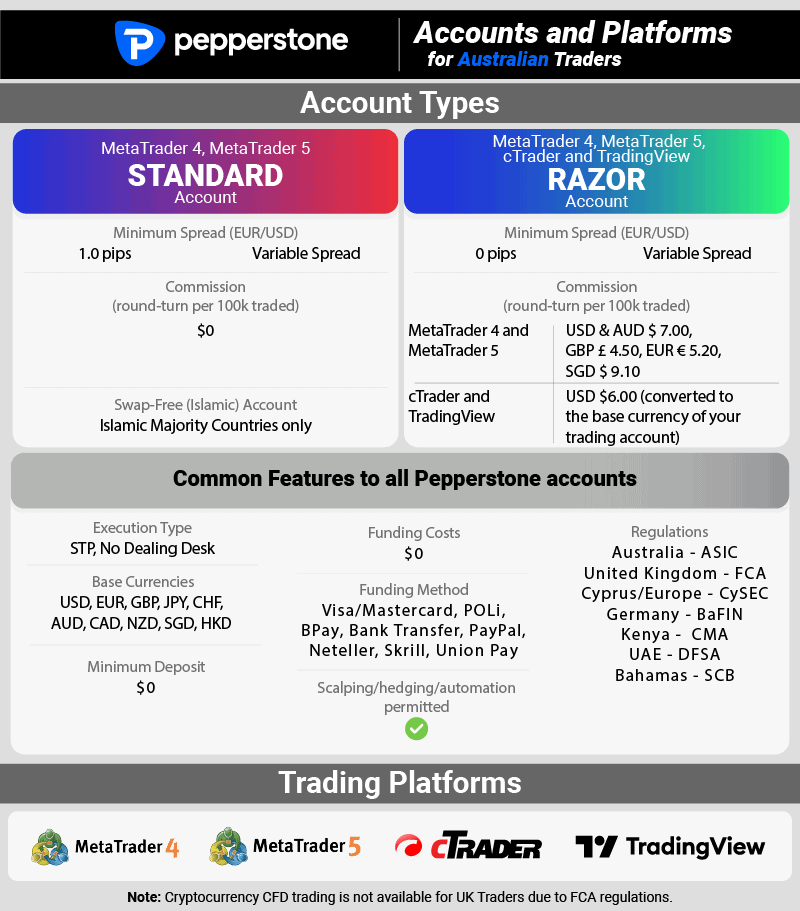
Pepperstone also has a Standard account. You can find out the differences between the two Pepperstone accounts in our Razor vs Standard review.
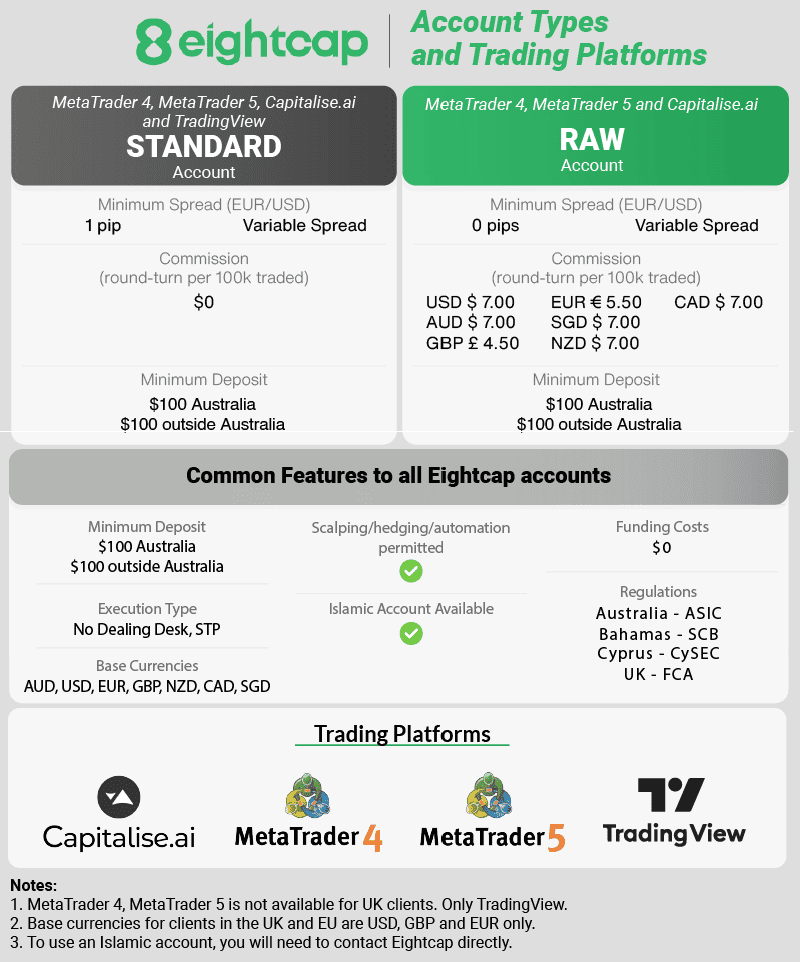
Eightcap
If you want to trade crypto along with forex, Eightcap provides a solid ECN account that gives you tight spreads from 0 pips and 95+ cryptocurrency and altcoin markets including Bitcoin and DOGE.
Fusion Markets
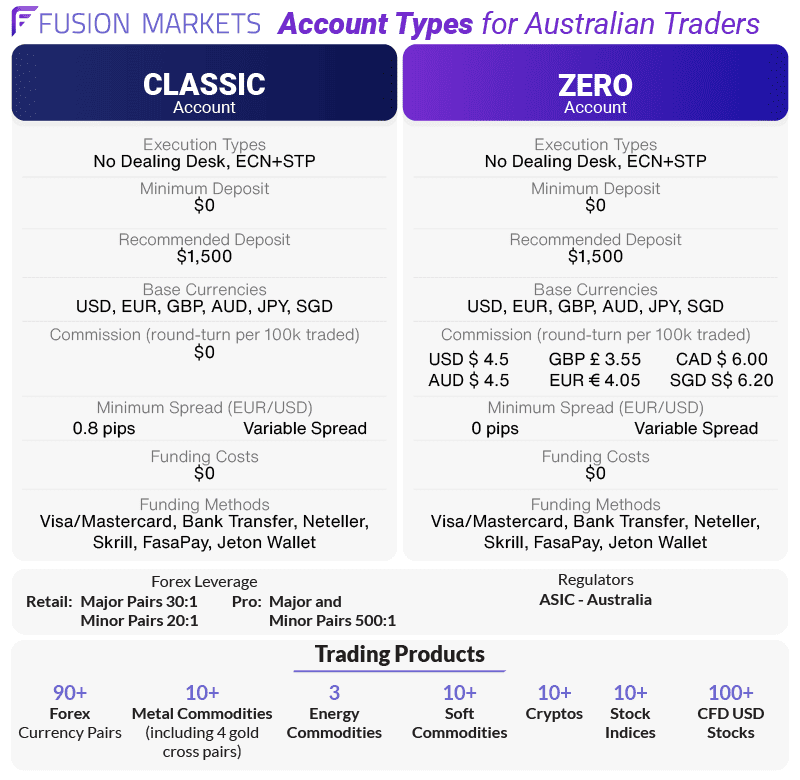
Fusion Markets is a decent pick if you want excellent trading conditions with some of the tightest spreads on its ECN account and low commissions (US$2.25). In our 2026 execution test, Fusion Markets filled market orders in 77 ms, ranking 1st of 36, and limit orders in 79 ms, ranking 3rd.
How Do ECN Accounts Work?
One advantage I’ve seen from ECN accounts is that they have fewer requotes compared to Standard accounts, and this is due to how they work. Instead of being placed as an “Instant Order” (fill or kill method), ECN accounts use Market Order that matches your order with the same price (or best available), providing no requotes.
Here’s a quick breakdown of the process:
- Your order gets transmitted straight to the ECN network (other traders and liquidity providers).
- The ECN matches your order with the best available quotes from the liquidity provider; this sometimes can be more (or less) expensive.
- You pay 0 to 0.5 pips (depending on your broker’s charges and markets) in addition to a small commission which varies from $2 to $4.50 depending on platform and broker.
The ECN account has a commission structure instead of a spread-only model, which typically ranges from $4.50-$7.00 per lot (round-trip). A round trip is the total cost of opening and closing a trade, so when brokers offer commissions at “$3.50” they mean it’s $3.50 per open plus close (I.E. $3.50 on each side).
How Do ECN Brokers Deliver Tighter Spreads?
ECN brokers can deliver spreads from 0 pips because the broker shows you the direct price feed from its liquidity providers. Since the spreads are rock low, it means spreads are unlikely to be marked up by the broker (which is why Standard account spreads are much wider).
ECN brokers can afford to do this as you pay a fixed fee (commission) for each trade instead of collecting the markup from the spread like Market Maker brokers do. By doing this, you get tighter spreads directly from the market, and the broker gets a commission for providing access.
What Is A Standard Trading Account?
A Standard account (sometimes called a Classic account) is the traditional approach to forex trading fees. You pay no commissions, but instead pay wider spreads than the ECN account, which can vary from 0.6 pips+.
I find the Standard account a beginner-friendly option as commission cost consideration doesn’t need to be factored when you open your position. This cost approach is more straightforward as you won’t have to ensure you’ve earned enough to cover the closing commission.
Brokers Offering Standard Accounts
IC Markets
In Ross Collins’s spread tests of standard accounts, IC Markets had the lowest EUR/USD spread of the 15 brokers, averaging 0.73 pips. You can benefit from the Standard account with ECN-style trading conditions across its 2,250+ markets.
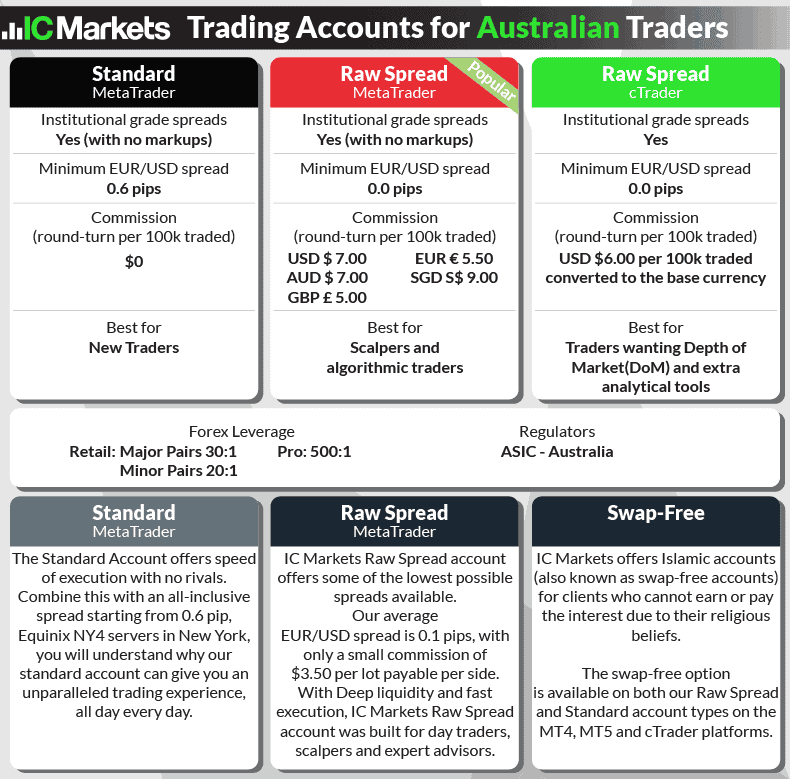
IC Markets also has a RAW account, you can find out more about the difference between IC Markets RAW vs Standard.
OANDA
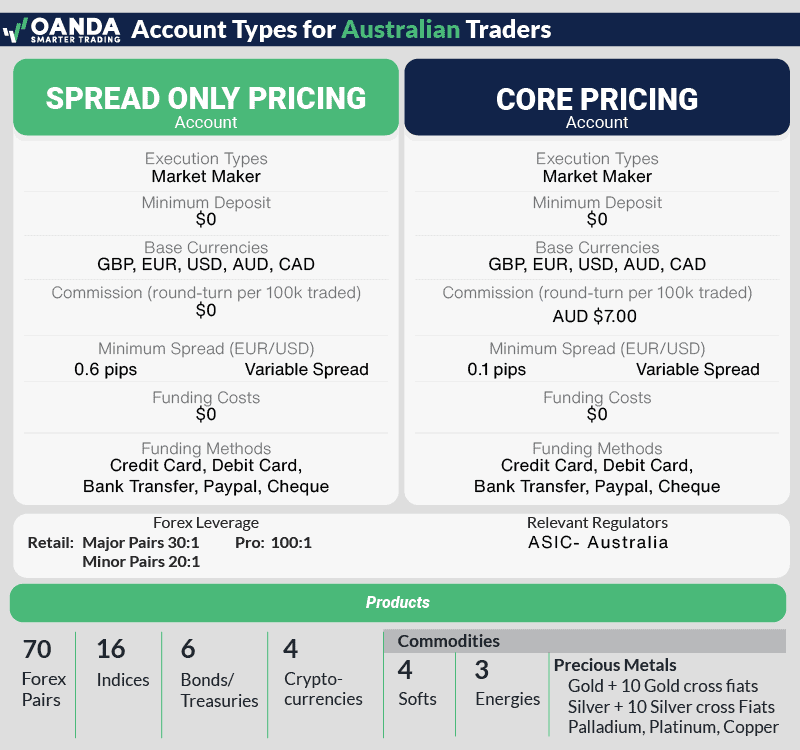
I think OANDA is the best for beginners as it has low spreads on its Standard account and no minimum deposit. With its OANDA Trade platform, it comes with TradingView charting and beginner friendly features like lower trade sizes (down to 1 unit).
IG Markets
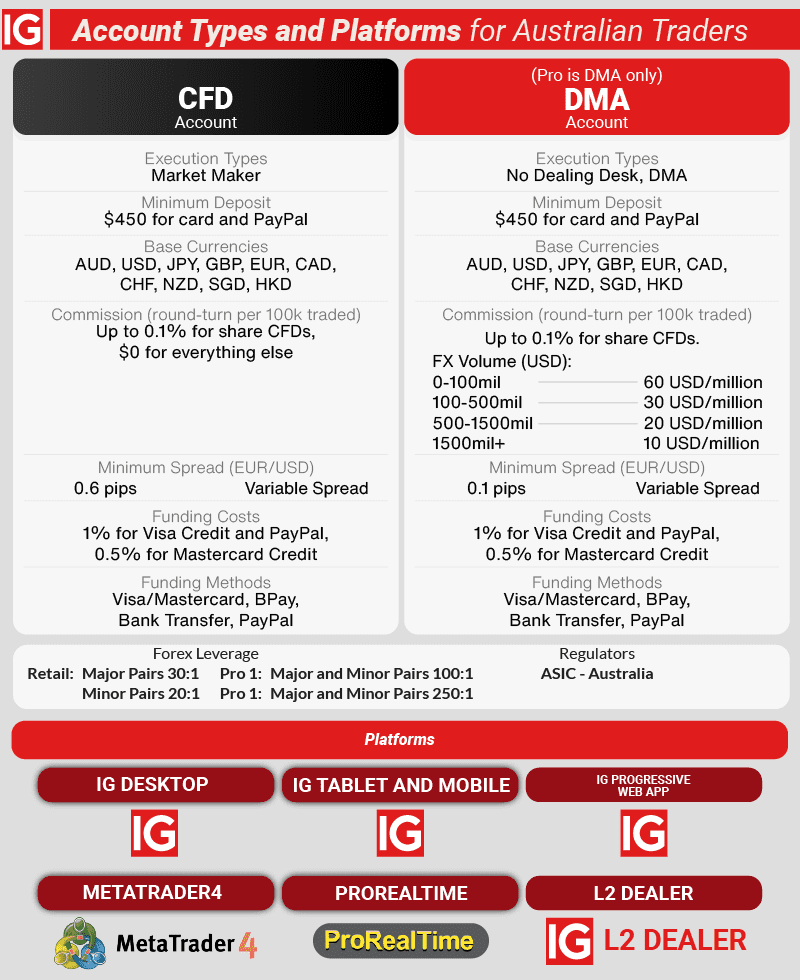
IG Markets offers the most trading products with over 17,000 markets including 100+ forex pairs, crypto, share CFDs, commodities, and indices. The spreads are competitive and their IG Trading platform has professional trading signals.
How Standard Accounts Work
Standard accounts are the easiest to work with as you pay the spread, which is the difference between the buy and sell price before opening a trade. What happens after opening a position is you’ll see your current PnL in the negative, this reflects the amount paid for the spread.
For example, if I were to open a 1 lot trade for EUR/USD with a 1 pip spread, I’d expect my opening PnL to be -$10. It’s perfectly natural for your trades to open in the negative with Standard accounts.
When you see $0+ in your PnL, it means you’ve covered the spread and have broken even or made a profit.
This is why I recommend Standard accounts to beginners as they’ll see their actual profit or loss, while ECN accounts have to deduct their commissions. For new traders, this could lead to mistakes by closing a profitable position before covering the commissions.
How do ECN and standard accounts differ?
At its core, the fundamental difference between each account type is the pricing structure. I’ve discussed. ECN accounts have tighter spreads (from 0 pips) and commissions per lot, while Standard accounts are spread-only.
The table above compares the cost of trading one standard lot of EUR/USD on each account type, using figures drawn from our fee dataset.
When choosing between the two options, I feel that the ECN account is an easy pick if you’re an experienced trader due to the direct market access. You get tighter spreads and faster execution type, ensuring no orders are requested, helping you execute all your trades and preventing missed opportunities.
The no commissions on the Standard account are appealing as they simplify the pricing structure, making it easier to read whether you’re making a profit or losing on your open trades.
I prefer to use ECN accounts as my strategies consist of breakout trading and scalping to benefit from the tighter spreads. However, both options are viable for all trading types.
Similar Features Between The ECN vs Standard Account
1. Straight-through processing with no dealing desk
Both trading accounts can use Straight-through Processing (STP) with no dealing desk. If your trading account is with an ECN broker like Pepperstone or IC Markets, their trading accounts are STP, which gives you fast execution speeds.
I recommend choosing a broker with this execution model, as slow execution speeds can lead to market slippage, which you would want to avoid. Slippage can wipe out your profits or double your losses if the price moves in the wrong direction, forcing your stop loss to exit at a worse price.
2. Access to all financial instruments
One to note is that even if you use an ECN trading, some financial instruments may still use spread-only trading. While Forex markets and commodities may be available with and without commissions, some products like crypto and indices only have spread-only pricing.
3. Trading Platforms
With both account types, you can use any third-party trading platforms, which include:
- MetaTrader 4
- MetaTrader 5
- cTrader
- TradingView
- ProRealTime
- NinjaTrader
However, I notice that some brokers limit trading accounts to different platforms, so double-check your account is available for your platform of choice.
For example, I’ve seen TradingView as an option for ECN accounts only, forcing you to open an ECN account if you want the advanced charting tools from TradingView.
4. Trading Size
Both account types let you trade the same lot sizes, including micro (0.01), mini (0.1), and standard (1.0) lot sizes, allowing you to tailor your risk management.
ECN account commissions are quoted for standard lots ($3.50), so you’ll be charged less if you trade lower lot sizes.
- Standard lot, $3.50
- Mini lot, $0.35
- Micro lot, $0.035.
These figures will also multiply by the number of lots traded.
5. Leverage
I’ve noticed that leverage (or margin) is not tied to the account type; instead, it’s linked to the asset and who the broker is regulated by. Australian traders fall under ASIC’s jurisdiction, so ECN and Standard accounts are limited to 1:30 on forex majors.
6. Negative Balance Protection
Retail forex traders have extra measurements in place through the Negative Balance Protection to prevent your account from falling below $0. While you don’t want to lose on your trades, Negative Balance Protection as least ensure you are not left owing the broker money which can crippling if you use high leverage.
Both accounts have this as it is a requirement for all regulated forex brokers, and it works by liquidating your positions as you get closer to a $0 balance. If the market is volatile and has a large spike, taking you below $0, regulated brokers will absorb the losses.
Just note that if you’re using a Professional account (available in Australia, the UK, Europe, and the UAE), you will lose this protection in favour of higher leverage.
7. Scalping/hedging
Both trading account types allow these strategies. For scalping, the ECN account is better thanks to its tighter spreads, which makes it faster to cover the spread and turn a profit faster.
8. Automation / Social Trading / Copy Trading
You have access to automation, social, and copy trading services on both accounts. Instead, these are trading platform features, so you are only limited to the broker’s platform selection.
Most brokers have MetaTrader 4, giving you access to automated trading through the Expert Advisors. For social trading, TradingView is my favourite platform, where you can view other people’s technical analyses and engage with others in chat rooms.
Copy trading is the least available, with some platforms offering bespoke tools like eToro’s CopyTrader, ZuluTrade, or DupliTrade.
With all of the features mentioned above, you’ll find they support both Standard and ECN accounts.
ECN vs Standard Account Trading Costs
Comparing the trading costs between the two accounts can be difficult due to external commissions and tight spreads, meaning there is no direct comparison. That is why I use the “Effective Spread Cost” to demonstrate the costs directly and clearly, showing the true trading costs for both accounts.
The Effective Spread Cost
Due to commissions being an “external” fee to your trades, they can contaminate the true cost of the account when comparing spread-only with ECN accounts. So to demonstrate this, the Effective Spread Cost follows the formula to convert it into a “spread-only” cost.
Based on a standard lot size (100,000 units), we know 1 pip is roughly $10 per pip:
ECN Effective Spread Cost (ESC) = Spread + Commission (round-trip)
So if you traded 1 lot EUR/USD with a spread of 0.10 pips and a $3.50 per lot traded ($7.00 round-trip), I can put that into my formula as:
ECN ESC = 0.1 pips + $7.00
On EUR/USD $7.00 is the same as 0.70 pips on a Standard account, and for every 0.1 pip is $1 in terms of commissions. So to translate this into a “spread-only” price, we can add the 0.70 pips to 0.10 pips, equaling 0.80 pips as the Effective Spread.
The Effective Spread = 0.80 (0.1 + 0.70)
In this example, the ESC gives a 0.80 pip spread, which is $8.00 in trading fees for trading the EUR/USD with 1 lot. If the Standard account has a 1 pip spread, that equates to $10.00 in trading fees.
Now when you compare the spreads with a Standard account, you can see how much cheaper (or expensive) the spreads are before choosing which account.
The Trading Cost Comparison
With that cleared up, it’s easy to understand the comparison between the accounts. I will use some of the lowest-spread brokers to help demonstrate the differences from Ross Collins’s Raw (ECN) and Standard spread tests.
| EUR/USD Tested Spreads | ECN Account | Standard Account | Difference |
|---|---|---|---|
| Pepperstone | Spread: 0.19 pips Commission: $7.00 (Round-trip) | 1.21 | ECN account is 0.32 pips cheaper |
| IC Markets | Spread: 0.19 pips Commission: $7.00 (Round-trip) Effective Spread: 0.89 | 0.73 | Standard account is 0.16 pips cheaper |
| Fusion Markets | Spread: 0.16 pips Commission: $7.00 (Round-trip) Effective Spread: 0.89 | 1.01 | ECN account is 0.12 pips cheaper |
As you can see, Standard accounts can be cheaper than their ECN counterparts, but it is rare. Comparing the two, ECN accounts are generally more affordable even when paying the commission.
It’s important to show it this way as you can see with Pepperstone’s ECN accountyou’ll save 0.32 pips (or $3.20) per lot traded compared to its Standard account. This cost difference is a large saving, and will save you a fortune over time, especially if you’re an active trader.
Which Brokers Offer The Lowest ECN Account Spreads?
The Top 3 ECN Account Spread Brokers Are:
- Fusion Markets
- StoneX Trading
- IC Markets
Special Mention: Pepperstone’s Razor account offering variable spreads starting from 0 pips. Our Chief Technology Researcher, Ross Collins, has developed his own tests, which capture average RAW account spreads at MetaTrader 4 brokers, to find the lowest spreads for ECN brokers. Ross found that Fusion Markets had the lowest overall ECN spreads, averaging 0.22 pips across the major pairs, beating the industry average by 55%. Other stand-out brokers include IC Markets and Pepperstone, who also generated low average spreads of 0.32 and 0.36, respectively.
| Tested Raw Spreads | Tested Raw Spreads |
|---|---|
| Broker | Combined for major pairs |
| Fusion Markets | 0.22 |
| StoneX Trading | 0.25 |
| IC Markets | 0.32 |
| TMGM | 0.32 |
| Pepperstone | 0.36 |
| FP Markets | 0.41 |
| Blueberry Markets | 0.43 |
| GO Markets | 0.46 |
| ThinkMarkets | 0.46 |
| Tickmill | 0.47 |
| Eightcap | 0.5 |
| Axi | 0.73 |
| CMC Markets | 0.73 |
| Admirals | 0.79 |
| BlackBull Markets | 0.94 |
| Tested Average | 0.49 |
| Broker | AUDUSD | EURUSD | GBPUSD | USDCAD | USDCHF | USDJPY | Grand Total |
|---|---|---|---|---|---|---|---|
| Pepperstone | 100.00% | 100.00% | 100.00% | 100.00% | 100.00% | 100.00% | 100.00% |
Which Brokers Offer The Lowest Standard Account Spreads?
The Top 3 Standard Account Spread Brokers Are:
- IC Markets
- CMC Markets
- Fusion Markets
Our Testing and Results
Like our ECN spread tests, Ross also compared theaverage spreads of the Standard account across 15 brokers.
IC Markets is the clear winner, averaging 1.03 pips across the major pairs tested, beating the industry average by ~31%. A highlight for me was EUR/USD on IC Markets, where the broker averages 0.73 pips, which was cheaper than its ECN account (0.89 pips effective spread).
| Tested Standard Spreads | Tested Standard Spreads |
|---|---|
| Broker | Combined for major pairs AUDUSD, EUR/USD, GBPUSD, USD/CAD, USDCHF) |
| IC Markets | 1.03 |
| CMC Markets | 1.11 |
| Fusion Markets | 1.19 |
| TMGM | 1.21 |
| Admirals | 1.31 |
| Pepperstone | 1.46 |
| FP Markets | 1.47 |
| FXCM | 1.47 |
| Go Markets | 1.49 |
| Eightcap | 1.51 |
| OANDA | 1.54 |
| Axi | 1.71 |
| StoneX Trading | 1.79 |
| Blackbull Markets | 1.82 |
| FxPro | 2.22 |
| Tested Average | 1.49 |
As IC Markets is an ECN broker (but has RAW and standard Account types), it’s a clear demonstration that this execution model provides the best spreads for both ECN and standard accounts due to the broker claiming top spots for both account types.
The more expensive brokers tend to be market makers, which is something to note when choosing a forex broker.
Which is better, an ECN or a standard account?
This will be a personal decision, as each account will reflect your trading style, experience, and preferences. However, I will shed some light on the subject based on my experience.
Choosing The ECN Account
I typically recommend ECN accounts for anyone trading several times a week, as this has a larger impact on trading costs compared to those who trade once a week (or month). However, there are other greater benefits to using an ECN account, which I’ve highlighted in this article.
ECN accounts have spreads from 0 pips, making them the tightest available for forex trading. The lower spreads make it quicker for scalpers and day traders to cover their spreads, placing you in a profitable position faster. This is a big positive if you’re in a trade for 30 seconds or so.
The fixed commissions stabilise your trading costs during volatile trading periods, allowing for consistent costs during the day and avoiding price spikes during high-impact economic news announcements. Stable trading costs make the ECN account a top contender for algorithmic trading as you can easily account for the fees, regardless of volatility.
Finally, a positive for all trading types is that ECN accounts typically have better trading conditions with faster execution speeds as the broker will provide a STP execution model.
Choosing The Standard Account
The Standard account is ideal for newer traders as your trading costs will be taken directly out of the trade you open, simplifying the process.
One of the main benefits in my eyes is that the PnL on your trading screen includes the spread, making it much easier to see if you’re profitable or not.
ECN accounts show the external commissions outside your PnL on some platforms (like MT4), meaning you have to make mental adjustments to include the commissions with your PnL. I see this as potentially leading to mistakes and new traders closing positions too early, not considering the closing commission.
Other than that, Standard accounts are subject to the same trading conditions as their ECN accounts counterparts (if you use ECN brokers). If you choose a Market Maker style broker, pricing and execution speeds will differ.
FAQs
Is ECN or Standard More Popular?
Which is better ECN or Standard account?
Which is better ECN or STP?
What are the disadvantages of ECN?
About the author

Justin Grossbard is the Co-Founder and CEO of CompareForexBrokers, which he established with Noam Korbl in 2014. He has over 20 years of professional experience in online marketing and holds a Master's in Marketing from Monash University.
Our reviews are reader-supported. We may receive payment when you click a link to a partner site. Learn how we make money.