
Some of the abbreviations on this page are expanded to the regulator's full name: a broker regulated by ASIC is regulated by the Australian Securities and Investments Commission.
Before you open up a live account with the Pepperstone brokerage and start trading, it’s worth having a decent understanding of how leverage works across various regions, markets, and products. We’re going to give a detailed breakdown so that you know exactly what rules and restrictions will apply to your trades.
What is leverage?
Leverage is when you’re able to trade with a greater amount than your actual account balance. It basically involves using borrowed capital to make a trade. You can use a smaller amount of upfront funds to gain larger exposure in a particular trade. The benefit is that you can potentially maximise your returns, but the downside is that it can also amplify losses.
When you look at leverage figures, they will be displayed as a ratio. So, 1:1 would mean no access to leverage with a trade. A leverage of 50:1 would mean the broker will lend you $50 for every $1 you place in your trading account. Put another way, to make a trade of $50,000, you need to use at least $1,000 of your own collateral. This means you need an initial margin of 2% in your trading account.
The difference between leverage and margin
It can be confusing when you start learning about using leverage or Margin Trading, but they are closely linked. Put simply, margin is collateral for leverage. You use margin to create leverage and the leverage is then used to trade larger positions than what’s in your trading account.
While margin is expressed as a percentage, leverage is expressed as a ratio. For example, if you wanted to trade 100,000 EUR/USD with a 2% margin, you would only need to deposit $2,000. Thus, the leverage provided for this trade would be 50:1
To calculate leverage, there is a simple formula: Leverage = 1 / Margin Requirement. So, for a margin requirement of 2%, leverage would be 1 / 0.2 which is 50, expressed as 50:1. In this way, leverage has an inverse relationship to margin.
Pepperstone leverage overview
The three key areas that will impact the level of leverage you can access on the Pepperstone trading platform are:
- Where you’re based, and the Pepperstone subsidiary you use (impacting financial regulation).
- The asset or product you want to trade.
- Whether you’re a retail or professional trader.
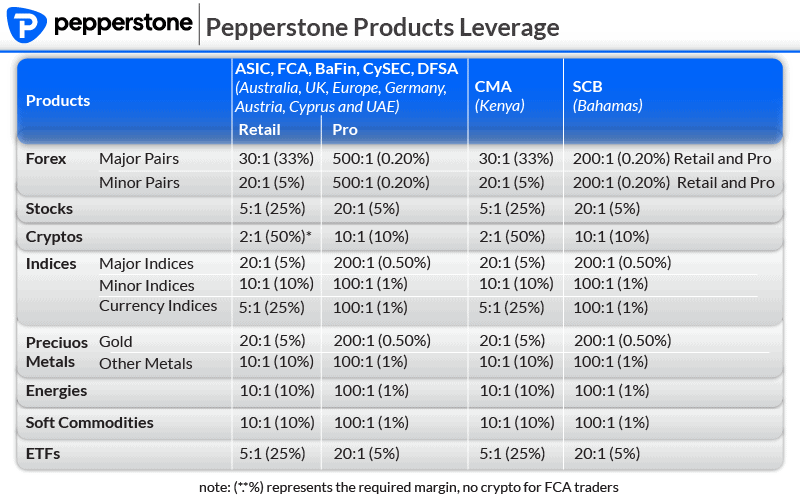
Below is an overview of the leverage limits in place for traders using Pepperstone:
Pepperstone Review Visit Pepperstone
Why leverage differs in different countries
Each country has its own financial regulator. For Pepperstone (or any forex broker) to offer trading services in the country, a licence from the financial regulator is required. Some regulators set a maximum limit forex brokers can allow for trading. For this reason, leverage can differ depending on which country you are trading from.
Pepperstone offers the maximum allowable leverage that the licence they hold permits. So, whatever the maximum leverage permitted by your relevant jurisdiction is, Pepperstone will allow you to access this leverage figure.
Traders operating from Australia, Europe, the UAE, or the UK fall under what’s referred to as top-tier regulators. Brokers regulated by top-tier regulators offer the highest level of safety or protection to their clients. Retail limits are identical under ASIC, the FCA, and CySEC, 30:1 on forex majors for example, except that crypto CFDs are not available to retail clients under the FCA, while UAE retail accounts sit on the UAE CMA route, which the firm recommends for all UAE traders, with Pepperstone Markets Limited as product issuer and a default leverage of 200:1. Professional limits, meanwhile, differ from entity to entity. For more details, you can read our assessment of Pepperstone Safety.
You will also find they distinguish between retail traders and ‘professional’ traders. While qualification for a professional trading account varies between regulators, they all recognise professional traders are better equipped to handle the risk involved with trading with high leverage.
In case you’re wondering, the Capital Markets Authority (CMA) of Kenya will be the overarching regulatory body whose jurisdiction you fall under if you’re a trader based in Africa.
United States and Canadian residents cannot open a Pepperstone account. Everyone else outside Africa, Australia, Europe, the UAE, and the UK, in Malaysia or Singapore for example, comes under Pepperstone Markets Limited, an entity based in The Bahamas and regulated by the Securities Commission of The Bahamas (SCB). This means that the leverage thresholds and limits of the SCB would apply and this differs from the so called tier-1 regulators.
If you come under the regulation of the CMA, there’s no distinction between ‘retail’ and ‘pro’ traders. The SCB licence is different, with leverage there depending on whether you are a retail or pro client: retail forex sits at 200:1, the firm’s tables give pro traders 500:1, and its professional page and tiered margin document both list up to 1,000:1.
Pepperstone Review Visit Pepperstone
Pepperstone leverage trading across markets and products
To give you a more detailed breakdown of the various leverage limits when trading different CDDs and markets using the Pepperstone brokerage, we’re going to explain all the nuances so that you’re fully informed about what you can and can’t trade when using the platform.
With the exception of shares, you can trade all these products with the trading platforms Pepperstone offer, MetaTrader 4 (MT4), MetaTrader 5, cTrader, TradingView. Share CFDs run on the Pepperstone Platform, MT5, TradingView, and cTrader, but not on MT4. Should you wish to automate your trading, you can use MetaTrader Signals or integrate Capitalise.ai with MT4. UK clients have no copy or social trading at all, while the SCB entity offers two copy trading services: CopyTrading by Pepperstone, which runs on the web platform and mobile app, copying trades to MT4 or MT5, and cTrader Copy, which sits inside cTrader. Social trading, meanwhile, is available with Myfxbook.
Forex trading leverage
Forex trading is at the core of what Pepperstone offers customers looking to trade on the platform. The firm’s account tables list 93 forex CFDs across major, minor, and exotic pairs, with the UK tables also listing 91 forex spread bets.
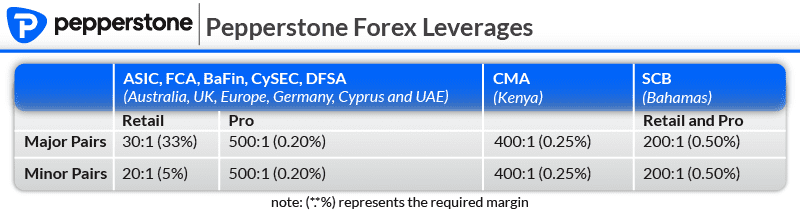
This is what the maximum leverage thresholds look like for different types of forex trading:
- Major currency pairs, this includes the likes of EUR/USD, GBP/USD, USD/JPY, UDF/CHF and some additional currency pairs. For these popular Major Forex Pairs, retail traders in Australia, the UK, and Europe face the same caps under ASIC, the FCA, and CySEC, 30:1 on major pairs and 20:1 on minor pairs, while UAE retail accounts on the UAE CMA route have 200:1 on both major and minor pairs.
Pro traders located in these regions can use up to 500:1 leverage. SCB forex leverage splits by client status, with retail traders at 200:1 and pro traders at 500:1 in the firm’s tables and up to 1,000:1 on its professional page, while forex traders based in Africa can use up to 400:1.
- Minor and exotic currency pairs, these are the less-traded currency pairs and some examples include CAD/CHF, CAD/JPY, CHF/JPY, EUR/CAD. Under ASIC, the FCA, and CySEC, retail traders in Australia, the UK, and Europe have 20:1 on minor pairs, below the 30:1 cap on majors, while the UAE CMA route holds minors at 200:1, the same as its majors.
Pro traders have the same ability to use 500:1 leverage as with the major pairs. Forex traders who come under SCB or CMA regulation have the same leverage as with major pairs, 200:1 and 400:1 respectively.
When trading Forex, Pepperstone offers two types of trading accounts. The first is the Standard account which is a spread-only account (aka no commissions) and the Razor account which Pepperstone commission fees are $7 round-turn for each 100,000 lot.
Pepperstone Review Visit Pepperstone
Leverage for stock trading
If you’re planning on trading stock CFDs using Pepperstone, the leverage limits are easy to grasp. Traders on Pepperstone who use the MetaTrader 5 (MT5) platform, cTrader or TradingView forex trading platforms are able to trade over 1,000 different stocks and shares for both long and short positions.
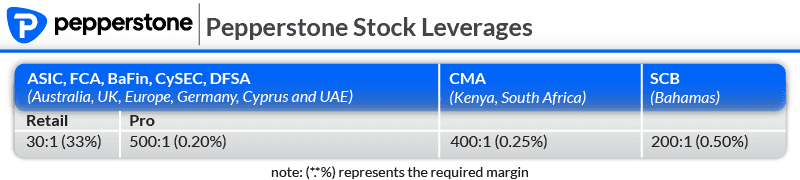
For retail traders under ASIC, the FCA, and CySEC, share CFD leverage sits at 5:1, with the UAE CMA route at 20:1 for its retail accounts. Professional traders have 20:1 under ASIC, the FCA, CySEC, and the UAE CMA route.
Outside the top-tier regulators, SCB clients have 20:1 leverage on share CFDs, whether retail or professional. Those who are regulated by the CMA can use up to 400:1 leverage for stock CFD trading.
Pepperstone Review Visit Pepperstone
Index leverage limits
Pepperstone allows you to trade 24 major and minor global market indices (such as the US 500, the UK 100, and the AUS 200), along with 3 currency indices, and 3 crypto indices.
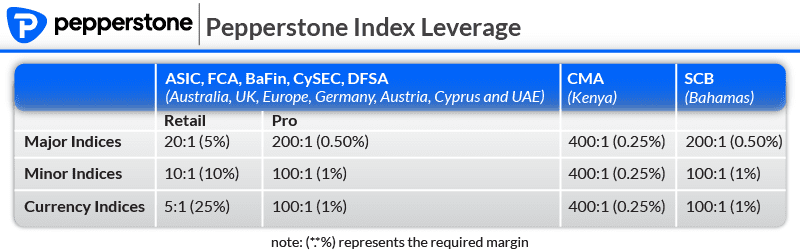
When trading the range of index CFDs available on Pepperstone, your leverage limits are described below.
Top-tier regulators (Australia, Europe, UAE, UK)
Retail traders on the UAE CMA route have 200:1 on major and currency indices and 100:1 on minor indices. For retail traders under ASIC, the FCA, and CySEC, your maximum leverage for trading indices CFDs is as follows:
- Major indices, 20:1
- Minor indices, 10:1
- Currency indices, 5:1
- Crypto indices, 10:1 (except in the UK)
For pro traders who fall under top-tier regulators, your leverage limits will be:
- Major indices, 500:1 under the FCA, CySEC, and the UAE CMA route, with ASIC split between 500:1 and 400:1 across the firm’s two Australian pages
- Minor indices, 100:1
- Currency indices, 100:1
- Crypto indices, 10:1
Traders under SCB supervision (rest of world)
- Major indices, 200:1 for retail traders and 500:1 for pro traders
- Minor indices, 100:1
- Currency indices, 100:1
- Crypto indices, 10:1
Traders under CMA supervision (Africa)
- Major indices, 400:1
- Minor indices, 400:1
- Currency indices, 400:1
- Crypto indices, 10:1
Pepperstone Review Visit Pepperstone
Commodity leverage limits
Pepperstone allows you to trade different types of commodity CFDs on the platform that can be split into categories:
- Hard commodities, like precious metals and energy.
- Soft commodities, this includes grown agricultural goods and livestock.
The type of commodity you’re looking to trade can impact the leverage that’s available to you. Varying limits apply to traders who want to buy and sell CFDs for metals, energy, or soft commodities.
Pepperstone Review Visit Pepperstone
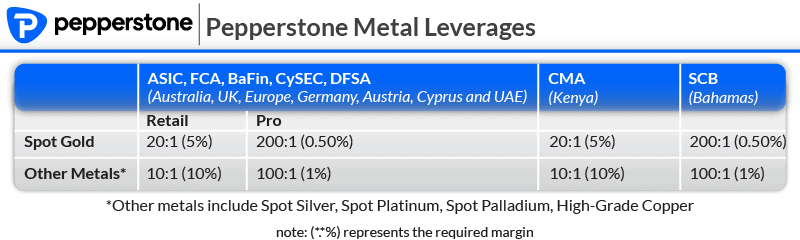
Metal trading leverage
If you’re interested in trading precious metals like gold, or industrial metals like copper, here’s what level of leverage you can access:
- Top-tier regulated retail traders, 20:1 for Best Brokers for Gold CFD Trading and 10:1 for other metals such as silver, platinum, palladium, and copper, both under ASIC, the FCA, and CySEC, though the UAE CMA route is the exception, with gold at 200:1 and other metals at 10:1 there too.
- Top-tier regulated pro traders, gold at 500:1 under ASIC, the FCA, CySEC, and the UAE CMA route, while other metals run at 50:1 under the FCA, CySEC, and the UAE CMA route, and 10:1 under ASIC.
- CMA regulated traders in Africa, 20:1 for spot gold and 10:1 for other metals.
- SCB traders in the rest of the world, gold at 200:1 for retail traders and 500:1 for pro traders, with up to 1,000:1 on the firm’s professional page, and other metals at 10:1 for retail traders and 50:1 for pro traders.
Pepperstone Review Visit Pepperstone
Leverage for energy CFDs
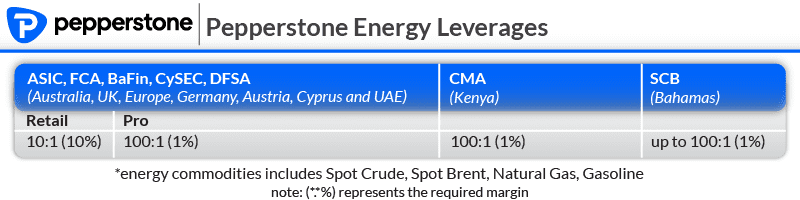
If you’re looking to trade energy CFDs, the Pepperstone brokerage allows you access to the following commodities:
- Crude oil
- Brent oil
- Natural gas
- Gasoline
Energy CFDs run at 10:1 for retail traders under ASIC, the FCA, and CySEC, and at 20:1 on the UAE CMA route. Pro traders have 200:1 under the FCA and CySEC, and 20:1 under ASIC and the UAE CMA route. The firm’s two Australian pages disagree on the ASIC figure, with its professional page showing 50:1 for commodities other than gold against the 20:1 in its costs table.
Traders based in Africa (CMA) have a 100:1 limit on energy CFDs. The SCB figures depend on which firm page you read, because the firm’s own sources disagree: the table on its professional page lists energies at 20:1 for retail and professional clients, its costs table gives commodities other than gold 50:1 for both client groups, and its retail tiered margin document sets spot Brent, spot crude, and oil futures at 200:1 in the first tier, with natural gas and gasoline at 20:1.
Pepperstone Review Visit Pepperstone
Soft commodity leverage
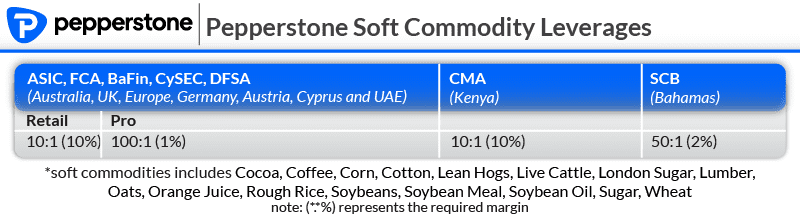
Soft commodities sit at 10:1 for retail traders under ASIC, the FCA, and CySEC, and at 50:1 on the UAE CMA route. Pro traders have 50:1 under ASIC, the FCA, CySEC, and the UAE CMA route.
For traders who fall under the supervision of the CMA, your leverage limit for soft commodities will be 10:1. And, for traders operating within the SCB regulated Pepperstone subsidiary, your leverage limit will be 50:1 if you’re looking to trade items such as Cocoa, Coffee, Live Cattle, or Lumber (for example).
Pepperstone Review Visit Pepperstone
ETF leverage
Pepperstone also offers clients the ability to trade ETF (exchange-traded fund) CFDs. ETFs operate in a similar way to an index fund, except that these investment products are openly traded on stock exchanges.
An ETF contains a basket of different investments, allowing you to gain exposure to a whole bunch of assets with a single trade. The key difference between trading standard ETFs and ETF CFDs is that with the CFDs, you’re able to use leverage to potentially boost your profits.
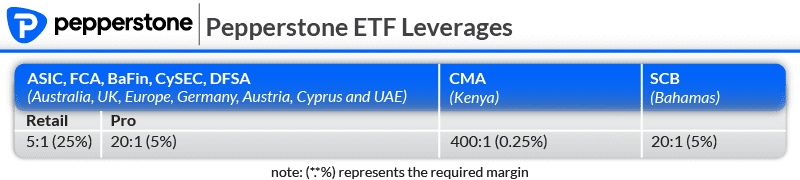
Pepperstone gives traders access to around 100 ETFs and the leverage capability looks like this:
- 5:1, retail traders under ASIC, the FCA, and CySEC, with 20:1 for retail accounts on the UAE CMA route.
- 20:1, pro traders in top-tier regulated regions.
- 20:1, traders in the rest of the world that are under SCB supervision.
- 400:1, traders based in Africa that are regulated by the CMA.
Pepperstone Review Visit Pepperstone
Cryptocurrency leverage limits
The Australian, European, UAE, and SCB account tables list 31 crypto CFDs, which UK retail clients cannot trade, and traders can buy and sell 3 crypto baskets mentioned under the indices trading leverage section. This is a solid range of cryptos to trade, matching or bettering the range with many Forex brokers but well shy of Eightcap who has 250 crypo products to trade.
Crypto is the one area that is slightly more complex for traders. Differences among top-tier retail traders show up in every asset class, not just crypto: the UAE CMA route stands apart from Australia, the UK, and Europe on retail limits, and even inside crypto, retail traders have 2:1 under ASIC and CySEC and 20:1 on BTCUSD and ETHUSD on the UAE CMA route. The FCA (Financial Conduct Authority) in the UK does not permit any retail traders to use leverage with cryptocurrency CFDs.
Also, with cryptocurrency the amount of leverage you’re able to use will also depend on the digital asset you’re looking to trade.
- Retail traders under ASIC and CySEC have 2:1 on crypto CFDs, while the UAE CMA route runs at 20:1 on BTCUSD and ETHUSD for retail accounts, with other crypto at 2:1.
- Crypto leverage for pro traders splits by entity and by coin. Under ASIC, BTCUSD and ETHUSD sit at 10:1 and other crypto at 2:1, while CySEC runs BTCUSD and ETHUSD up to 500:1 and other crypto up to 10:1, and the UAE CMA route carries BTCUSD and ETHUSD up to 500:1 with other crypto at 2:1. The firm’s UK professional page under the FCA disagrees with itself, showing crypto at 10:1 in its leverage table against up to 400:1 in its feature text.
- Traders under CMA regulation can use up to 10:1 leverage with crypto CFDs. Under SCB regulation, BTC/USD and ETH/USD run at 20:1 for retail traders and 500:1 for pro traders, with other crypto at 10:1 or 2:1 for retail traders depending on the coin, though the firm’s cryptocurrencies page still carries a heading of up to 2x leverage, at odds with its costs and fees table.

Open a demo account Visit Pepperstone
Spread betting leverage limits
CFD trading isn’t the only way to use leverage. If you are in the UK then Pepperstone offers spread betting and bettors can bet on the same products and use the same leverage as CFD traders. Spread betting is not available outside the UK.
Are the leverage limits the same across all Pepperstone account types?
Yes. It doesn’t matter whether you’re using a Standard Account, Razor Account, or an Islamic (swap-free) Account. What impacts your leverage is where you’re based, what you’re trading, and whether you’re a retail or pro trader.
Within the same set we also publish Pepperstone Account Types.
Related pages
About the author

Justin Grossbard is the Co-Founder and CEO of CompareForexBrokers, which he established with Noam Korbl in 2014. He has over 20 years of professional experience in online marketing and holds a Master's in Marketing from Monash University.
Our reviews are reader-supported. We may receive payment when you click a link to a partner site. Learn how we make money.