
What is the best offshore forex broker?
Pepperstone is the best offshore forex broker overall, with the highest global score of the ten we rank here, and its global account is opened with Pepperstone Markets Limited, licensed by the Securities Commission of The Bahamas. Each of the ten brokers below is ranked by our global score, and every account is opened with a licensed offshore company. Fusion Markets charges the lowest commission, and TabTrade publishes the lowest average EUR/USD spread.
This page is a desk-based comparison built from each broker's published pricing and terms and our recorded data; we have not tested these accounts except in our recorded tests.
Broker comparison table
| Rank | Broker | Score | Global licence | Min. deposit | Raw commission (round turn) | Platforms | Visit |
|---|---|---|---|---|---|---|---|
| 1 |  Pepperstone | 93.5 | SCB (Bahamas) SIA-F217 | US$0 | US$7 | MT4, MT5, cTrader, TradingView | Visit |
| 2 |  IC Markets | 89 | FSA Seychelles SD018 | US$0 | US$7 | MT4, MT5, cTrader, TradingView | Visit |
| 3 |  OANDA | 88.3 | FSC BVI SIBA/L/20/1130 | US$0 | US$8 (Premium Plus core pricing) | OANDA app, MT5, TradingView | Visit |
| 4 |  Fusion Markets | 85 | FSA Seychelles SD096 | US$0 | US$4.50 | MT4, MT5, cTrader, TradingView | Visit |
| 5 |  BlackBull Markets | 84.5 | FSA Seychelles SD045 | US$0 | US$6 | MT4, MT5, cTrader, TradingView | Visit |
| 6 |  TabTrade | 81.5 | FSC Mauritius GB26206419 | US$0 | US$7 | MT5 | Visit |
| 7 |  MultiBank Group | 80.3 | CIMA (Cayman) 1811316 | US$50 | Not published | MT4, MT5, MultiBank-Plus | Visit |
| 8 |  Exness | 80 | FSA Seychelles SD025 | US$200 (Raw Spread) | Up to US$7 | Exness Terminal, MT4, MT5 | Visit |
| 9 |  FP Markets | 78.4 | FSA Seychelles SD130 | US$100 | US$6 | MT4, MT5, cTrader, TradingView | Visit |
| 10 |  Eightcap | 77.5 | FSA Seychelles SD100 | US$100 | US$7 | MT4, MT5, TradingView, TradeLocker | Visit |
Our recommended list of brokers onboarding offshore residents:
Ordered by our overall rating, highest first.
- Pepperstone - Best overall
- IC Markets - Raw pricing on four platforms
- OANDA - Most trusted
- Fusion Markets - Lowest commission
- BlackBull Markets - Fastest execution
- TabTrade - Lowest average spread
- MultiBank Group - 20,000+ instruments
- Exness - Fee-free deposits and withdrawals
- FP Markets - Share CFDs on four platforms
- Eightcap - TradingView and TradeLocker

Key sections
Broker reviews
We rank Offshore Forex Brokers against every other broker we score on Best Forex Brokers (2026).
These observations cover Philippine signups, identity verification, card funding, and MT5 access with offshore entities in October 2026. Offshore observations do not prove legal permissions to serve any country and do not demonstrate regulator protections. Entity identities follow each record and remain uncertain where noted. Pricing on this page stays a desk-based comparison of published figures, separate from this account evidence.
1. Pepperstone
Global licence
SCB (Bahamas) SIA-F217
Platforms
MT4, MT5, cTrader, TradingView
Minimum deposit
US$0
Why We Recommend Pepperstone
For the best all-round offshore broker, I would send you to Pepperstone, which holds the highest global score of the ten. Its Razor account advertises an average of 0.1 pips on EUR/USD (August 2026) plus a commission of US$3.50 per side, US$7 round turn, while the Standard account averages 1.1 pips with no commission. You can trade on MT4, MT5, cTrader and TradingView with no minimum deposit. Global accounts are opened with Pepperstone Markets Limited, licensed by the Securities Commission of The Bahamas (SCB) under licence SIA-F217. It does not accept United States residents.
Pros & cons
Pros
- Razor account average EUR/USD spread: 0.1 pips (August 2026)
- Best Trading Platform Range
- Strong Regulation + Reputation
Cons
- No Share Or ETF CFDs On MT4
- Not Available For US Traders
- Limited Crypto Range
2. IC Markets
Global licence
FSA Seychelles SD018
Platforms
MT4, MT5, cTrader, TradingView
Minimum deposit
US$0
Why We Recommend IC Markets
Raw pricing on all four major platforms, with a US$0 minimum deposit, is why I would pick IC Markets for a low-cost start. The Raw Spread account publishes an average of 0.1 pips on EUR/USD with commission of US$7 per standard lot round turn (US$3.50 per side on MT4), and the Standard account is commission free from 0.8 pips. You get MT4, MT5, cTrader and TradingView. Global accounts are opened with Raw Trading Ltd, trading as IC Markets Global, which holds Securities Dealer licence SD018 from the Financial Services Authority of Seychelles.
Pros & cons
Pros
- Standard account EUR/USD spread: from 0.8 pips, published minimum
- Fast execution speeds
- All major trading platforms offered
Cons
- Seychelles regulation with no government-backed compensation scheme
- Limited market analysis
- Lacking educational material
3. OANDA
Global licence
FSC BVI SIBA/L/20/1130
Platforms
OANDA app, MT5, TradingView
Minimum deposit
US$0
Why We Recommend OANDA
If trust is your top priority, I rate OANDA as the most trusted name on this list, with the top score of 10 out of 10 in our trust category. The OANDA Group says it is regulated in eight jurisdictions, though those other licences belong to the group's other companies, which serve their own residents, not the global client. There is no initial deposit, the Standard tier charges US$0 commission with spreads from 0.6 pips on 10 major instruments, and copy trading is built into MT5, with the OANDA mobile app and TradingView also available. One real drawback: there is no negative balance protection, so your losses can exceed deposits. Global accounts are opened with OANDA Global Markets Ltd, authorised and regulated by the BVI Financial Services Commission (licence SIBA/L/20/1130).
Philippine account evidence
Loyal applied to OANDA Global Markets Limited from the Philippines on October 20, 2026, with the live account created about a day later. Her US$50 card deposit on October 30 required a manual move from the landing account, and both approvals sat less than two minutes apart before MT5 showed 50.00 USD. I would keep the practical distinction between landing and trading balances in mind when your own funding runs.
Pros & cons
Pros
- Copy trading built into MT5
- Zero minimum deposit
- MetaTrader premium tools for MT5 from FX Blue Labs
- Expert advisors on MT5
- Volume rebates of US$4 and US$6 per million on Premium and Premium Plus, with monthly minimums of US$20 million and US$50 million
- Group regulated in eight jurisdictions
Cons
- No negative balance protection
- No swap-free accounts published
- Could have more educational resources
- Core pricing needs Premium Plus at US$50 million a month
- No MetaTrader 4 since October 2024
- US$20 bank wire withdrawal fee
4. Fusion Markets
Global licence
FSA Seychelles SD096
Platforms
MT4, MT5, cTrader, TradingView
Minimum deposit
US$0
Why We Recommend Fusion Markets
The lowest commission of the ten brokers on this page is Fusion Markets, and that alone makes it worth a look if you trade costs closely. The Zero account charges US$2.25 per side, US$4.50 per 100k round turn, and its raw EUR/USD pricing averages 0.03 pips, a figure we derived by averaging the 515 hourly EUR/USD averages the broker published from August 27 to September 25, 2026. All-in, one EUR/USD lot costs US$4.80. The Classic account carries no commission and advertises an average of 0.83 pips. Global accounts sit with Fusion Markets International Ltd, authorised by the Financial Services Authority of Seychelles under Securities Dealer licence SD096, with a US$0 minimum deposit. It does not accept United States residents.
Pros & cons
Pros
- Tight spreads
- Fast account opening
- Good customer service
Cons
- Limited products offered
- Advanced Academy modules in development
5. BlackBull Markets
Global licence
FSA Seychelles SD045
Platforms
MT4, MT5, cTrader, TradingView
Minimum deposit
US$0
Why We Recommend BlackBull Markets
Speed is BlackBull Markets' case for your money: it recorded the fastest average limit order time of any broker in our 2026 execution test. On MetaTrader 4 demo accounts, BlackBull averaged 72 ms on limit orders, the fastest of every broker in the test, and took first place in the overall speed ranking. The Prime account advertises EUR/USD spreads from 0.0 pips with US$6 per standard lot round turn commission, and the standard account advertises an average of 1.1 pips on EUR/USD. Global accounts are with BBG Limited, regulated by the Seychelles Financial Services Authority under licence SD045, and the minimum deposit is US$0. It does not accept United States residents.
Philippine account evidence
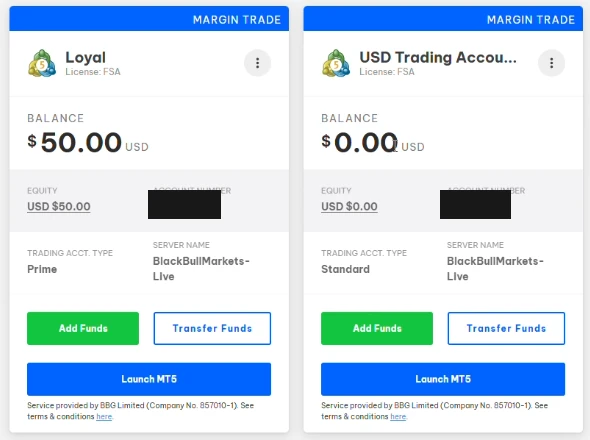
Loyal's Philippine account with BBG Limited, trading as BlackBull Markets, was approved on October 14, 2026 after an ID plus a utility bill. Her US$50 card deposit on October 30 landed in a wallet first, so she moved the money into her Prime account herself before MT5 showed 50.00 USD. I would flag that wallet step for you, since a card deposit does not reach the trading account until you shift it.
Pros & cons
Pros
- Fastest limit order fills of the 36 brokers in our MT4 test
- High leverage of up to 500:1
- Low fees for high volume traders
Cons
- Not ideal for beginner traders
- Higher standard account spreads
- Only regulated in NZ (FMA) and FSA (Seychelles)
6. TabTrade
Global licence
FSC Mauritius GB26206419
Platforms
MT5
Minimum deposit
US$0
Why We Recommend TabTrade
The lowest average EUR/USD spread of the ten belongs to TabTrade, though I would not call it the cheapest overall, since its commission matches IC Markets and Pepperstone rather than undercutting them. The Edge account averaged 0.03 pips on EUR/USD for April 2026, measured by the independent firm Datalyst and published by TabTrade, and its commission is US$3.50 per side per standard lot, US$7 round turn, so one lot costs you US$7.30 all-in. There is no minimum deposit on the Standard or Edge accounts, MT5 runs on desktop, web, iOS and Android, leverage reaches 1000:1, and the terms include no negative balance protection. A global account is opened with TabTrade (Mauritius) Ltd, which holds Investment Dealer licence GB26206419 from the Financial Services Commission of Mauritius. It does not accept United States residents.
Philippine account evidence
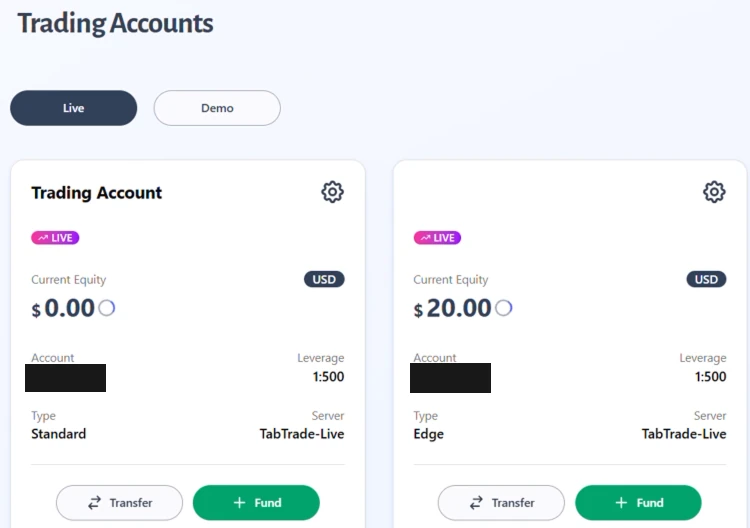
Loyal signed up with TabTrade (Mauritius) Ltd from the Philippines on October 20, 2026, uploading a passport page through a separate provider, and verification completed the same day at 3:37 PM Philippine time. Her US$20 card deposit on October 30 funded the Edge account, which showed 20.00 in MT5, while the Standard account stayed at 0. I would check which account a card payment targets before confirming.
Pros & cons
Pros
- Edge account average EUR/USD spread: 0.03 pips (April 2026)
- Raw spreads from 0.0 pips on Edge
- US$0 minimum deposit on Standard and Edge
Cons
- FSC Mauritius licence belongs to TabTrade (Mauritius) Ltd only, no licence named for TabTrade Ltd
- No negative balance protection
- Can't Onboard AU, NZ, US clients
7. MultiBank Group
Global licence
CIMA (Cayman) 1811316
Platforms
MT4, MT5, MultiBank-Plus
Minimum deposit
US$50
Why We Recommend MultiBank Group
Market range is MultiBank Group's draw: more than 20,000 instruments from a group that says it is regulated across five continents by 17+ authorities. The Standard account averages 1.5 pips on EUR/USD with no commission, and the ECN account advertises an average of 0.1 pips, but the international site does not publish its commission, so I would confirm that cost before you open it. Minimum deposits run US$50 on Standard, US$1,000 on Pro and US$10,000 on ECN, and you can trade MT4, MT5 and MultiBank-Plus. A global account is held with MEX Atlantic Corporation, authorised by the Cayman Islands Monetary Authority (CIMA) under licence 1811316.
Pros & cons
Pros
- Regulated across five continents by 17+ authorities
- ECN accounts offering raw spreads from 0.0 pips
- Over 20,000 tradable instruments
Cons
- Fee of $60/month, after 3 months of inactivity
- Minimum deposits for Pro ($1,000) and ECN ($10,000) accounts
- Services are limited for U.S. clients
8. Exness
Global licence
FSA Seychelles SD025
Platforms
Exness Terminal, MT4, MT5
Minimum deposit
US$200 (Raw Spread)
Why We Recommend Exness
No fees on deposits or withdrawals is Exness's pitch, and I like that its spreads are checked against an independent source rather than the broker's own claim. The Raw Spread account charges commission up to US$3.50 a side, US$7 round turn per lot, and Myfxbook's EUR/USD session averages for raw pricing over September 24 to 26, 2026 were 0.19 and 0.26 pips, about 0.2 pips, above the 0 pips Exness advertises. The Standard account advertises an average of 0.8 pips on EUR/USD. Platforms are Exness Terminal, the Exness Trade App, MT4 and MT5, with a US$200 minimum deposit on Raw Spread. A global account sits with Exness (SC) Ltd, authorised by the Seychelles Financial Services Authority (SD025).
Pros & cons
Pros
- MetaTrader supported
- Free VPS hosting provides traders with fast execution
- Instant withdrawals
Cons
- FCA and CySEC licences, neither taking retail clients
- Proprietary trading app uses a third party with no information
- A relatively limited number of markets to trade
- Spreads aren’t overly competitive
9. FP Markets
Global licence
FSA Seychelles SD130
Platforms
MT4, MT5, cTrader, TradingView
Minimum deposit
US$100
Why We Recommend FP Markets
Share CFD traders who want every main platform should look at FP Markets: 800+ share CFDs, tradable on MT4, MT5, cTrader and TradingView. The Raw account advertises an average of 0.1 pips on EUR/USD with commission of US$3 per side, US$6 per 100k round turn, and the Standard account advertises an average of 1.2 pips with no commission. The minimum deposit is US$100 on both Standard and Raw. A global account is opened with First Prudential Markets Limited, registered in the Seychelles and authorised by the FSA under licence SD130.
Pros & cons
Pros
- Great variety of trading tools and platforms
- Competitive spreads
- Good customer reviews
- Large range of CFD stocks
Cons
- Limited cryptocurrency selection
- No Iress or Mottai share platforms for global clients
10. Eightcap
Global licence
FSA Seychelles SD100
Platforms
MT4, MT5, TradingView, TradeLocker
Minimum deposit
US$100
Why We Recommend Eightcap
If you trade from TradingView or TradeLocker, Eightcap is your pick, and it is the only broker of the ten offering TradeLocker. Platforms are MT4, MT5, TradingView and TradeLocker, with no cTrader. The Raw account advertises spreads from 0.0 pips on EUR/USD plus US$3.50 per side commission (US$7 round turn), and the Standard account is commission free from 1.0 pips; both ask a US$100 minimum deposit. International clients sign their client agreement with Eightcap International Ltd, a Seychelles company licensed by the Seychelles Financial Services Authority under licence SD100.
Pros & cons
Pros
- Low fees
- No deposit and withdrawal fees
- Easy account opening
Cons
- High conversion fee
- Limited products
- Monthly inactivity fee after 12 months
- No investor compensation scheme
What is offshore regulation in forex?
Offshore regulation in forex refers, as I use the term, to the act of a broker obtaining a regulatory licence from a jurisdiction based outside of your country of residence.
Which entity a client is onboarded under decides what protection applies, and one broker’s entity map is set out in Pepperstone Trust And Safety.
This is typically done so the brokerage can benefit from advantages such as relaxed regulatory rules and lower operational costs.
As a trader, you can choose to open an account with an offshore broker. However, I urge you to bear in mind that the rules protecting your account are usually set by the regulator in the broker’s jurisdiction rather than your own, and the exact protections depend on which entity you actually contract with. In my judgement that can leave you with weaker recourse if something goes wrong, so verify the contracting entity’s status for your residence before you deposit.
Pros And Cons Of Offshore Regulation
- Higher leverage levels
- Potentially lower minimum deposits
- Easier signup process with less stringent checks
- May not require identity checks and verification
- Crypto funding allows for more anonymous trading
- Increased confidentiality and privacy
- Potentially accepts clients that regulated brokers will reject
- May accept US citizen
- Poor trust and reputation
- Heightened risk of fraud and personal data leaks
- Lack of transparency
- Little to no customer service
- May have no recourse if there is dispute
What is an offshore regulated forex broker?
In my usage, an offshore regulated forex broker means an entity licensed in a jurisdiction outside the reader’s country. That licence does not establish local permission or local protections, and I would check which entity within a group actually holds the account, since a group can hold multiple licences. This is not a claim that every broker needs a local office.
The regulated part refers to the broker’s compliance with the rules and standards of the regulatory authority based in the chosen jurisdiction.
Often, these standards are significantly laxer than those of a tightly regulated country (like Canada, Europe or the USA) which gives the brokerage more freedom to operate in a manner of their choosing, including putting less stringent security measures in place for its clients.
A single Forex brokerage may have offshore entities with the same brand name in addition to the onshore one. As a trader, the only entity I would focus on is the one operating in your country, and my advice is to check the regulator’s register to confirm that this specific entity holds permission to serve clients there.
How To Choose An Offshore Regulated Broker
When choosing an offshore regulated forex broker you must ensure the safety and reliability of its service by thoroughly checking its methods of operation.
- Evaluate the offshore regulatory body under which the broker operates and how it protects its customers.
- To ensure thorough protection, look for features such as segregated funds, negative balance protection, and a compensation scheme.
- Review the broker’s reputation. Positive reviews and online reputation indicate trustworthiness.
- Scrutinise the broker’s account features, costs, and pricing mechanisms to ensure they align with your trading preferences.
- Tax Liabilities vary according to jurisdiction. Therefore, consider the tax implications of trading with an offshore broker
- Ensure that the broker accepts clients from your country.
- Verify if the broker is regulated by well-known authorities such as the Financial Conduct Authority (FCA) in the UK or the Australian Securities and Investments Commission (ASIC)
Risks Of An Offshore Regulated Broker
There are several risks associated with using an offshore regulated broker. Therefore, my recommendation is that you perform due diligence before opening an account with one.
1. Limited Complaints Resolution
An offshore regulator forex broker may have a limited or non-existent complaints management procedure. Lax regulatory oversight may leave you with limited options to address disputes or seek restitution if you fall victim to malpractice, a gap I would take seriously.
2. Limited Legal Protection
Offshore regulators often provide limited legal protection to their customers. If there is no strong regulatory framework in the broker’s jurisdiction, you may find it a challenge, or impossible, to seek legal recourse in case of financial irregularities, mismanagement, and in the worst cases, fraud, which is why I flag this first.
3. Personal Data May Be Insecure
Data leaks occur when there are not enough safeguards for sensitive information. This puts you at risk of identity theft, financial fraud, or other nefarious activities. Many jurisdictions lack adequate data protection laws, and that is a risk I would weigh heavily. Therefore, when you hand your data over to an offshore regulated broker, you are risking its security.
4. Stability And Security Concerns
Some jurisdictions have less stable economic and political environments. This instability can create a heightened risk of economic downturns and political upheavals which may impact the stability of the broker and the safety of any deposited funds you have with them, a combination I take seriously.
5. Risk Of Scams
One of the most significant risks of trading with offshore brokers is that consumer protections can be weaker than those at home. A licence from an overseas regulator does not tell you much on its own, so I recommend you look closely at that regulator’s rules, its complaint and recourse channels, and the actual entity you would be contracting with.
Is Using An Offshore Broker Legal?
CFD Trading using an offshore broker may be legal and many countries allow their residents to use them. However, some regulators will advise against it since they will be unable to help you if you become a victim of malpractice or a scam, and I think that advice is worth heeding. New Zealand’s FMA, for example, recommends its residents avoid overseas forex services without a New Zealand licence, even when the provider is regulated abroad (foreign exchange trading).
Some offshore brokers operate in jurisdictions where there is little to no regulatory oversight. Whether using one is legal for you depends on your own country’s rules, so I recommend you verify that before you sign up, and you may find you have little or no recourse if something goes wrong.
Who are the main offshore regulators?
Some of the main offshore regulatory bodies for forex brokers include:
- British Virgin Islands Financial Services Commission (BVIFSC)
- Vanuatu Financial Services Commission (VFSC)
- The Financial Services Authority of Seychelles (FSA)
- The Financial Services Authority of St. Vincent and the Grenadines (FSA SVG)
- The International Financial Services Commission (IFSC) of Belize
- The Malaysian Labuan Financial Services Authority (Labuan FSA)
Why We Only Recommend Regulated Brokers
We only recommend regulated brokers because we consider appropriate regulator licensing a core element of what makes a broker trustworthy and reliable.
The reality is that there is no benefit to trading with an offshore unregulated broker. They offer the same services, trading platforms, and products as a regulated broker. They are not cheaper, nor do they offer any other financial advantages that make them more attractive than a regulated brokerage.
In contrast, by using a regulated broker you get access to everything you need for forex trading but with stronger security and safety measures in place, which is why I lean this way. Regulation can give you avenues for recourse if the broker mishandles your funds, but it does not remove the risk of loss, misconduct or insolvency, so I would never treat any broker as risk-free.
Are offshore broker spreads lower?
No, an offshore licence on its own does not make spreads lower; cost depends on the broker and the account, and the published figures for these ten show a wide range. On raw accounts, the published EUR/USD averages run from 0.03 pips at TabTrade (Edge account, measured by Datalyst, April 2026) and 0.03 pips at Fusion Markets (our own calculation from the hourly averages it published from August 27 to September 25, 2026), through 0.1 pips at Pepperstone (Razor, August 2026), IC Markets, FP Markets, and MultiBank Group, to about 0.2 pips at Exness on Myfxbook’s session averages for September 24 to 26, 2026, against the 0 pips it advertises. Standard commission-free accounts range from 0.8 pips at Exness to 1.5 pips at MultiBank Group. If you are chasing tight spreads, my advice is to compare the account, not the licence. See Lowest Spread Forex Brokers.
Are offshore broker commissions lower?
No, commissions depend on the broker and the account, not on where the licence sits, and the published round-turn figures per standard lot for these ten range from US$4.50 at Fusion Markets (US$2.25 a side) and US$6 at BlackBull Markets and FP Markets, to US$7 at Pepperstone, IC Markets, TabTrade, and Eightcap, with Exness charging up to US$7 and OANDA US$8 per US$100k on core pricing, which needs its Premium Plus tier. MultiBank Group’s international site does not publish its ECN commission. To compare all-in cost, I suggest you add commission to the spread. On one EUR/USD lot, Fusion Markets comes to US$4.80 all-in and TabTrade US$7.30. See Lowest Commission Brokers.
Which is the best regulated broker?
The best-regulated broker that we recommend is Pepperstone. It’s a multiregulated brokerage with a good choice oftrading platforms (MT4, MT5, cTrader and TradingView, low spreads (including zero spreads), and reasonable commission fees.
This broker is a particularly good choice if you’re a beginner trader thanks to its range of third-party social trading tools (Myfxbook, DupliTrade) and Automation software (Capitalise.ai).
Ross Collins’s spread tests covered RAW accounts at 15 brokers. Pepperstone’s Razor account averaged 0.19 pips on EUR/USD and 0.36 pips across the major pairs, which puts it among the lower-cost brokers in those tests.
| Raw Spreads | Raw Spreads |
|---|---|
| Broker | Major pairs average |
| Pepperstone | 0.36 |
| ThinkMarkets | 0.46 |
| Eightcap | 0.5 |
| Axi | 0.73 |
| CMC Markets | 0.73 |
| BlackBull Markets | 0.94 |
Pepperstone has also impressed us with its lightning-fast execution speeds that outperform most other brokers and its high level of customer service.
| Execution Speed Testing | Execution Speed Testing | ||
|---|---|---|---|
| Broker | Overall Speed Ranking | Limit Order Speed (ms) | Market Order Speed (ms) |
| Blackbull Markets | 1 | 72 | 90 |
| Pepperstone | 3 | 77 | 100 |
| Fusion Markets | 2 | 79 | 77 |
| Axi | 15 | 90 | 164 |
| TMGM | 11 | 94 | 129 |
| StoneX Trading | 12 | 95 | 131 |
Which is the most trusted broker?
Through our analysis, the broker that gives us the most peace of mind is OANDA. While based in the US, OANDA is regulated in eight regions including several tier-one regulatory bodies.
We gave OANDA a trust score of 100/100 and appreciate their very good customer service, Oanda is our trusted and reliable choice for safe trading.
Additionally, OANDA is our top pick for offering the lowest spreads at zero commission and we were impressed by the number of trading platforms on offer, including its own proprietary OANDA Trader.
With a demo account available and no minimum deposit for opening a real account, you can get started easily and quickly with an OANDA Review.
| Standard Account Spreads | EUR/USD | AUD/USD | EUR/GBP | GBP/USD | USD/JPY |
|---|---|---|---|---|---|
 | 0.94 | 1.50 | 1.47 | 1.73 | 1.75 |
 | 1.10 | 1.10 | 1.20 | 1.20 | 1.30 |
 | 1.13 | 1.01 | 1.71 | 1.66 | 1.12 |
 | 1.10 | 1.10 | 1.60 | 1.80 | 2.20 |
 | 1.20 | 1.30 | 1.30 | 1.50 | 1.10 |
 | 1.27 | 1.43 | 1.58 | 1.66 | 1.43 |
 | 0.70 | 0.70 | 0.90 | 0.80 | 0.70 |
 | 1.70 | 1.60 | 1.70 | 2.00 | 1.60 |
Avg. spreads are taken from each broker’s website and updated monthly. Last update on 1 Sep 2026
Broker Methodology And Disclaimer
Before opening any account, I would confirm the broker in question is appropriately authorised for my residence. Checking the actual legal entity and its permitted activities on the official register matters, because a local licence is not blanket permission for every service, nor a guarantee against loss. Authorisation does not make all legal uncertainty disappear.
However, sometimes a broker cannot meet your needs. This might be because you wish to trade with higher leverage or you want to fund your account using a crypto wallet, and I understand both reasons.
As part of the write-up for each broker, we briefly cover:
- Trading Accounts
- Fees and Commissions
- Trading Platforms
- Range of Products
- Regulation
You will find all these brokers are no-dealing desk (NDD) brokers that use straight-through processing (STP) or electronic communication networks (ECN). This means spreads are taken directly from the liquidity providers. While it is easy to assume that because the offshore brokers on this list do not use tier-1 regulators (which are expensive), they must be cheaper, this is far from the case. Our average spreads will prove that multi-regulated brokers do offer lower spreads.
As always, be aware of the risks when using an offshore broker. We don’t recommend offshore brokers over well-respected and regulated brokers such as Pepperstone, IC Markets and Eightcap. These brokers not only need to comply with a high standard of regulation but also have a reputation to uphold so you can expect safer and more reliable trading.
Risk Warning On Offshore Brokers
The nature of being an offshore broker means they are based in tax-haven countries like Vanuatu, Seychelles, Bahamas and Bermuda but that doesn’t necessarily make them less trustworthy.
Many of these countries do indeed have regulatory requirements that the broker must abide by, so you will get an element of protection. However, the standards a broker is required to meet will be lower than that required by Tier 1 regulators such as those found in:
- The UK (the Financial Conduct Authority or FCA)
- Across Europe such as the Cyprus Securities Exchange Commission or CySEC) or the Federal Financial Supervisory Authority based in Germany)
- Across the United Arab Emirates such as the Dubai Financial Services Authority or DFSA
- Singapore (the Monetary Authority Of Singapore or MAS)
- The National Futures Association (NFA) or Commodities Futures Trading Commission (CFTC) in America
When I assess a broker, I separate business registration from authorisation to offer regulated financial services, because this list includes regulated brokers only. The professionalism of an unregulated operation is not an acceptable substitute, so check the relevant register and entity before assuming any recommendation applies.
I would always check whether the actual entity holds any permission required to serve a resident of my country, and a foreign licence alone does not answer that. If local authorisation is required, confirm it before applying, since regulated firms still carry risks. Several reasons to check regulation follow below.
- The broker has documented procedures so there is recourse to settle disputes
- There is a published Product Disclosure Statement so you know exactly what services you can expect
- The broker is less likely to go bankrupt as they must keep a sufficient reserve of funds
- The broker cannot access your funds as they are kept in a segregated bank account with a tier 1 bank
With all these safeguards, using a (locally) regulated broker protects you from untrustworthy brokers with bad reputations to engage in scamming activity, as well as legal concerns regarding tax evasion given their unregulated nature, from brokers at risk of bankruptcy due to low liquidity.
For this reason, you look at regulated brokers. Here are some of the best brokers we rate that are licensed by regulators such as the Canadian Investment Regulatory Organization (CIRO) or the Monetary Authority of Singapore (MAS).
FAQs
Are offshore brokers regulated?
What regulatory bodies are responsible for overseeing offshore brokers?
Do Offshore Forex Brokers use segregated accounts?
Are client Funds insured With offshore brokers?
Are offshore Forex brokers cheaper?
If I am based in a country with a strict financial regulator, can I open an offshore forex account?
What is leverage in forex trading?
How does leverage work with offshore brokers?
What does high leverage mean?
What's The Difference Between An Offshore Regulated Broker And Unregulated Broker?
Can US Traders Trade With An Offshore Broker?
About the author

Justin Grossbard is the Co-Founder and CEO of CompareForexBrokers, which he established with Noam Korbl in 2014. He has over 20 years of professional experience in online marketing and holds a Master's in Marketing from Monash University.
Our reviews are reader-supported. We may receive payment when you click a link to a partner site. Learn how we make money.