
What Are Forex Trading Costs?
The trading cost is the amount the market must move before you make a profit. For example, if you go long (buy) 1 lot (100,000) with a trading cost of $10, your trade will need to increase by $10.00 before making any profit. The lower the trading cost, the more profit you can make.
Low trading costs matter to your success when your trading strategy relies on profits of just a few pips (e.g., scalping) or automated trading. If your profit target on each trade is that small, I would compare fees between brokers before committing to that strategy, because the fee difference eats into such margins directly. This applies equally where the strategy runs automated.
How We Analyse Standard Account Spreads
Standard Accounts charge no commission but have variable spreads (the difference between the bid and ask price). With no commission to add, our Standard Account comparison isolates the spread as the cost we account for. Other possible costs sit outside that comparison, so I would still read a broker’s full fee schedule before treating the spread as your entire cost of trading.
We compare spreads for Standard Accounts in two ways, and I keep those ways separate because a published average and a tested average answer different questions. A figure on a broker’s website is an advertised spread, while the figures carried over from global testing, run by Ross Collins, show what an account actually delivered, and knowing which tier you are reading changes how much weight either deserves. The two methods are:
- By comparing the average spreads published on brokers’ websites
- By comparing the spreads recorded in Ross Collins’s spread tests, which use the IceFX SpreadMonitor MT4 indicator
Comparing Published Average Spreads
We collate data from brokers’ websites monthly. The table below shows the published spread data our team collated in February 2026. The most recent data can always be found on our Lowest Spread Forex Brokers page.
| No Commission Spreads: Standard Accounts | EUR/USD | AUD/USD | EUR/GBP | EUR/JPY | USD/CAD |
|---|---|---|---|---|---|
 | 0.10 | 0.10 | 1.27 | 1.30 | 0.12 |
 | 0.83 | 0.83 | 1.01 | 1.38 | 0.91 |
 | 1.00 | 1.20 | 1.00 | 1.20 | 1.00 |
 | 0.80 | 1.20 | 1.20 | 1.50 | 1.20 |
 | 0.90 | 0.90 | 1.00 | 1.20 | 1.00 |
 | 0.80 | 0.90 | 0.80 | 2.10 | 1.80 |
 | 1.40 | 1.90 | 1.70 | 2.80 | 2.30 |
 | 1.10 | 1.40 | 1.30 | 1.70 | 1.40 |
 | 1.00 | 1.11 | N/A | 1.30 | 1.28 |
 | 0.60 | 0.60 | 0.90 | 1.50 | 1.30 |
 | 1.10 | 1.10 | 1.10 | 1.20 | 1.20 |
 | 0.70 | 0.70 | 0.90 | 1.10 | 0.80 |
 | 1.20 | 1.30 | 1.20 | 1.20 | 4.00 |
 | 1.2 | 1.48 | 1.47 | 1.83 | 1.69 |
 | 1.10 | 1.10 | 1.20 | 2.20 | 1.30 |
 | 1.00 | 1.00 | 1.50 | 2.00 | 1.50 |
 | 0.80 | 0.90 | 1.20 | 1.80 | 1.80 |
 | 0.50 | 0.60 | 0.70 | 1.20 | 1.30 |
 | 0.90 | 1.30 | 1.40 | 1.40 | 1.80 |
 | 0.80 (published) | 0.90 | 1.30 | 1.60 | 1.40 |
 | 1.13 | 1.01 | 1.71 | 2.27 | 1.98 |
 | 0.90 | 1.30 | 3.60 | 3.00 | 1.70 |
 | 1.00 | 1.20 | 1.60 | 2.10 | 1.80 |
 | 1.30 | 1.80 | 2.40 | 6.10 | 2.20 |
 | 1.10 | 1.20 | 1.60 | 2.00 | 1.20 |
 | 1.10 | 1.50 | 1.00 | 1.40 | 1.10 |
 | 1.44 | 2.03 | 1.52 | 2.14 | 1.79 |
 | 1.10 | 1.10 | 1.60 | 2.00 | 1.90 |
 | 1.40 | 1.40 | 0.36 | 0.85 | 0.45 |
 | 1.50 | 1.50 | 1.70 | 1.60 | 1.60 |
 | 1.20 | 1.30 | 1.30 | 1.50 | 2.00 |
 | 0.70 | 0.70 | 1.20 | 2.30 | 1.60 |
 | 1.60 | 1.60 | 1.60 | 1.60 | 1.60 |
 | 1.20 | 1.40 | 1.90 | 2.20 | 2.20 |
 | 1.40 | 1.40 | 1.70 | 1.80 | 2.20 |
 | 1.10 | 1.40 | 2.00 | 2.30 | 2.30 |
 | 1.40 | 1.60 | 1.40 | 2.10 | 1.90 |
 | 1.10 | 0.90 | 1.20 | 2.20 | 1.60 |
 | 0.80 | 0.90 | 1.50 | 2.70 | 2.00 |
 | 1.70 | 1.60 | 1.70 | 2.50 | 2.70 |
 | 1.30 | 1.70 | 1.20 | 1.50 | 1.90 |
 | 1.40 | 2.50 | 2.50 | 2.60 | 2.60 |
| 1.20 | 1.80 | 1.90 | 2.30 | 2.30 |
 | 2.10 | 2.10 | 2.70 | 2.50 | 2.80 |
 | 1.80 | 2.00 | 1.80 | 2.50 | 3.00 |
Avg. spreads are taken from each broker’s website and updated monthly. Last update on 1 Sep 2026
Testing Actual Standard Account Spreads
Ross Collins’s standard-account spread tests use the six Major Forex Pairs: AUDUSD, EURUSD, GBPUSD, USDCAD, USDCHF, and USDJPY. The spread monitor’s screen output looks like this on an AUDUSD chart for H1 (hourly) data:
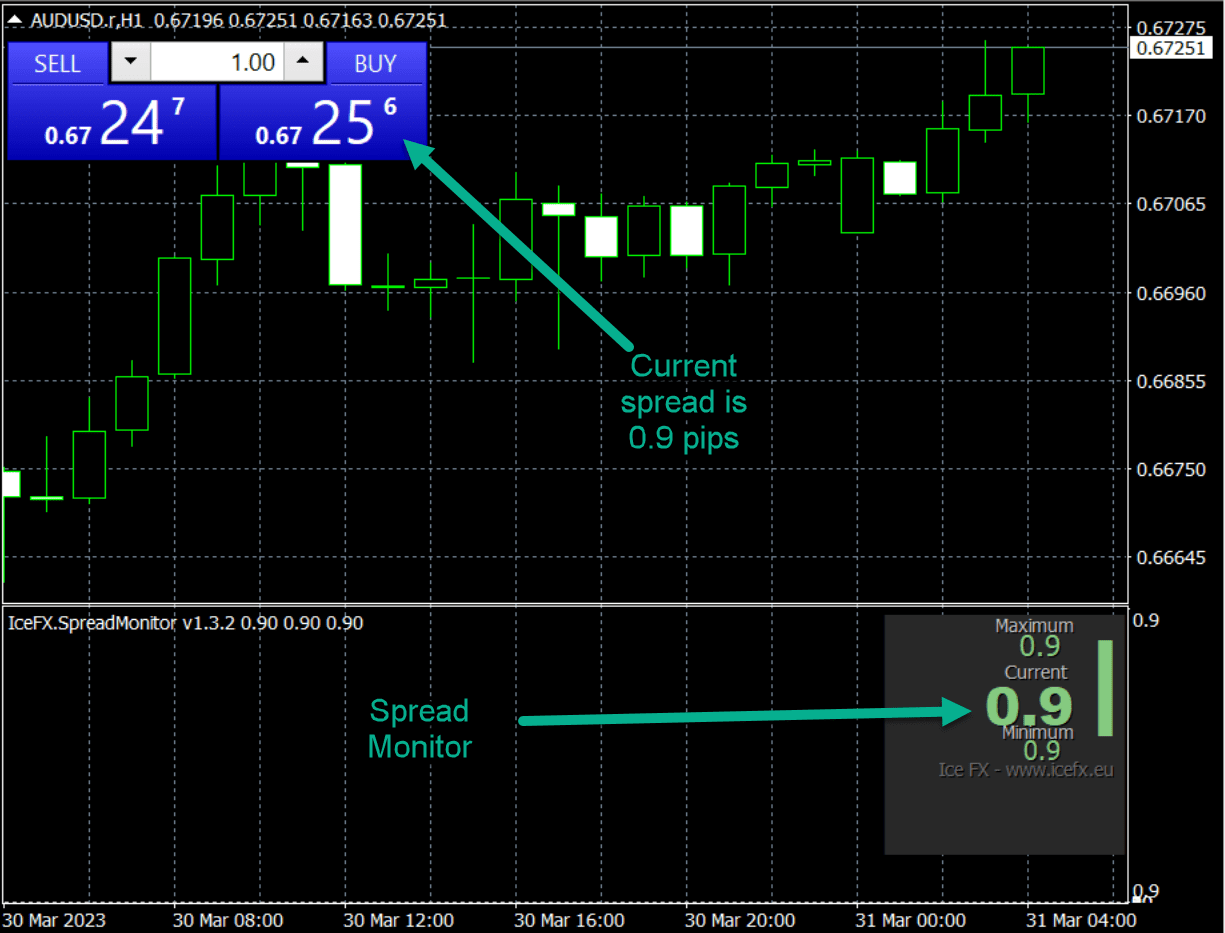
The indicator also writes the results to CSV files, providing us with data to perform our analysis. That common dataset is what I find most useful here, because every broker’s numbers come from the same source, so you are comparing like with like rather than figures gathered in different ways.
How We Compare Raw Account Spreads
RAW Accounts charge a fixed commission and have variable spreads (generally lower than for Standard Accounts). RAW accounts at some brokers are also known as “Zero”, “Pro”, “Prime”, “Direct”, “FX-Active”, “Plus+”, “Razor”, and “Edge” accounts.
In Forex Trading, regardless of the name, these accounts follow a no-dealing desk model, meaning the broker is not your counterparty. Instead, they use electronic communication networks (ECN) or straight-through processing (STP) to connect traders to liquidity providers.
We compare spreads for Raw Accounts in two ways, and the same distinction between published and tested figures applies. A published average is what the broker advertises, while a tested average is what a Raw Account delivered, and I hold the two apart rather than mixing them. The two approaches are:
- By comparing the average spreads published on brokers’ websites
- By comparing the results of Ross Collins’s RAW spread tests
Comparing Published Average Spreads
We collate data from brokers’ websites monthly. The most recent data is below (commissions “per side”).
| ECN Forex Spread Comparison | EUR/USD | USD/CAD | USD/JPY | EUR/GBP | AUD/USD |
|---|---|---|---|---|---|
| 0.00 | 0.00 | 0.10 | 0.10 | 0.20 |
| 0.1 | 0.59 | 0.40 | 0.37 | 0.38 |
| 0.10 | 0.30 | 0.30 | 0.20 | 0.10 |
| 0.10 | 0.20 | 0.30 | 0.20 | 0.10 |
| 0.90 | 0.18 | 0.14 | 0.14 | 0.13 |
 | 0.30 | 0.50 | 0.30 | 0.50 | 0.40 |
| 0.00 | 0.00 | 0.00 | 0.20 | 0.00 |
| 0.16 | 0.70 | 0.24 | 0.54 | 0.29 |
 | 0.20 | 0.70 | 0.30 | 0.50 | 0.40 |
| 0.00 | 1.20 | 0.40 | 0.40 | 0.90 |
| 0.10 | 0.60 | 0.60 | 0.60 | 0.50 |
 | 0.28 | 1.03 | 0.39 | 0.63 | 0.87 |
Avg. spreads are taken from each broker’s website and updated monthly. Last update on 1 Sep 2026
This table is one of the data sets we keep. Our Lowest Spread Forex Brokers page is ordered by the average EUR/USD raw spread each broker publishes (Myfxbook’s average for Exness), lowest first, with brokers that state how and when they measured coming first.
Testing Actual Raw Account Spreads
Ross Collins’s RAW spread tests use the same spread monitor across the six major currency pairs. Spreads for Raw Accounts are typically lower than those for Standard Accounts. Often, spreads for these accounts are Zero Spread Accounts, justifying the “Zero” in some brokers’ account branding.
How We Calculate Spread Costs (in USD)
This table shows the calculations we use to compare spread costs across the currency pairs. A standard USD spread cost allows us to compare spreads across brokers and currency pairs. That standardisation is why I treat the USD figures as the fair basis for comparison, because a cost stated in one quote currency cannot be compared directly with a cost stated in another, and a single USD figure puts every pair on the same scale before you read anything into the numbers.
| CurrencyPair | Close | Unit Size (1 lot) | Pip Size | Spread | Value of a Pip (USD) | Spread Cost (USD) |
|---|---|---|---|---|---|---|
| AUDUSD | 0.669 | $100,000 | 0.0001 | 0.82 | $10.00 | $ 8.21 |
| EURUSD | 1.061 | $100,000 | 0.0001 | 0.73 | $10.00 | $ 7.31 |
| GBPUSD | 1.208 | $100,000 | 0.0001 | 1.15 | $10.00 | $11.52 |
| USDCAD | 1.374 | $100,000 | 0.0001 | 1.00 | $7.28 | $ 7.26 |
| USDCHF | 0.924 | $100,000 | 0.0001 | 1.40 | $10.82 | $ 15.15 |
| USDJPY | 132.897 | $100,000 | 0.0100 | 1.09 | $7.52 | $ 8.21 |
Spreads are always stated in pips in forex trading, a pip being 1/10,000th (0.0001) of a standard “lot”. A “lot” is 100,000, so a pip in the case of an AUDUSD trade is USD $10 (0.0001 x 100,000).
If the average spread for AUDUSD is 0.821 pips (for example), the cost of the spread is USD $8.21 (0.821 x $10). This method of calculation is used in the same way to give USD spread costs for EURUSD and GBPUSD spreads.
To calculate USD spread costs For USDCAD and USDCHF spreads, it’s a little more complicated. Pips are always stated in terms of the quote currency or the second currency in the pair. So, USDCAD pips are in CAD and USDCHF pips are in CHF.
To convert CAD and CHF to hourly USD spread costs, we use the hourly close prices of the USDCAD and USDCHF, respectively. For example, if USDCAD had a closing price of 1.374, the value of a pip is USD $7.27 (10 / 1.374).
Finally, to calculate USD spread costs for USDJPY, we use the same method as for USDCAD and USDCHF, with the exception that a pip is 1/100th (0.001) instead of 1/10,000th.
How We Compare Broker Commissions
For Raw Accounts, we compare Commission Rates by collating the commission rates published on broker’s websites. Collating the figures is only half the job, because a rate means little until you know the basis it sits on. Before comparing any two of them, I would confirm the account currency each rate is quoted in.
Brokers publish their commission rates in the base currency of your account. The commission is calculated per lot (100,000). If your broker’s website shows a 7.00 commission and your account is based in AUD, your commission is AUD 7.00 per lot.
Brokers publish Commission Rates either on a “per side” or on a “round trip” basis (per lot). Before comparing rates, I would check which basis each broker quotes, because a per side figure and a round trip figure can describe the same total cost in two different ways, and a comparison that mixes the two will flatter whichever broker quotes the smaller-looking number.
- “Per side” means a commission for each of the open and close transactions for a trade. For example, if the commission is $2.50 per side, $2.50 is charged for the opening of the trade and again for the closing of the trade, giving a $5.00 total commission. Note that the entire -$5.00 will show as the commission (in your MT4 window) when you open the trade.
- “Round trip” means a commission for both open and close together. It is the total commission for the trade. For example, if the commission is $5.00 round trip, -$5.00 will show as the commission in your MT4 window.
The following example is a report from an MT4 terminal’s Account History, showing an open trade of 0.01 lots with a commission of -$.05 (-$5.00 x 0.01). This could have been from either a $2.50 “per side” commission or a $5.00 “round trip” commission (per lot).

Some brokers charge commissions as a percentage of the transaction size rather than quoting a fixed commission per lot.

For example, CMC Markets charges 0.0025% per side. This equates to a total commission of $5 per lot (100,000 x 0.0025 / 100 x 2). Unlike other brokers, CMC markets also show the commissions as a separate line item in its Account History, as below:
We listed the best in this category on the Lowest Commission Brokers page and found in our Fusion Markets Review that the broker has the lowest commissions.
How We Calculate Total Trade Costs for Raw Accounts
For Raw Accounts, the total trade cost is the sum of
- The Spread Cost
- The Commission
We standardise spread costs across currency pairs by calculating a USD cost. However, commissions are charged in the base currency of the trading account. That USD standardisation applies to the spread-cost comparison described above rather than to every table or tool, and the fee comparison calculator ranks stored figures in the account currency you select, performing no currency conversion at all. Before relying on any single figure, I would also confirm the commission basis is comparable across the brokers you are weighing.
Our Free Forex Fee Calculator
To compare forex fees across brokers, I point readers to our Broker Fee Comparison Calculator. You choose a currency pair, an account currency, and a trade size in standard lots, and the tool scales the stored spread and commission figures to that size and ranks the stored totals, with no exchange-rate conversion of its own. Those figures are a published historical snapshot, and they leave out financing, overnight charges, slippage, and other costs. I would confirm the broker’s current terms for your account, including the account entity, the platform, and whether commission is quoted per side or round turn, before you rely on a result.
Key Takeaways
- We compare trading costs for Standard (no commission, variable spread) and Raw (fixed commission, lower variable spread) accounts from the data brokers publish on their websites and from Ross Collins’s spread tests with the MT4 indicator.
- We calculate the total trade cost for Raw Accounts as spread plus commission.
- We present total spread costs either in the chosen base currency of the user or in USD as the default.
About the author

Justin Grossbard is the Co-Founder and CEO of CompareForexBrokers, which he established with Noam Korbl in 2014. He has over 20 years of professional experience in online marketing and holds a Master's in Marketing from Monash University.
Our reviews are reader-supported. We may receive payment when you click a link to a partner site. Learn how we make money.