
Execution speed, every broker tested
36 brokers, ranked on limit order speed in milliseconds, fastest first. The 21 ECN brokers average 135 ms on a limit order against 154 ms for the 15 market makers.
| Rank | Broker | Execution type | Limit order | Market order |
|---|---|---|---|---|
| 1 | BlackBull Markets | ECN | 72 ms | 90 ms |
| 2 | Pepperstone | ECN | 77 ms | 100 ms |
| 3 | Fusion Markets | ECN | 79 ms | 77 ms |
| 4 | Octa | ECN | 81 ms | 91 ms |
| 5 | OANDA | Market Maker | 86 ms | 84 ms |
| 6 | Blueberry Markets | ECN | 88 ms | 94 ms |
| 7 | Global Prime | ECN | 88 ms | 98 ms |
| 8 | Axi | ECN | 90 ms | 164 ms |
| 9 | Tickmill | ECN | 91 ms | 112 ms |
| 10 | Exness | Market Maker | 92 ms | 88 ms |
| 11 | TMGM | ECN | 94 ms | 129 ms |
| 12 | StoneX Trading | Market Maker | 95 ms | 131 ms |
| 13 | FOREX.com | Market Maker | 98 ms | 88 ms |
| 14 | FXCM | Market Maker | 108 ms | 189 ms |
| 15 | Trading.com | Market Maker | 114 ms | 138 ms |
| 16 | Admiral Markets | ECN | 132 ms | 182 ms |
| 17 | IC Markets | ECN | 134 ms | 153 ms |
| 18 | FBS | ECN | 135 ms | 118 ms |
| 19 | CMC Markets | Market Maker | 138 ms | 180 ms |
| 20 | Eightcap | ECN | 143 ms | 139 ms |
| 21 | GO Markets | ECN | 144 ms | 145 ms |
| 22 | XM | Market Maker | 148 ms | 184 ms |
| 23 | Markets.com | Market Maker | 150 ms | 141 ms |
| 24 | FxPro | ECN | 151 ms | 138 ms |
| 25 | easyMarkets | Market Maker | 155 ms | 155 ms |
| 26 | ThinkMarkets | ECN | 161 ms | 248 ms |
| 27 | IG Group | Market Maker | 174 ms | 141 ms |
| 28 | VantageFX | ECN | 175 ms | 154 ms |
| 29 | Tradersway | ECN | 198 ms | 214 ms |
| 30 | Libertex | Market Maker | 215 ms | 244 ms |
| 31 | FP Markets | ECN | 225 ms | 96 ms |
| 32 | AvaTrade | Market Maker | 235 ms | 145 ms |
| 33 | ATC Brokers | ECN | 238 ms | 241 ms |
| 34 | HYCM | Market Maker | 241 ms | 268 ms |
| 35 | FXTM | ECN | 248 ms | 210 ms |
| 36 | Swissquote | Market Maker | 258 ms | 198 ms |
A broker with no review on this site is still listed where we tested it; its name carries no link.
BlackBull Markets had the fastest execution overall in our 2026 execution test, averaging 72 ms on limit orders and 90 ms on market orders.
Our 2026 execution test used Expert Advisors on MetaTrader 4 demo accounts, which were not funded accounts, at 36 brokers over two 30-hour periods, and measured the average time in milliseconds from placing a limit or market order to its execution, with network latency (ping) subtracted.
Which Forex Broker Has The Fastest Execution?
Our 2026 execution test found that BlackBull Markets had the fastest execution, placing first on the overall speed ranking.
The test determined the following category finalist. Top 2 Limit Order Execution Speeds
- Blackbull Markets
- Pepperstone
Top 2 Market Order Execution Speeds
- Fusion Markets
- OANDA
Based on the above, the overall winner was Blackbull Markets when it came to the fastest execution speed. It should be noted that the brokers we selected:
- are well covered on our website
- represent a mix of No-dealing Desk (NDD) brokers and market makers
- support MT4 as we wanted to use freely available Expert Advisors (EAs) for testing
Execution speeds for limit orders
BlackBull Markets executed limit orders fastest at 72 ms, ahead of Pepperstone at 77 ms, Fusion Markets at 79 ms, Octa at 81 ms, and OANDA at 86 ms. Swissquote was the slowest at 258 ms, against an average of 143 ms across all tested brokers. The table at the top of this page lists the limit order time for every broker.
Execution speeds for market orders
Fusion Markets was fastest on market orders at 77 ms, followed by OANDA at 84 ms, Exness at 88 ms, FOREX.com at 88 ms, and BlackBull Markets at 90 ms. HYCM was the slowest at 268 ms, against an average of 149 ms across all tested brokers. You will find the market order time for every broker in the table at the top of this page.
Fastest execution speeds
The table at the top of this page shows each broker’s average limit order time, average market order time, and execution type (ECN or market maker), with rows ordered fastest first on limit orders. Our results workbook also records a limit order rank, a market order rank, and an overall speed ranking for each broker. The overall top five were BlackBull Markets, Fusion Markets, Pepperstone, OANDA, and Octa.
ECN brokers and market makers
The 21 ECN brokers in the test averaged 135 ms on limit orders and 143 ms on market orders, while the 15 market makers averaged 154 ms and 158 ms. OANDA, a market maker, was the fastest of that group and finished fourth overall, with 86 ms on limit orders and 84 ms on market orders, the second fastest market order time in the test. Exness, also a market maker, came sixth. A market maker can still be fast, so if you are choosing by execution type, check the broker’s own figures rather than the label.
Why does order execution speed matter?
A faster execution speed matters because it can help prevent slippage. All trades have a lag time (even if miniscule) between an order being placed and being filled which is enough time for forex prices to change and this process is called slippage. While slippage can be both positive or negative depending on which way the price moves, most traders prefer to get the price they placed their order at.
If your trading strategy relies on profits of just a few pips (e.g. scalping), or if you use automated trading, execution speeds are key to your success
What factors influence execution speed?
Factors that can influence the speed trades are executed include:
- The type of execution the broker is using
- Where broker’s servers are located
- The quality of the infrastructure the broker is using
- The trading platform you are using.
Type of execution
How brokers execute your trades will affect the time taken to process your orders. Brokers consist of two types: those with their own Dealing Desk (DD) such as a market maker who use their own liquidity and those without. No Dealing Desk (NDD) brokers use Straight-through Processing (STP) or Electronic Communication Networks (ECN) to source quotes from external liquidity providers and open and close your orders.
Where the servers are located?
The location of the broker’s servers will also affect the time taken to execute orders. Storing servers in the same data centres as the liquidity providers is one way to reduce the travel time to transmit data. Another way brokers reduce the distance your orders need to transmit is to use data centres closer to your trading desk.
We talk about the network latency due to server locations in this section: Location Independent Testing.
Quality of the infrastructure
The quality of the infrastructure is another factor that can affect execution speed. Is the broker using fibre optic cables and if so how many? fewer cables mean more congestion and therefore slower speed.
Trading platform speed
One last factor worth mentioning is the trading platform you are using. Some trading platforms are just faster than other platforms. MetaTrader 5 for example, has 64-bit processing, so is more powerful than MetaTrader 4 which has 32-bit processing and by extension faster speed.
How we tested
Our 2026 execution test used MetaTrader 4 demo accounts, which were not funded accounts, at each of the 36 brokers. Because we wanted data for both limit and market orders, we chose two freely available MT4 Expert Advisors designed for those two order types. Our separate account-opening test is covered at Account Opening.
For limit orders, we used the MT4 EA known as ExTest_ForExpat. This EA places several limit orders (buy and sell) and calculates the time between sending orders to brokers and receiving an answer from them or executing the orders. Minimum, maximum, and average response times are recorded.
For market orders, we used the MT4 EA known as Broker Latency Tester. This EA sends a market order and calculates the time between sending the order and receiving the confirmation. After confirmation, the position is closed. The average response time is calculated across 20 trades at a lot size of MODE_MINLOT (the minimum amount allowed by the broker).
Demo Testing Limitation (and possible advantage)
There are some testing limitations with using a demo account as opposed to a live account.
Demo accounts don’t require orders to be filled since there is no cash involved. While a demo account simulates a real trading environment, your trades never leave the trading platform since there is no requirement for a liquidity provider to accept or fill your trade. Trades with a demo account are therefore server-side only so there will be a difference in how fast trades are executed. For the reasons explained above, you will find there are no partials fills or slippage with a demo account.
One could argue that using a demo account provides a more even comparison for each broker since variables such as available liquidity and time to fill an order is removed. This, however, doesn’t recognise that brokers use different infrastructures to execute trades and often different liquidity providers which can influence execution time along with the fill rate.
We ran our 2026 execution test on demo accounts from a test machine in Australia, not on live accounts or on a Virtual Private Server (VPS). A test on live accounts or VPS setups would capture more of the real-world influences on how fast an order fills.
How we ranked forex brokers
Each broker in our 2026 execution test carries a limit order rank and a market order rank, where 1 is the fastest, together with an overall speed ranking across both order types. That overall ranking puts BlackBull Markets first, Fusion Markets second, and Pepperstone third.
One part of this is covered separately on Best Forex Brokers for fast VPS.
Location Independent Testing
In our 2026 execution test, the test machine was in Australia. While some brokers have demo servers in Australia, many don’t. Overall execution speeds are slower when using overseas servers, due to the time it takes data packets to travel over the network to and from the broker’s server.
To compare brokers fairly, our 2026 execution test subtracted the network latency (ping) between the test machine and each broker’s server from the execution times, so the results would in theory be the same wherever the test machine sat. In other words, the test is location independent.
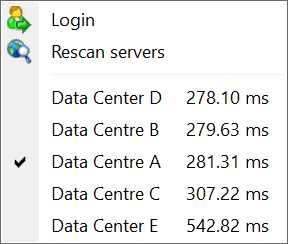
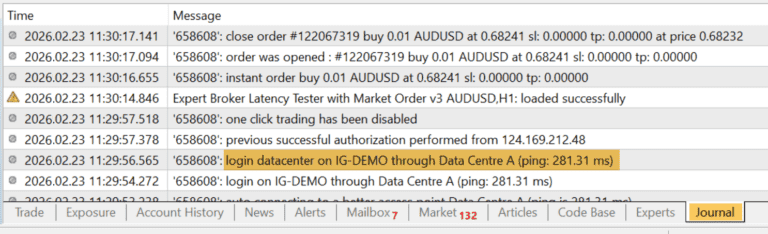
Network latency (known as “ping”) can be found in two places on an MT4 terminal.
One way to see “ping” is in the connection status (bottom right of the terminal).
The other way to see “ping” is in the Journal tab of the Terminal Window.
Combined test results
BlackBull Markets finished first overall, first on limit orders at 72 ms and fifth on market orders at 90 ms. Fusion Markets took second place overall with the fastest market orders at 77 ms. Both figures for every broker are in the table at the top of this page.
Using VPS to reduce Latency
In our 2026 execution test, the fastest brokers averaged under 80 ms with ping subtracted: BlackBull Markets at 72 ms on limit orders and Fusion Markets at 77 ms on market orders. The network latency between your own machine and the broker’s server comes on top of that.
The best way to reduce this delay is to remove the network latency between the trader’s machine and the broker’s servers. And the best way to do that is to do your trading on a Virtual Private Server (VPS).
A VPS will sit in the same data centre as the broker’s servers, preferably with a network Cross Connection between the VPS and the broker’s servers.
Tests (VPS Latency) show that Cross Connection VPS setups result in average latencies of 0.33 milliseconds for the LD4 (London) data centre and 0.37 milliseconds for the NY4 (New York) data centre.
At those latencies, the only delay between placing your order and it being executed is the execution speed of your broker. That’s why VPS is the chosen configuration of scalpers and automated trading.
Key Takeaways
- BlackBull Markets, Fusion Markets and Pepperstone were the most consistent performers across the limit order and market order tests.
- For the top 5 brokers, Order Execution Speeds average less than 100 milliseconds.
- Removing network latency (ping) means these tests are location independent.
- The best way to remove network latency is to use a cross-connected VPS configuration.
Next Up
Here’s a quick view of our pipeline of testing:
- Comparing order execution speeds for regulated versus unregulated brokers
- Testing for a broader set of brokers
- Order execution speeds on live accounts
- Average spreads on different brokers by currency pair
- Slippage monitoring across different brokers and currency pairs
About the author

Justin Grossbard is the Co-Founder and CEO of CompareForexBrokers, which he established with Noam Korbl in 2014. He has over 20 years of professional experience in online marketing and holds a Master's in Marketing from Monash University.
Our reviews are reader-supported. We may receive payment when you click a link to a partner site. Learn how we make money.